REDD
Redd is a surname that is traditionally classified as of English origin. Its earliest attestations appear within the record books of the British Isles, and it remains most closely associated with England, although it can also be found in Scotland.
In the earliest stages of the English language the word read (pronounced /red/) denoted the colour red. A person whose hair was a bright crimson or who possessed a ruddy complexion was often nicknamed red; over time this sobriquet was adopted as a hereditary surname. The same phonetic root is preserved in modern spellings such as Reed, Read and Redd.
Besides the descriptive nickname hypothesis, there exist locational explanations for the surname. The name has been linked to places named Read in Lancashire, Rede in Suffolk, and Reed in Hertfordshire. Each of these place names derives from an Old English term related either to reeds growing in wet terrain or to land frequented by deer. Records such as the Curia Regis rolls of Hertfordshire (1203) and the Pipe Rolls of Devonshire (1208) contain entries that support these toponymic links.
A third plausible origin is topographical: the Old English word ried refers to a clearing in the woods, a feature that would have defined the residential setting of early bearers of the name. Such a meaning is suggested by entries such as Roger de la Rede in the Pipe Rolls of Devonshire (1208).
Historical documents corroborate the antiquity of the surname. William Red appears in the Pipe Rolls of Gloucestershire (1176), Gilbert le Rede of Coul, Scotland, is recorded in the year 1296, and Ralph de Rede is listed in the Curia Regis rolls (1203). The earliest known spelling of the family name is attributed to the Northumbria record of Leofwine se Reade in 1016, during the reign of King Canute.
The surname’s spelling variants are numerous. Reid, Read, Reade, Reed, and Red are all recognised forms. Each variant can be traced back to the same Old English root, although regional differences in pronunciation and spelling account for the diversity of manifestations.
In contemporary times the name is most widespread outside of the British Isles, with approximately 26,000 individuals in the United States reporting Redd as their surname according to the latest census data. Within England, the surname persists in close to 4,000 households, and it has a presence of about 300 individuals in Australia. Notably, these figures represent genuine bearers of the name rather than approximate estimates.
While some families trace their lineage back several centuries to England or Scotland, the precise geographic origins of a particular line cannot be definitively ascertained without specific genealogical research. The surname has remained stable in its spelling and pronunciation over the centuries, a testimony to its established cultural significance within the English-speaking world.
Typical given names associated with the Redd surname
Male
- David
- Hugh
- Paul
- Terence
- Timothy
Female
- Anne
- Elaine
- Helen
- Judith
- Natalie
Similar and related surnames
Related and similar names are generated algorithmically based on the spelling, and may not necessarily share an etymology.
How to communicate the surname Redd in...
Braille
⠗⠑⠙⠙
Morse
.-..-..-..
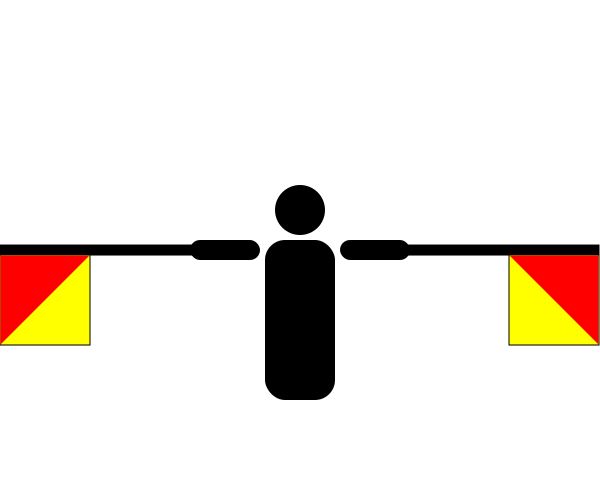
Semaphore


There are approximately 75 people named Redd in the UK. That makes it one of Britain's least common surnames. Only around one in a million people in Britain are named Redd.
Origin: English
Region of origin: British Isles
Country of origin: England
Religion of origin: Christian
Language of origin: English
