RASMUS
The surname Rasmus traces its roots back to two distinct linguistic traditions that have converged across Europe. It is derived from the Greek word erasmos, meaning “beloved” or “desired”, through the medieval given name Erasmus, of which Rasmus is a Latinised variant. The same name was adopted in Scandinavia, where it evolved from the Old Norse personal name Ragnvaldr, a compound of regin (counsel) and valdr (power). Both derivations point to a sense of affection and authority, characteristics cherished by the societies in which the surname has flourished.
In its earliest recorded uses, the name appears in German archives under a variety of spellings, including Rasmus, Erasmus, Asmus, Eras, and Rassman. The earliest extant example is that of Augustus Erasmi, noted in Berlin in 1420, followed by Conrad Erasmus of Prague in 1427. Additional evidence shows the name crossing the North Sea, as illustrated by the marriage of Johan Asmus to Jane Elizabeth Taylor at St John the Baptist in Shoreditch on 29 September 1839, where the couple later had six children.
During the Crusading era, the name was considered a “Crusader” surname, having been borrowed from Greece in the 11th century when the Knights Templar and other Christian forces operated from that region. Although the Crusades themselves were largely unsuccessful, the tradition of adopting biblical or Greek personal names continued, and the name was bestowed upon children in the hopes that they would inherit the virtues of the Christian Church. The saint of the 6th century, whose name was derived from erasmos, was eulogised as the patron of seamen and turners, further cementing the name’s association with courage and skill.
In Scandinavia, Rasmus is regarded primarily as a patronymic surname, indicating descent from a man named Rasmus. In Denmark, the form Rasmussen is among the top ten surnames, and Rasmusson ranks within the top fifties, with roughly 19,000 and 8,000 bearers respectively as of 2017. Sweden records nearly 31,000 individuals carrying the surname Rasmus (2018), making it one of the country's most common names. Norway and Iceland also list it as a popular surname, with 11,000 and 630 individuals respectively in 2017. The name remains widespread among descendants of Scandinavian emigrants in Canada, the United States, Australia, New Zealand, South Africa, and other parts of Europe, where it continues to be witnessed in variations such as Rasmusson, Rasmusen, Rasmuson, and Råsås.
The range of orthographic forms illustrates the name's adaptability to different linguistic systems. Aside from the primary Scandinavian variants, German records include Rössmus, a rare form linked to the Saxon dialect and originally derived from Rötger or Rotger. The Polish version Rasmusz reflects further integration into Baltic and Eastern European societies.
Because of its Viking heritage, the surname has acquired symbolic associations with strength, resilience, honour, and courage – traits that were deeply admired by the Nordic peoples. These attributes are frequently invoked in contemporary discussions of Scandinavian identity and heritage, and they contribute to the surname’s enduring appeal among those who trace their lineages back to that era.
Similar and related surnames
Related and similar names are generated algorithmically based on the spelling, and may not necessarily share an etymology.
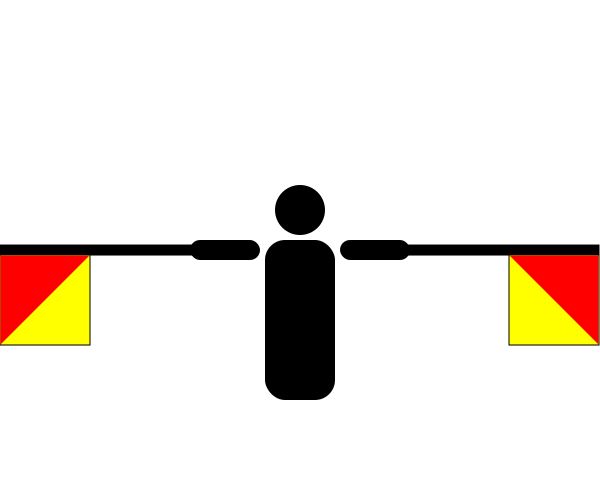
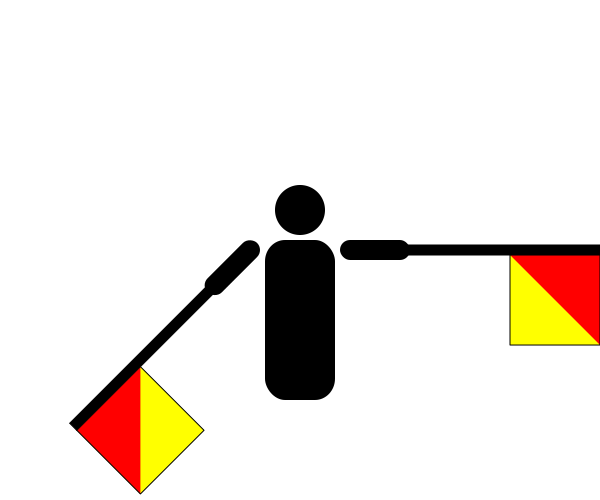
How to communicate the surname Rasmus in...
Braille
⠗⠁⠎⠍⠥⠎
Morse
.-..-...--..-...
Semaphore



Sorry, we don't have any statistics on this name. That's probably because it's very uncommon in Britain.
Region of origin: Europe
Country of origin: Germany
Language of origin: German
