RAMM
The surname Ramm is of German origin and is derived from the Middle High German word ram, meaning “ram” or “male sheep”. It is primarily an occupational or nickname name, originally applied to individuals who worked as shepherds or whose personal characteristics—such as strength or stubbornness—resembled those of a ram.
In addition to its occupational connotation, the name appears in various spellings across Europe—Ram, Ramm, Ramas, Ramos, Rampling, Ramard—and can also be linked to different meanings. In some contexts it denotes a lusty or vigorous man; in others it refers to a person who lived at an inn bearing the sign of the Ram or to a person living near a thickly wooded area, derived from the word raim. There is also a locational sense connected with the pre‑7th century Scandinavian word for a boundary post, traditionally associated with settlements in northern Europe.
The earliest surviving record of the family name is that of Hendricus Ram, dated 1188 in the register of the abbey of Bury St Edmunds, England, during the reign of King Henry XI. Subsequent medieval documentation includes figures such as Geoffrey Ram of Essex, England, in 1274; Konrad Rame of Eblingen, Germany, in 1350; and Claus Rams of Eblingen, 1377. Later ecclesiastical records record individuals such as Juan Ramos of Nuestra Senora la Antigua, Valladolid, Spain, in 1535, and Joan Pau Ramo of Santa Maria, Mataro, Barcelona, in 1552.
In the modern era the surname is widely documented in German‑speaking countries, including Germany, Austria, Switzerland, and the South Tyrol region of Italy. Its presence has also been established in the United Kingdom, particularly within England and Wales, and in the United States, where significant concentrations of bearers are found in Pennsylvania and Ohio. The American distribution is largely a consequence of German, Austrian and Swiss immigration during the 18th and 19th centuries, and the name remains common in rural communities such as Seaford, Rocky Ridge and Newville in Pennsylvania, and in Zanesville, Huron and Huron in Ohio.
Scandinavian countries—Denmark, Norway and Sweden—record the name as well, reflecting migration and the historic use of the word for a boundary post. In North America the surname shows a notable presence in New York, Texas and California, again reflecting patterns of European settlement.
Throughout its history the surname Ramm has functioned as both a patronymic—derived from an ancestor’s given name Ram or Ramme—and as an occupational nickname. Its continued use today, and its persistence in civil and church registers across multiple continents, attest to its established place within the tapestry of European and North American genealogical tradition. The name remains a testament to the medieval practices of naming families after trade, physical trait or dwelling place, and has survived centuries as a marker of personal and familial identity.
Typical given names associated with the Ramm surname
Male
- Anthony
- Daniel
- David
- John
- Jonathan
- Michael
- Paul
- Peter
- Robert
- Simon
- Stephen
Female
- Alison
- Angela
- Carol
- Deborah
- Emma
- Hayley
- Jacqueline
- Janet
- Jessica
- Joanne
- Laura
- Nicola
- Patricia
- Sarah
- Susan
Similar and related surnames
- Raam
- Rahm
- Rahma
- Rahme
- Rahmi
- Raim
- Raime
- Raimes
- Raimi
- Raimie
- Raimo
- Ram
- Rama
- Ramah
- Ramai
- Ramay
- Ramb
- Rame
- Rameau
- Rames
- Ramey
- Rami
- Ramie
- Ramme
- Rammo
- Rammos
- Ramms
- Ramn
- Ramo
- Ramoo
- Ramp
- Rams
- Ramu
- Ramy
- Raymes
- Ream
- Reames
- Reams
- Reem
- Rehm
- Reim
- Reime
- Rem
- Reme
- Remm
- Remme
- Remmie
- Remmy
- Rhaim
- Rham
- Rhames
- Rheam
- Rheams
- Rhem
- Riem
- Roome
Related and similar names are generated algorithmically based on the spelling, and may not necessarily share an etymology.
How to communicate the surname Ramm in...
Braille
⠗⠁⠍⠍
Morse
.-..-----
Semaphore
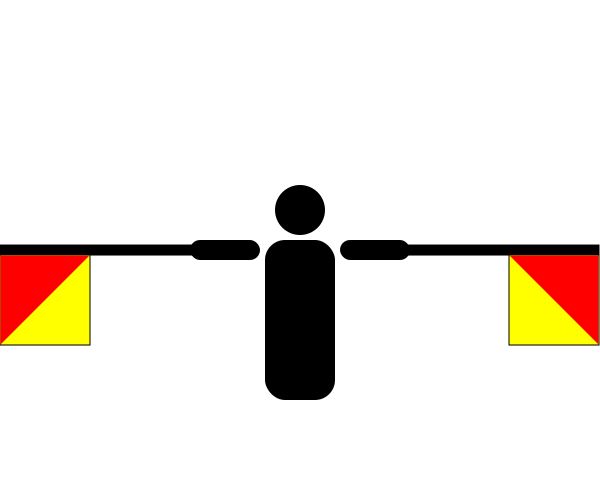

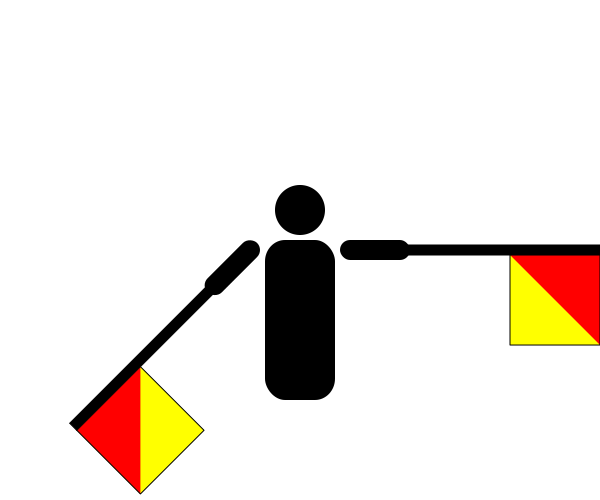
There are approximately 1,262 people named Ramm in the UK. That makes it roughly the 6,162nd most common surname in Britain. Around 19 in a million people in Britain are named Ramm.
Origin: English
Region of origin: British Isles
Country of origin: England
Religion of origin: Christian
Language of origin: English