QUIGG
Quigg is a surname of Irish origin that has long-standing roots in the Gaelic tradition of the British Isles. The name is historically linked with the ancient Gaelic kingdom of Ulster and is predominantly found in County Donegal.
The earliest etymological form of the name is Mac Cuaid, translating literally as “son of Cuaid.” The personal name Cuaid itself has an uncertain origin, but it is generally believed to derive from the Gaelic word cu, meaning “hound” or “wolf.” An alternative tradition traces the name back to the pre‑10th century Gaelic word coigeal, which means “untidy” or “messy.” In this variant the surname is prefixed with either O or Mac, which were dropped after the early 19th century.
Historical records show the Quigg sept as originally situated in County Mayo before spreading in the late 16th century to the neighbouring counties of Sligo, Donegal and Derry. The 1659 Irish census lists O'Quig as one of the principal surnames of the barony of Coleraine in County Derry. A notable example from this period is Teag O'Quigley of the Inishowen Peninsula, whose name appears in Commonwealth records between 1649 and 1659.
In the late eighteenth and early nineteenth centuries the name appears in a number of significant individuals. James MacQuigge, a poet residing in Ulster, is recorded circa 1795. Manus Quig, an emigrant from the Potato Famine of 1846‑1848, landed in New York on 16 April 1846. Dr James Edward Quigley, who served as bishop of Buffalo in the United States between 1840 and 1915, was an active supporter of the trade union movement.
The surname has many accepted spellings and variants. In addition to Quigg, Quig and Quigley, the name appears as Quiggle, Quiggin, Quiggly, Quillan, Quillinan, Quilkin, Quillin and Quigly. The forms Cogley, Kegley and Twigley are also recognised as historically associated with the same Gaelic root. The most common variant is O'Quigley, derived from the Gaelic Ua Cuigealaigh, meaning “descendant of Cuigealaigh.” The personal name Cuigeallach translates as “noble‑minded.”
In contemporary use the Quigg surname remains comparatively common throughout the United Kingdom, Ireland and Scotland. Its presence in Northern Ireland, particularly in counties Tyrone and Londonderry, is well documented. The diaspora has also spread the name to the United States, where it can be found in Massachusetts, Illinois and California, a pattern that reflects broader waves of Irish and Scottish migration during the nineteenth and early twentieth centuries.
The name carries a range of associations that extend beyond its linguistic roots. In some traditions it is linked with intelligence and strength; in others it symbolizes noble-mindedness and courage. These meanings are reflected in the historical context of the Gaelic-speaking immigrant groups that adopted the name when settling in various parts of Ireland and Scotland.
Typical given names associated with the Quigg surname
Male
- Andrew
- David
- Edward
- Henry
- Ian
- James
- John
- Joseph
- Kevin
- Manus
- Michael
- Thomas
- William
Female
- Anne
- Bridget
- Catherine
- Elizabeth
- Jennifer
- Lorraine
- Margaret
- Mary
- Nicola
- Pamela
- Patrina
- Philomena
- Sally
- Sarah
Similar and related surnames
Related and similar names are generated algorithmically based on the spelling, and may not necessarily share an etymology.
How to communicate the surname Quigg in...
Braille
⠟⠥⠊⠛⠛
Morse
--.-..-..--.--.
Semaphore
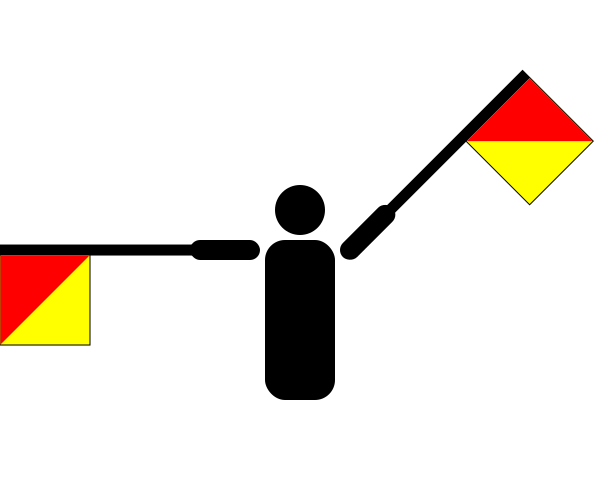

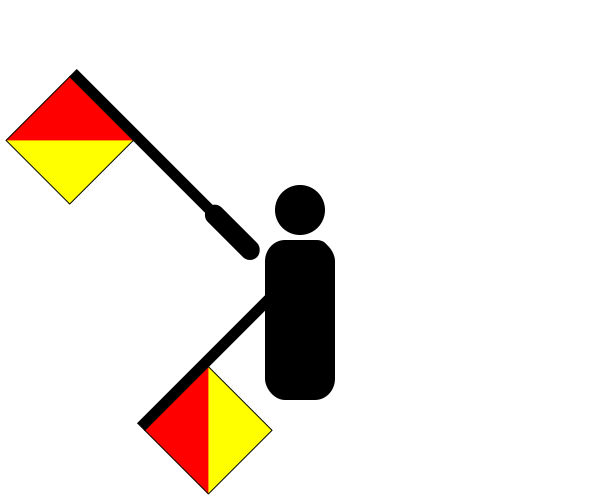

There are approximately 518 people named Quigg in the UK. That makes it one of Britain's least common surnames. Only around eight in a million people in Britain are named Quigg.
Origin: Celtic
Region of origin: British Isles
Country of origin: Ireland
Religion of origin: Christian
Language of origin: Gaelic

Famous people named Quigg
- Eoghan Quigg - Singer
- Scott Quigg - Professional boxer
- Robert Quigg - Recipient of the Victoria Cross (1885 to 1955)
Names and descriptions courtesy of Wikipedia, and may contain errors. This is not intended to be an exhaustive list of every famous person with this name.