PULLAN
Pullan is a surname of predominantly English provenance, with ancillary connections to Greek, Latin and, in some instances, Germanic and Norse lineages. The name can first be recognised as a patronymic form derived from the medieval given name Pull, itself a diminutive of Apollonius, a Latinisation of the Greek name belonging to the sun‑deity Apollo, who was revered as the god of music, poetry and prophecy. In this derivation the surname signified a descendant or associate of a person named Pull.
Historical records from the early Middle Ages record the surname in several spelling variants, including Pullen, Pullin, Pulleyn and Pullein, evidencing the fluid orthography of the period. Early attestations include Nicholas le Pullen in Shropshire in 1273 and John Polayn in Somerset in 1327. A 1509 register of the Guild of the Corpus Christi in the City of York lists a Thomas Pullan, indicating the name was already in established use in that jurisdiction.
In the Pipe Rolls of Norfolk, dated 1166 and compiled under King Henry I, a name rendered as Richard Pulein appears, offering one of the earliest documentary proofs of the surname’s existence. The family’s heraldic emblem comprises an azure shield displaying three red escallops on a silver bend cotised, superimposed upon a gold chief bearing black martlets. The crest is described as a golden pelican on its nest. Such heraldic descriptions, recorded in contemporary armorial bearings, confirm a well-established family identity during the late Middle Ages.
Alternative etymological interpretations identify Pullan as a metonymic occupational surname. From the Old French poulain, meaning colt or young horse, and ultimately from the Latin pullamen (derived from pullus), the name could denote an individual engaged in horse breeding or one possessing a spirited or youthful demeanour. In this sense the surname mirrors the medieval practice of appending sobriquets formed from an employee’s task or a prominent personal trait to the inherited family name.
Geographically, the surname was first concentrated in the counties of Lancashire and Yorkshire during the Middle Ages. The 2015 national records for England recognise over five hundred individuals bearing the name, with the highest distribution remaining in those two counties. While the surname has seen a general decline in frequency nationwide, especially since the nineteenth‑century period marked by a reduction in purely English-origin surnames, it still maintains a conspicuous presence in its historic heartlands.
In addition to the English development, some documented branches of the name appear in the Irish province of Munster and the province of Ulster (particularly in Sligo and Waterford). These Irish lineages are occasionally traced to Norse ancestors, specifically a sept of the Uí Fiachrach that had lost its pedigree to the early Norse settlers of Ireland and Scotland. The Gaelicised form rendered as Pullain is occasionally found in eastern territories of Ireland and Scotland, signifying the surname’s dissemination by migration and cultural integration.
The name is also noted in continental Europe, where its variant can be an adaptation of the Germanic surname derived from Paul, which in German is rendered as Paule and in Dutch as Pauwels. The Latin root Paulus, meaning “small” or “humble”, has become the base for numerous European surnames such as Paolo in Italian, Paulo in Portuguese and Pablo in Spanish. While such continental versions are distinct, the orthographic similarity has occasionally produced an Americanised spelling of Pullan from the Germanic source in the eighteenth century.
Overall, the surname Pullan exemplifies a multifaceted genealogical heritage that reflects the dynamic nature of medieval naming conventions, the interweaving of linguistic influences across Europe, and the continuity of family identity through heraldic and civil records. The surname serves as a point of study for those researching English, Gaelic, Norse and Germanic lineage, illustrating how one family name may evolve through time, geography and cultural exchange while retaining its core identity.
Typical given names associated with the Pullan surname
Male
- Andrew
- Christopher
- David
- James
- John
- Mark
- Michael
- Richard
- Robert
- Stephen
- Steven
Female
- Ann
- Claire
- Dorothy
- Elizabeth
- Emma
- Frances
- Jane
- Margaret
- Mary
- Michele
- Nicola
- Rachel
- Sarah
- Susan
Similar and related surnames
Related and similar names are generated algorithmically based on the spelling, and may not necessarily share an etymology.
How to communicate the surname Pullan in...
Braille
⠏⠥⠇⠇⠁⠝
Morse
.--...-.-...-...--.
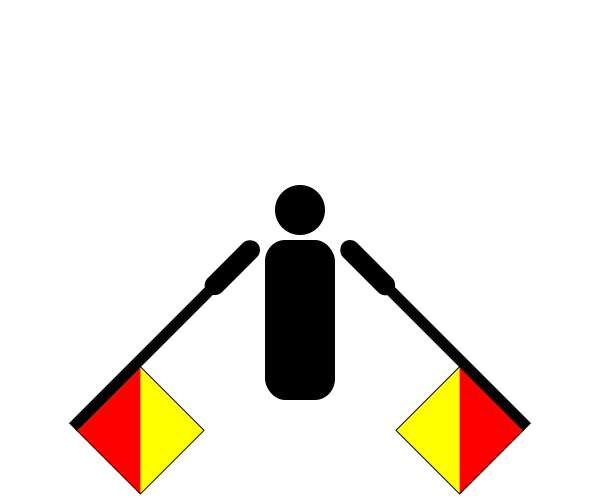
Semaphore


There are approximately 1,886 people named Pullan in the UK. That makes it roughly the 4,418th most common surname in Britain. Around 29 in a million people in Britain are named Pullan.
Origin: English
Region of origin: British Isles
Country of origin: England
Religion of origin: Christian
Language of origin: English

Famous people named Pullan
- Cecil Pullan - Cricketer (1910 to 1970)
- Hartley Pullan - Flying ace (1899 to 1)
Names and descriptions courtesy of Wikipedia, and may contain errors. This is not intended to be an exhaustive list of every famous person with this name.