POLIN
The surname Polin is a name of considerable antiquity, and its origins are reflected in a number of distinct linguistic and geographical traditions.
In England the name is chiefly understood to be a patronymic derivative of the medieval given name Paulin, itself a diminutive of Paul. The Latin root paulus – meaning 'small' or 'humble' – is the source of the personal name, so that the surname Polin would originally signify 'son of Paulin' or 'descendant of Paul'.
English records evidence a range of orthographic variants, including Poland, Polland, Pollane, Pollin, Powland and Powlesland. Early parish entries attest to bearers such as Elenore Pollane of Bramley (Hampshire), recorded 6 November 1581; Emmee Powland, who married Henry Elliott at St Dunstans, Stepney, on 21 July 1613; and Robert Powlesland, who married Mary Skipworth at St Pancras Old Church, London, on 3 May 1860.
In Ireland the surname appears in both the forms Polin and the patronymic prefix McPolin. The 17th‑century introduction of the name is documented by the record of John McPolin in County Armagh (1665) and the 18th‑century entry of Elizabeth Poland at St Dunstans (9 January 1727). In many Irish cases the surname is thought to derive from the same Old English village source, or from a Gaelic diminutive of the ancient name Paul.
Central to the locational narrative is the village of Poland, situated near Odiham in Hampshire. The place-name is pre‑7th‑century Old English, coming from pol landa – a tract of agricultural land surrounded by lakes or pools, or perhaps a site where fencing poles were pollarded. As families moved out of this settlement, they were identified by the name of their former home, a customary practice that produced the surname Polin among refugees and migrants from the area.
Beyond Britain and Ireland, the surname has been recorded in Eastern Europe, where it is often associated with Polish and Jewish heritage. Some families adopted Polin as a shortened form of Poland, indicating ancestral origins in the modern country, while others derived it from the Jewish name Pohl or Poll, terms used in the medieval period to denote a particular region or area. Variants such as Polanski, Polinski and Polinsky appear in Polish, Ukrainian, Belarusian, Russian, Lithuanian and Latvian records, and the name is found among Jewish diaspora communities in North and South America.
The array of spellings that have survived – including Poline, Poalin, Polinne, Polinn, Polkynne, Polline, Pollynne and Pollon – reflects multiple linguistic influences. French sources treat the name as either deriving from the Latin polis ('citadel') or from Old French polin ('agitated' or 'restless'); Italian and Spanish variants include Pollino and Polito. Related surnames such as Paulin, Paullin, Paulon, Pollen, Pollain and Poelen often appear in the same genealogical contexts.
In sum, the surname Polin illustrates a multifaceted etymology that combines patronymic, locational and ethnic elements. Its presence across the United Kingdom, Ireland and Eastern Europe, together with its diverse orthographic forms, demonstrates the historical mobility of families and the enduring ways in which surnames preserve clues to personal and communal origins.
Similar and related surnames
Related and similar names are generated algorithmically based on the spelling, and may not necessarily share an etymology.
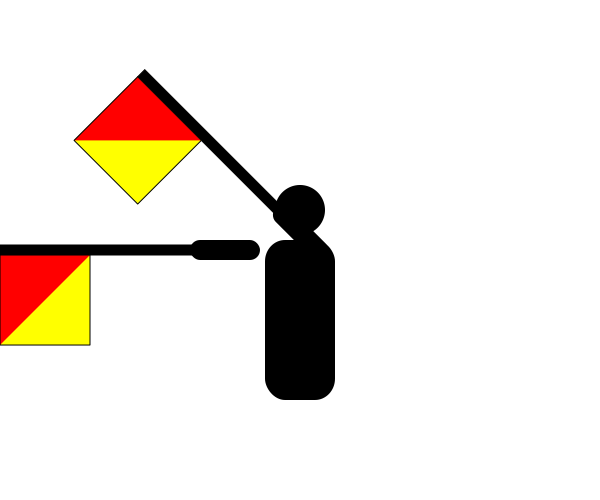
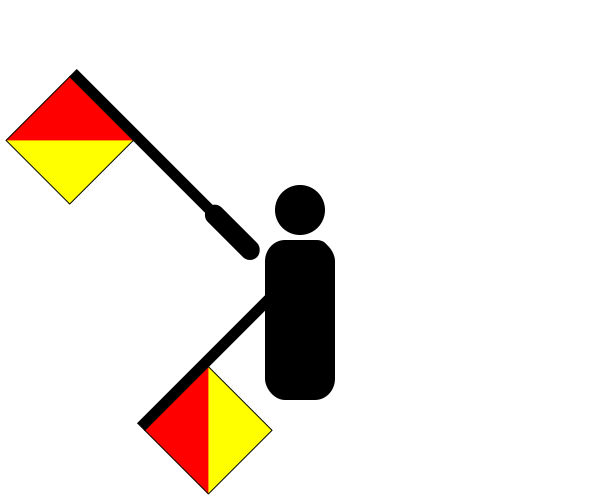
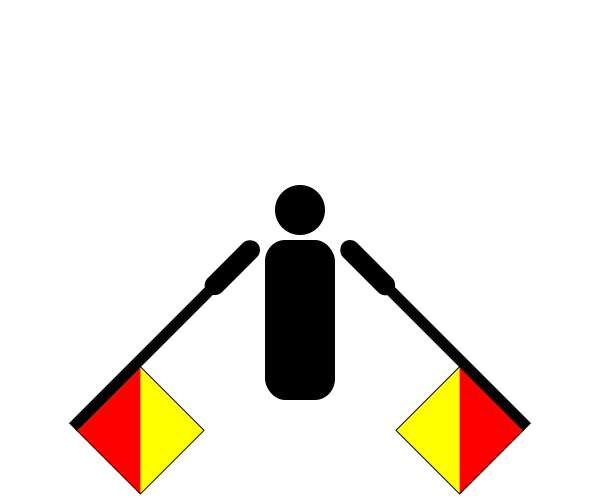
How to communicate the surname Polin in...
Braille
⠏⠕⠇⠊⠝
Morse
.--.---.-....-.
Semaphore


There are approximately 54 people named Polin in the UK. That makes it one of Britain's least common surnames. Only around one in a million people in Britain are named Polin.