PLOTT
Plott is a surname of English origin that derives from the Middle English word plot, meaning a small piece of land or a small enclosed area. It is believed that the name originally served as a topographic identifier for an individual who lived on or owned a modest plot of ground.
The name may have been used as a nickname for someone associated with a particular plot of land or, alternatively, for a person of small or compact stature. The etymology indicates that the meaning could be closely tied to the holder’s immediate surroundings or physical appearance.
Recorded variants of the surname illustrate its spread across Europe. In England the spellings Plaide, Pleat, Plett, Pletts and Plott were present, while in France the forms Plaid, Plait, Playe and Plet were noted. The French usage is associated with Huguenot refugees who fled persecution between 1580 and 1750; many were skilled artisans, particularly in the textile industry, which aligns with the medieval sense of the word plait as a fashion designer or a fashionable man. Early French records include Jean Joseph Plaid of Gerbeviller (19 March 1670) and Jean Plait of Pagny-sur-Moselle (13 January 1707). In England, Marthe Plet was christened at the French Church, Threadneedle Street, London (3 January 1686), and James Lewis Pletts later witnessed a deed at St Thomas's Church, Stepney (1 July 1852).
In addition to its English and French lineages, the surname also appears in German records, where it may have been an occupational name for a plotter (derived from Middle High German plot meaning a plan) or a nickname for a person who plotted or plotted affairs (from the verb plotten). The name arrived in the United States in the mid‑1700s with brothers John, Henry and Jacob Plott, who settled in North Carolina. The Plott name subsequently became firmly established in the American South, particularly in North Carolina, Georgia, Tennessee and South Carolina, where it accounts for roughly two per cent of the population of each state according to recent census data. A branch of the family extended to Latin America in the early 1900s, and today Plotts are found in Panama, Colombia and Peru.
There are several orthographic variants of the surname which reflect regional spelling practices and linguistic shifts. Common spellings include Plott, Plot, Plote, Plotts and Plottes; earlier forms such as de la Plotte or Plogge also occur in historical records. Other related names—Plout, Ploot, Ploht, Plath, Plotkin, Pillot and Playt—share a common pronunciation and are believed to arise from the same root. The surname ultimately traces back to the Latin word Plattus, meaning low‑lying or small plot of land, a reference to early agricultural activities. Jewish families in Eastern Europe adopted similar derivatives such as Plotnik, Plotnick and Plutnik, reflecting Yiddish influences.
The surname Plott thus presents a rich tapestry of linguistic evolution, geographic migration, and social association. Its presence in Britain, continental Europe, North America and Latin America demonstrates a lasting heritage that continues to shape modern identity for many bearers of the name.
Typical given names associated with the Plott surname
Male
- Desmond
- Raymond
- Stephan
- Stephen
Female
- Jayne
- Theresa
Similar and related surnames
Related and similar names are generated algorithmically based on the spelling, and may not necessarily share an etymology.
How to communicate the surname Plott in...
Braille
⠏⠇⠕⠞⠞
Morse
.--..-..-----
Semaphore


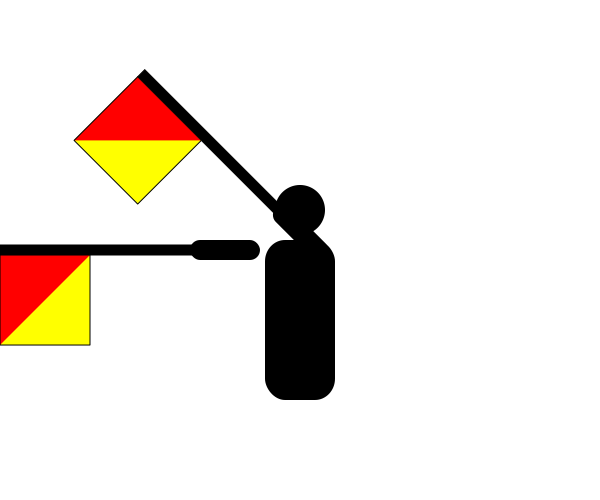
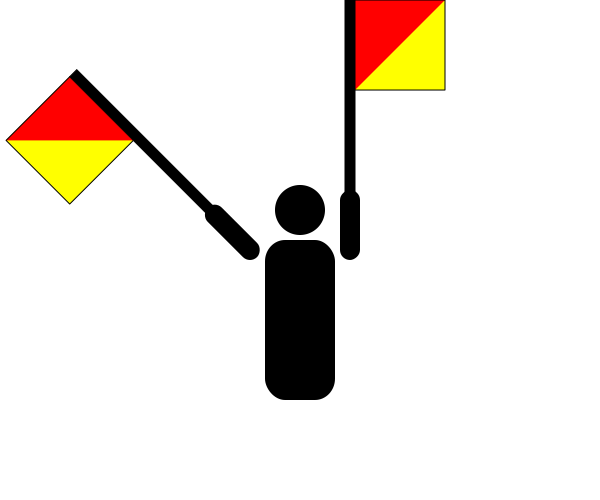
There are approximately 22 people named Plott in the UK. That makes it one of Britain's least common surnames. Fewer than one in a million people in Britain are named Plott.
Origin: English
Region of origin: British Isles
Country of origin: England
Religion of origin: Christian
Language of origin: English