PLANTE
Plante is a surname of French provenance, derived directly from the French word plante, which translates to “plant” in English. The term has been employed historically as an occupational identifier for those engaged in horticulture, plant cultivation, or nursery work. It has also been used as a topographic epithet for individuals dwelling near a conspicuous bush or hedge, or as a metaphorical comparison suggesting characteristics associated with vegetation.
In medieval Europe a similar occupational name surfaced in the English‑speaking world. The variant Plante is recorded in Anglo‑Saxon and Middle English as a metonymic surname for gardeners or planters of shrubs and herbs. Documentary evidence places the name in the mid‑13th century, with contemporaneous entries such as William Plante in the Select Pleas of the Forest (1262) and a William Plauntes in the 1275 Hundred Rolls of Norfolk. Earlier cognates include Ralph Plantebene (Norfolk, 1199) and Alice Planterose (Warwickshire, 1221), indicating a family of namebearers whose occupation or residence was associated with plants.
Geographically, the surname is most densely concentrated in France, where it is commonly observed in Paris and throughout the north‑eastern provinces. Historical patterns show presence in south‑western France, particularly within the Gascony region, a zone traditionally influenced by neighbouring Spanish‑speaking culture. In the French diaspora, the name is chiefly found in Quebec and Ontario, with additional occurrences across Alberta, Manitoba and Nova Scotia. In the United States, Louisiana retains a notable proportion of Plante bearers, a reflection of the state’s French‑speaking heritage; the name is also recorded in the north‑eastern states of Massachusetts and New York. Beyond North America, Plante is documented in Mexican states with sizable French‑speaking populations, as well as in Spain, Morocco, Algeria, Haiti, Madagascar and the Seychelles.
The surname has accumulated a variety of alternative spellings, reflecting phonetic adaptation and regional orthographic practices. Common variants include Plant, Plantes, Planta, Plantain, Plantier, Planté, Plantive and less frequent forms such as Plantz or Planteau. In Western European records, Latinised forms such as Plantae occasionally appear, while in North American contexts, anglicisation has produced simplified spellings without the terminal e.
As with many hereditary surnames, the contemporary rendering of Plante generally diverges from its original occupational or topographic meaning, having evolved under the influence of linguistic, migratory and social transformations over the centuries. The persistence of the name across multiple linguistic cultures attests to its enduring association with the natural world and its adaptability to the naming conventions of diverse societies.
Typical given names associated with the Plante surname
Male
- Alan
- David
- Douglas
- Martinus
- Simon
Female
- Linda
- Louise
- Nadia
- Stephanie
- Zanine
Similar and related surnames
Related and similar names are generated algorithmically based on the spelling, and may not necessarily share an etymology.
How to communicate the surname Plante in...
Braille
⠏⠇⠁⠝⠞⠑
Morse
.--..-...--.-.
Semaphore


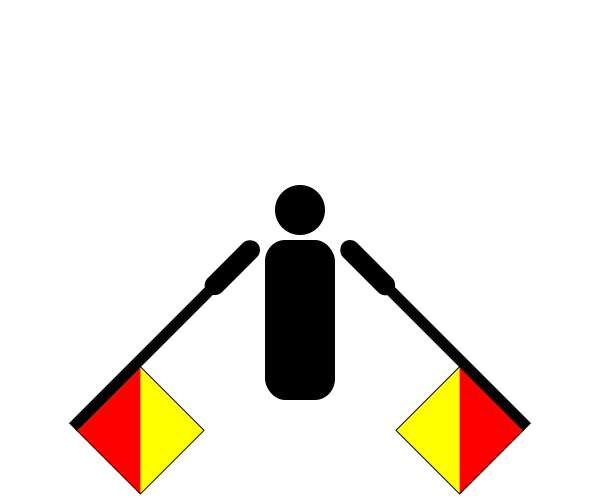
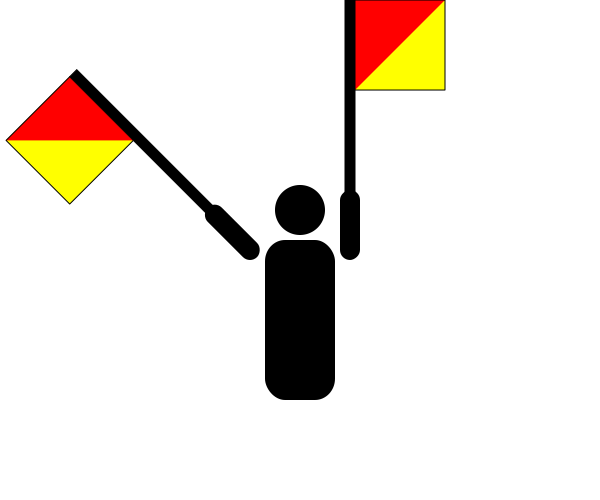

There are approximately 76 people named Plante in the UK. That makes it one of Britain's least common surnames. Only around one in a million people in Britain are named Plante.
Region of origin: Europe
Country of origin: France
Language of origin: French
