PINSON
Pinson is a surname with origins that can be traced back to Old French, a linguistic and cultural heritage introduced to England in the wake of the Norman Conquest of 1066. The original French word pinçon, meaning finch, gave rise to the name in two principal ways. Firstly, it functioned as a nickname for a cheerful, agile, or petite individual whose character was thought to resemble that of the small songbird. Secondly, it served as a metonymic occupational name for a person who employed pincers or forceps in his trade, a profession documented under early forms such as Pinch(e)on and Pinchen.
Early records attesting to the name appear in England at the close of the thirteenth century. The Red Book of the Exchequer (Lincolnshire, 1166) cites an individual named Ralph Pincun, while a marriage register from St. Mary at Hill, London, records the union of Edward Pinchin and Margrett Jackson on 11 March 1651. These documents establish the durability of the surname within English society and its continuity through the Middle Ages.
Variants of the surname have evolved over the centuries, reflecting regional dialects and the phonetic spelling practices of early orthography. Notable historical forms include Pinsonneaux, Pinçon, Pinsonneaulx, Pinsonneault, and Pinzon. In France the surname is still frequent, particularly in the Normandy region, where it is borne by over twelve thousand people as of 2019. The name remains relatively uncommon globally, yet it occupies a visible presence in the United States, especially in the South, where states such as Mississippi, Alabama, Georgia and Tennessee record the highest concentrations. According to the 2010 census, 43,668 individuals carried it in the United States.
In addition to its French and Anglo‑Saxon manifestations, Pinson has been adapted to a variety of linguistic contexts. In German‑speaking countries the surname appears as Pinse or Pintschner, while in Switzerland the spelling Pinçon remains standard. Italian usage shows the form Pinzon, and in the United States pronunciation often oscillates between “Pin‑sawn” and “Penn‑sawn”, occasionally yielding spellings such as Pinsonneault or Penzien.
The name’s persistence across continents demonstrates the enduring nature of surnames that originate from simple natural references or occupational descriptors. It also illustrates how linguistic evolution, migration, and cultural interchange shape the orthographic and phonetic presentation of a family name over time. Although the original connotations associated with finch‑like lightness or the use of pincers may no longer apply to those who now bear the name, the surname Pinson continues to carry the legacy of its historical roots within the tapestry of contemporary naming traditions.
Typical given names associated with the Pinson surname
Male
- Carl
- Darren
- David
- Gordon
- John
- Keith
- Mark
- Nicholas
- Paul
- Richard
- Robert
- Steven
- Stuart
Female
- Diane
- Elaine
- Emma
- Florence
- Helen
- Jean
- Jennifer
- Jessica
- Laura
- Lisa
- Lucy
- Norma
- Sarah
- Susan
Similar and related surnames
Related and similar names are generated algorithmically based on the spelling, and may not necessarily share an etymology.
How to communicate the surname Pinson in...
Braille
⠏⠊⠝⠎⠕⠝
Morse
.--...-....----.
Semaphore

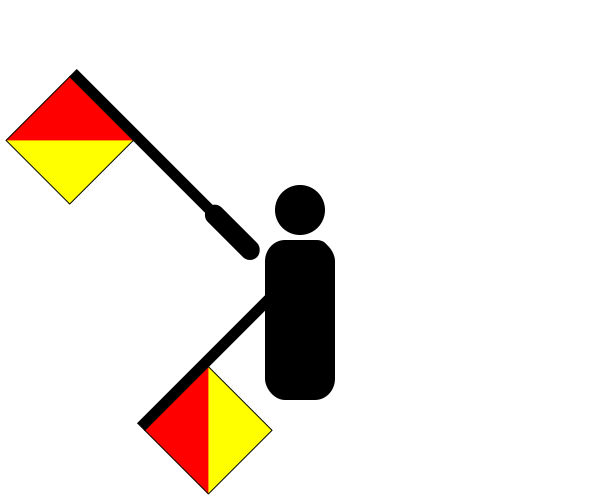
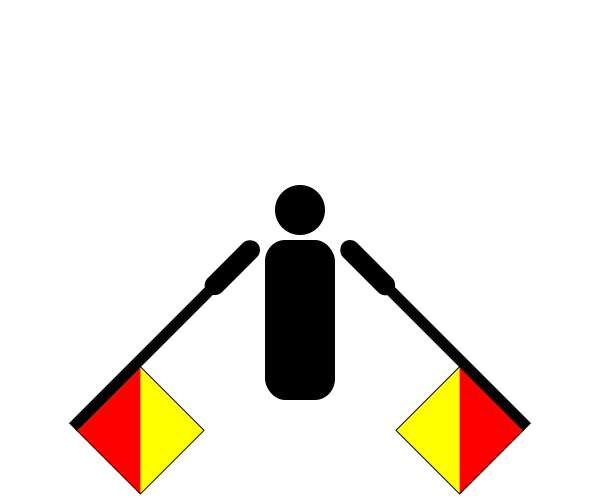

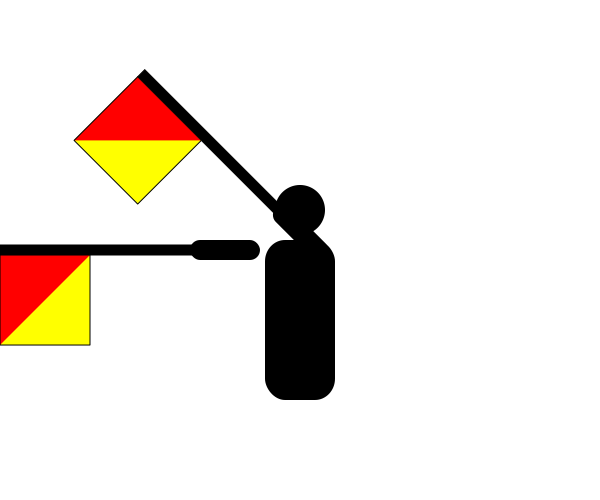
There are approximately 524 people named Pinson in the UK. That makes it one of Britain's least common surnames. Only around eight in a million people in Britain are named Pinson.
Origin: English
Region of origin: British Isles
Country of origin: England
Religion of origin: Christian
Language of origin: English
