PINNICK
Pinnick is a surname of English origin. Its earliest known use is found in the late 12th century, and the name is firmly situated within the British Isles, specifically England.
The etymology of the surname is linked to the Old English word pin, meaning a peg or a pin. This suggests that the name could have originally described a person who lived near a prominent peg‑like landmark, such as a boundary marker or a hill with a pointed summit. Alternatively, it may have referred to an occupation, designating a maker or seller of pins.
There is also evidence that Pinnick may be a locational name deriving from the medieval village of Pinnock in Gloucestershire or Pinnox in Staffordshire. The place name itself is thought to come from the ancient Celtic word pen, meaning hill, which in its diminutive form was recorded in the Domesday Book of 1086 as "Pignoscire" and later as "Pinnok" in the Close Rolls of 1248. This connection implies a topographic origin, with the surname meaning “one who lives on or near a hill.”
Recorded variants of the spelling include Pinock, Pinnock, Pinnocke, and Pinnick. Early documentary evidence shows the name in the Pipe Rolls of Wiltshire in 1199, where it appears as “Nicholas Pinnoch,” during the reign of King John. Subsequent entries in the Hundred Rolls of Wiltshire (1255) and Oxfordshire (1273) mention individuals named Walter Pinnok and William Pinnoc, confirming the continued use of the name through the 13th century.
In later centuries, parish registers in London record baptisms of individuals bearing the surname: for example, Denise, daughter of John Pinock, was christened on 18 August 1593 at St. Margaret's, Westminster, and Sarah Pinnock, daughter of William, was christened on 10 April 1614 at St. James' Clerkenwell. These entries indicate that the name persisted into the 16th century and was established in ecclesiastical records.
Today, Pinnick is a relatively uncommon surname in the United Kingdom. It is most frequently found in counties such as Kent, Hampshire, and Dorset, and to a lesser extent in Perthshire in Scotland. In Ireland, occurrences are limited mainly to Dublin and Meath. In the United States, the name is mainly identified in the southern states, particularly Texas, Alabama, and Florida, but it also appears in states with large urban populations such as Pennsylvania, New York, and Illinois. The surname is not widely represented in modern records and is considered a minority name in comparison to more common English surnames.
While the surname has been noted as a possible variant of the unrelated name Pinckney, the two origins are distinct. Pinckney is chiefly associated with Scottish roots and an American lineage, and no evidence suggests a direct relationship between the two surnames beyond superficial similarity. Therefore, Pinnick remains a distinct English surname with a clear historical pedigree linked to both occupational and topographic origins.
Typical given names associated with the Pinnick surname
Male
- Andrew
- Anthony
- Benjamin
- Christopher
- David
- John
- Mark
- Matthew
- Nigel
- Scott
- Steven
- Tony
Female
- Angela
- Betty
- Christine
- Donna
- Hannah
- Jennifer
- Julie
- Karen
- Kathryn
- Pamela
- Sally
- Samantha
- Sharon
- Susan
Similar and related surnames
Related and similar names are generated algorithmically based on the spelling, and may not necessarily share an etymology.
How to communicate the surname Pinnick in...
Braille
⠏⠊⠝⠝⠊⠉⠅
Morse
.--...-.-...-.-.-.-
Semaphore

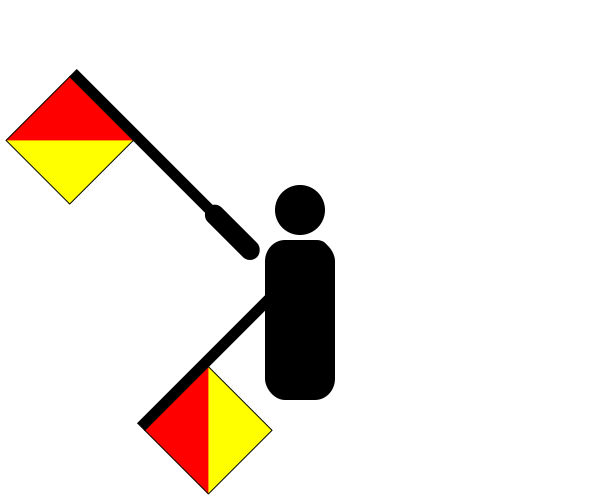
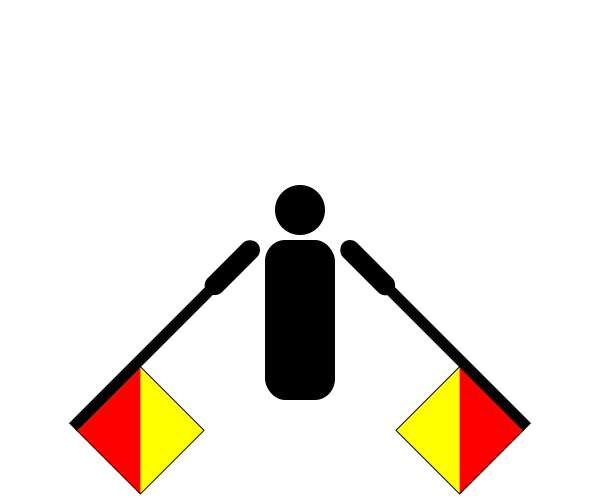

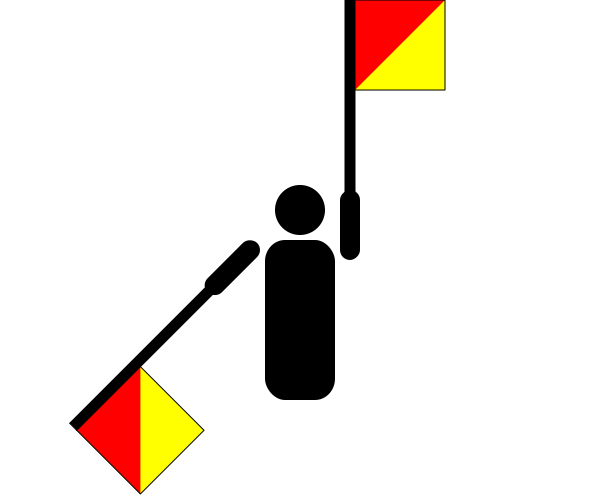
There are approximately 346 people named Pinnick in the UK. That makes it one of Britain's least common surnames. Only around five in a million people in Britain are named Pinnick.
Origin: English
Region of origin: British Isles
Country of origin: England
Religion of origin: Christian
Language of origin: English
