PINN
The surname Pinn has its roots firmly in the English linguistic tradition of the British Isles. It first appears in medieval documentary records and has endured with variations across subsequent centuries.
Historical evidence shows that the name may derive from a number of Old English and Old French lexical roots. One theory places it as a variant of Penn, originating with the Old English word penn, signifying a hill or a bounded enclosure. Another explanation links it to the Old English word pinn, meaning a pin or a peg. A further possibility treats Pinn as a variation of the occupational surname Pinder, indicating a person who impounded stray animals. In the French context the name stems from the pre‑7th‑century term pin meaning pine, used as a topographical identifier for individuals living near a distinctive pine tree or forest. Finally, some medieval scholars hint at an older word pinne, meaning “find” or “discover”, suggesting a nickname for someone who discovered something valuable.
Early documentary appearances of the name include Bonde Pine recorded in the Records of St. Benet of Holme in Norfolk in 1101, and Thomas de Pyn mentioned in the 1273 Hundred Rolls of Devonshire. The spelling also appears as Thomas de Pyne in Somerset in 1277 and John atte Pyne in Cambridgeshire in 1327. A family of de Pyn held the estates of Combepyne and Upton Pyne in Devon during the thirteenth century, possibly connected to the French town of Le Pin in Calvados.
The surname has accrued a range of orthographic variants over time. These include Pyne, Pynn, Penn, Pene, Pynne, Pin, and Pender, among others. Such diversity reflects both phonetic spelling practices of the Middle Ages and regional linguistic influences.
In terms of geographic distribution, the name was most prevalent in England in the south‑west counties, particularly Devon, Somerset, and Cornwall. Within Cornwall it ranked highest in the electorates of St Ives, Launceston, and Bodmin. In the national census records of the period 1881‑1902, the name was recorded most frequently in Essex, specifically in the Billesdon and Burgh electoral divisions. These figures demonstrate the concentration of the surname in specific locales rather than a uniform national spread.
Beyond the United Kingdom, the surname appeared in several English‑speaking countries. In the United States it is most common in New Jersey, especially Bergen County and Hunterdon County, followed by New York, Pennsylvania, and Connecticut. It is also recorded in California, Massachusetts, and Florida. In Canada, Australia, and New Zealand, pockets of individuals bearing the surname exist, usually tracing back to British migration patterns of the nineteenth and early twentieth centuries.
Because the name has proliferated through multiple independent lineages, there is no single definitive ancestral branch for those identified as Pinn. Instead, modern bearers of the name likely trace their ancestry to distinct regional origins, each with its own historical narrative rooted in English or Anglo‑French linguistic heritage. The surname therefore represents a tapestry of genealogical stories spanning several centuries and continents.
Typical given names associated with the Pinn surname
Male
- Alan
- Anthony
- Christopher
- Daniel
- David
- Derek
- John
- Michael
- Paul
- Richard
- Robert
- Stephen
Female
- Catherine
- Christine
- Elizabeth
- Emma
- Jacqueline
- Jane
- Louise
- Lynne
- Margaret
- Mary
- Patricia
- Sarah
- Shirley
- Sylvia
- Yvonne
Similar and related surnames
Related and similar names are generated algorithmically based on the spelling, and may not necessarily share an etymology.
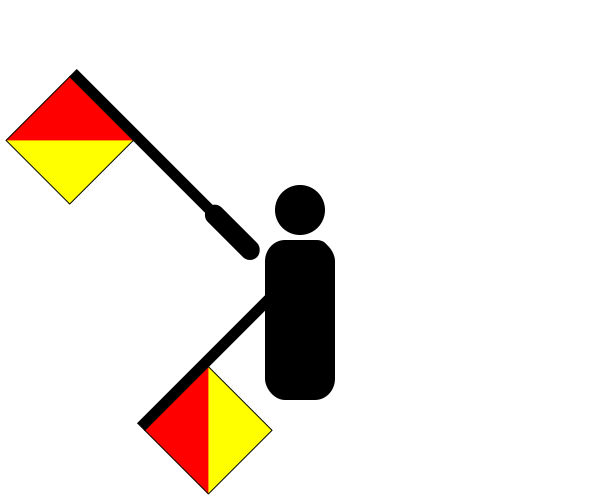
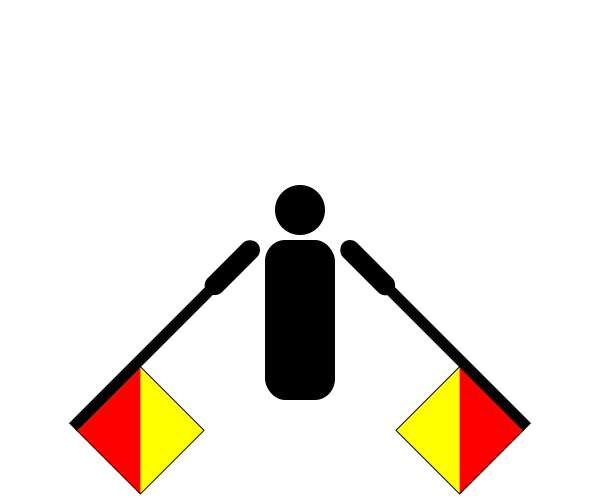
How to communicate the surname Pinn in...
Braille
⠏⠊⠝⠝
Morse
.--...-.-.
Semaphore

There are approximately 564 people named Pinn in the UK. That makes it one of Britain's least common surnames. Only around nine in a million people in Britain are named Pinn.
Origin: English
Region of origin: British Isles
Country of origin: England
Religion of origin: Christian
Language of origin: English