PIEL
Piel is a surname of predominantly Germanic origin, first recorded in the late twelfth century. The earliest known instance is that of Robert de Pele, dated 1199 in the Memoranda Rolls of Somerset, contemporaneous with the reign of King John.
The name derives from the Middle High German word pil, meaning “arrow”. Accordingly, Piel is an occupational surname that was likely bestowed upon individuals renowned for their skill in archery, or who were otherwise associated with the craft of shooting. The occupation-based interpretation is reinforced by the surname’s prevalence in German-speaking regions, especially in areas where archery played a vital military role.
Alternative derivations present a richer, more complex picture. One hypothesis holds that the name was a nickname for a tall, thin man, stemming from the Anglo‑Norman French pel – a stake or pole (derived from Old French piel and Latin palus). From this root the surname may also have served as a topographical label for a dweller beside a stake fence, or as a metonymic occupational name for a builder of such fences. The locational angle is supported by place‑names such as Peil, Peel and Peele in England and the Isle of Man; the Celtic element peel denotes a stronghold or fortified tower, indicating that some bearers may have lived near or worked on such structures.
In Prussian contexts, the surname has been linked to the Latin Pilus – “stout pillar” – which conveys an image of physical robustness and steadfastness. Those who carried the name in this setting were said to possess a sense of resoluteness, reliability and a willingness to confront adversity. Such connotations, while historical, illustrate how occupational and locational elements intertwine to shape identity.
Modern occurrences of the surname are widespread across Europe, notably in Germany, France, Belgium and the Netherlands. Variants have evolved in accordance with regional linguistic preferences. In Germany, Piel remains common in Baden‑Württemberg, sometimes appearing as Pielemans in Dutch contexts, and in France as Peyrel or Peyron. The French variant Peyron traces its roots to a 12th‑century noble line in Burgundy. In Louisiana, French‑speaking Cajuns may spell the name as Piellé, stemming from migrations in the eighteenth and nineteenth centuries.
Further variations arise in other cultural settings. The Irish form O'Piel or O'Pill derives from the Gaelic O'Bhile (“descendant of Bile”), while in Spain variants such as Pel, Phiel, Phel and Pil exist. In North America, the surname occasionally appears as Piall, a hybrid spelling that emerged during immigration processing when officials could not confirm the original orthography.
Across these diverse strands, the surname Piel consistently reflects associations with strength, skillful precision, and a connection to place or occupation. Its persistence in Belgian, French, German, Dutch, Irish, Spanish and American contexts underscores the enduring nature of family names as vessels of history and identity.
Similar and related surnames
Related and similar names are generated algorithmically based on the spelling, and may not necessarily share an etymology.
How to communicate the surname Piel in...
Braille
⠏⠊⠑⠇
Morse
.--.....-..
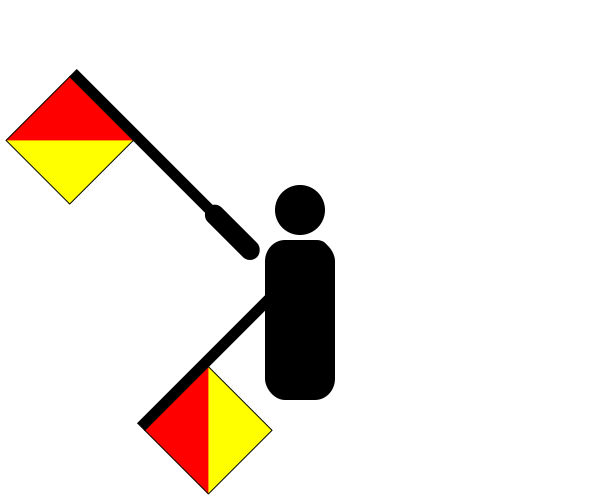
Semaphore



Sorry, we don't have any statistics on this name. That's probably because it's very uncommon in Britain.
