PETTUS
The surname Pettus is of English origin, but its roots reach back into Greek, early Anglo‑Saxon, and Old French linguistic traditions. Its earliest known appearance in the Pipe Rolls of Sussex dates from 1182, where it is recorded as Geruase de la Puette. The construction of the name in that period reflects a Norman influence, with the use of the pre‑position de la signalling a toponymic connection.
In England the name developed into a patronymic surname. Medieval records show it adopted from the given name Pet or Petyt, a diminutive of Peter. The Christian name Peter itself derives from the Greek word petros meaning “rock” or “stone”, a semantic foundation that can be seen across many European surnames. Consequently, individuals who were descended from an ancestor named Peter were identified as “Pettus” in the growing practice of hereditary surnaming during the High Middle Ages.
Early phonological variation is evident in the numerous spellings found in surviving documents, including Pitt, Pitts, Pett, Petts, Pott, Potts, Pettis, Pettys, Pates, Patis, Patise, Pettus. This diversity reflects regional pronunciation differences and the lack of standardised spelling before the advent of printing. Certain forms such as Johan atte Pitte (1294) or Thomas in the Pyt (c.1300) illustrate how the name could incorporate pre‑positions and articles that are often omitted in modern usage.
The name also has a strong topographical or locational element. Derived from the Old English pytt, meaning a pit or hollow, it frequently merged with the suffix -hus (house) in dialectal forms. Thus, a person dwelling near a pit or a pit‑house might be described as de la Pitte or de Petts. Place names echoing the word element can be found in Hampshire and East Sussex, suggesting that the surname may denote origin from such locales. The earliest specifically recorded patronymic forms appear in the mid‑13th century: Thomas de la Pitte (1225 Southam Assizes) and Roger de Petts (London rolls, 1276). Subsequent legal entries, such as William Bitheputte of Somerset (1277) and the Pyt of Worcestershire (c.1300), provide a detailed view of the name’s phonetic evolution.
Although its linguistic pedigree is firmly English, the surname has become most prominent in the United States. According to a 2019 census analysis, the name is found in every state, but its density concentrates in the southeastern region. In Alabama, Mississippi, and Tennessee the surname ranks among the top twenty, with over a thousand households recorded in Kentucky, Arkansas and Georgia. In the states of Virginia, South Carolina, Florida and Louisiana, numbers of households fall between four hundred and five hundred, while smaller figures occur in the remaining states. The prevalence of Pettus families throughout the American South reflects the migration and settlement patterns of English emigrants and subsequent demographic growth.
Notable bearers of the surname have extended its recognition beyond genealogical interest. In 1759 the younger William Pitt, the English statesman, was a prominent politician at a time when some documents show his surname as Pettus in similarity to the family name. Modern American history records Senator Edmund Pettus, a key figure of the Confederacy, whose legacy includes the Edmund Pettus Bridge in Selma, Alabama. These associations underline the surname’s lasting influence across both sides of the Atlantic.
Research into the genealogy of families bearing the surname Pettus should therefore consider the full range of spelling variants—Pett, Petts, Pettis, Pettys, Pitte, Pyt, Petty, Petou—to maximise the chances of locating records in parish registers, tax rolls, military files and contemporary census data. Archival collections in Sussex, Hampshire, Somerset and London will be particularly fruitful for early English references. In the United States, state archives and county repositories in Alabama, Mississippi and Tennessee provide the richest sources of 19th and 20th century documentation. Modern digital resources, including genealogical databases and digitised newspapers, continue to supply additional records, given the name’s persistence in the public record.
The surname Pettus exemplifies the layered nature of English surnames, integrating patronymic, linguistic, topographical and colloquial elements. From its Greek linguistic roots to its medieval legal mentions and contemporary demographic distribution, the name carries a well‑documented tradition that can be traced through a breadth of reliable archival sources, allowing researchers to explore the lineage of this family name with confidence.
Similar and related surnames
Related and similar names are generated algorithmically based on the spelling, and may not necessarily share an etymology.
How to communicate the surname Pettus in...
Braille
⠏⠑⠞⠞⠥⠎
Morse
.--..--..-...
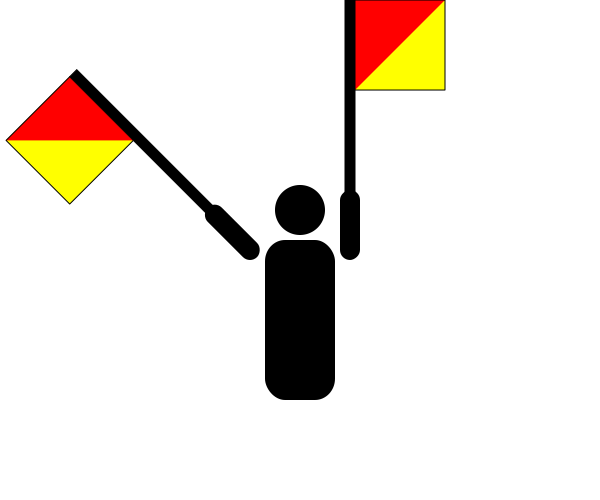
Semaphore




Sorry, we don't have any statistics on this name. That's probably because it's very uncommon in Britain.
