PETRUS
Petrus is a surname with its earliest roots in the Greek word Petros, meaning “rock” or “stone.” The name first entered Latin usage as Petrus, a patronymic derived from the biblical disciple Simon who was renamed Peter by Jesus. The association of the name with the rock of the Christian church has imbued it with longstanding spiritual connotations.
Throughout the medieval period, the name spread across Europe, becoming a common surname in many languages. It is widely represented in forms such as Peter, Pieter, Pierre, and as patronymics including Peterson, Peters, Pedersen, and their variants. The sheer number of spellings is estimated at over seven hundred, and at least one form can be found in every European country. This proliferation is evidenced by historical records ranging from Luke Petre of London in 1282 to William Petres of Somerset in 1327, and to later entries such as Andres Guillen Perez of Spain in 1565 and Martina Josepha Perez of Mexico in 1775.
The earliest documented instance of the family name appears in the pipe rolls of Hertfordshire, dated 1195, where a certain Ralph Peter is recorded. This early reference suggests that the name was established in England well before the Reformation and would subsequently be carried to the New World by emigrants.
There is a distinct heraldic emblem traditionally associated with the Petrus line: a red field charged with a cross flory, surrounded by four fleur-de-lys, all rendered in gold. The elegance of this coat of arms reflects the name’s perceived attributes of strength and foundation.
Culturally, the surname is found in Latin, English, German, Dutch, Scandinavian, and Italian contexts, and today it is common throughout France, Germany, Belgium, The Netherlands, Switzerland, Italy, Portugal, Brazil, Venezuela, Argentina, North America, the Caribbean, and the Philippines. In North America, the name is particularly noticeable among French-Canadians and French-Americans, where it continues to evoke a sense of heritage and religious devotion.
Beyond its historical frequency, the name carries suggestions of character and resilience. Families identified with the Petrus surname often describe a profound sense of stability, cultivating a strong bond between faith and family. In literary and artistic traditions, the name has appeared repeatedly, giving it an aura that has inspired paintings, sculptures, songs, films, and books.
In contemporary society, the Petrus surname remains prevalent across all social strata. It is found among aristocratic lineages and ordinary households alike, and it continues to serve as a marker of identity for those who value the symbolic weight of a rock-like foundation in a world that frequently shifts.
Typical given names associated with the Petrus surname
Male
- Brian
- Kamil
Female
- Anna
Similar and related surnames
Related and similar names are generated algorithmically based on the spelling, and may not necessarily share an etymology.
How to communicate the surname Petrus in...
Braille
⠏⠑⠞⠗⠥⠎
Morse
.--..-.-...-...
Semaphore


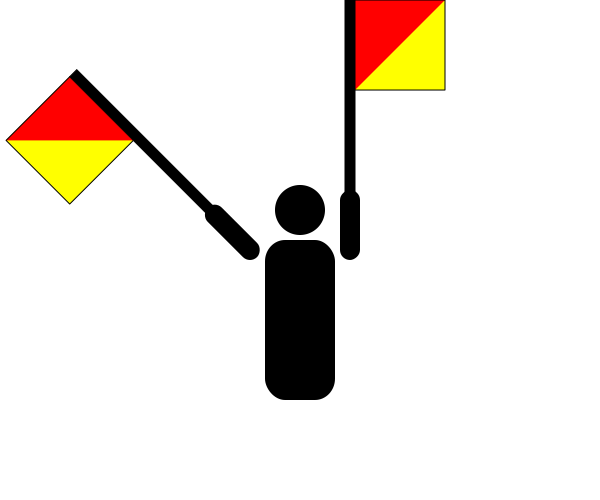
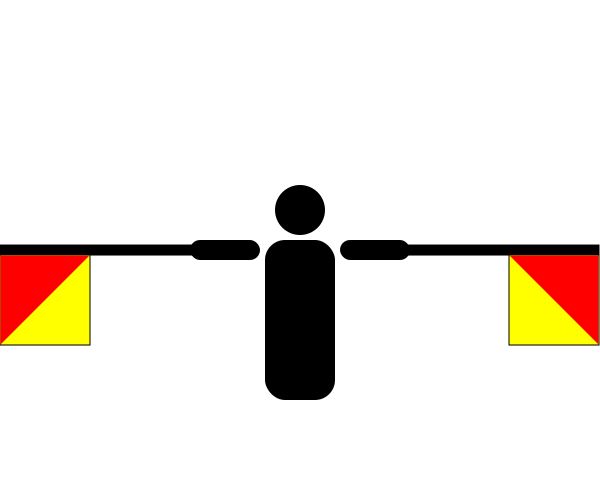


There are approximately 60 people named Petrus in the UK. That makes it one of Britain's least common surnames. Only around one in a million people in Britain are named Petrus.
