PETRI
Origins The surname Petri is originally Greek, deriving from the Hellenic given name Petros, meaning “rock” or “stone.” The name was adopted by early Christians to signify the steadfastness associated with Saint Peter, whom Christ designated as the foundational rock of the Christian Church.
Patronymic meaning In medieval Europe, surnames often identified lineage. Thus Petri is a patronymic surname, originally used to designate descendants of an individual named Peter. The spelling remained generally unchanged throughout much of Europe, though regional orthographic differences produced variants such as Peterson, Peters, and Petros.
Distribution across Europe The surname is found widely throughout the continent. In the United Kingdom it appears mainly among families who settled after the 17th‑century Protestant Reformation. In Germany it is especially frequent in Lower Saxony, Schleswig‑Holstein and Bavaria, while Switzerland records a substantial number of Petris in the cantons of Zurich and Basel‑Landschaft. Austria hosts many Petris in Styria, Vienna and Lower Austria; Liechtenstein contains the surname in small pockets across its municipalities. The name also appears in the Mediterranean, and in English‑speaking countries such as the United States, Canada, and Australia, often among people of Germanic descent.
etymological connections Beyond its Greek origin, Petri is cognate with the Old High German word petare, meaning “to fatten” or “to feed.” This connection suggests that early bearers of the name were sometimes involved in food production, sale or butchery. The Latin root petrus also means “stone” and underscores the likelihood that some families adopted the name because of a stone‑cutting trade or residence near a notable stone landmark.
Historical records The earliest recorded instance of the family name is Ralph Peter in the pipe rolls of Hertford, dated 1195 during the reign of King Richard I of England. Subsequent early examples include Luke Petre of London in 1282, William Petres of Somerset in 1327, Andres Guillen Perez of Zaragoza, Spain in 1565, Martina Josepha Perez of Santa Catarina, Mexico in 1775, and Antonio Diego Peres marrying Maria Ysabel Yorba in Los Angeles in 1864. These entries illustrate the name’s early and persistent migration from Europe to the Americas.
Heraldry The coat of arms frequently associated with the Petri name features a red field charged with a cross flory and four fleur‑de‑lis, all rendered in gold. This distinctive blazon has been linked to several bearer families throughout medieval Europe and signifies sobriety, faith and solidarity.
Overall, the surname Petri retains strong ties to its Hellenic roots and Christian symbolism while reflecting a broad European spread, occupational connotations in food production and stone working, and longstanding familial continuity emphasising stability, support and faithfulness.
Typical given names associated with the Petri surname
Male
- Andreas
- Andrew
- David
- Dion
- Johannes
- Michael
- Nicholas
- Peter
- Petro
- Saverio
- Stefan
- Stuart
- Walter
Female
- Anna
- Beatriz
- Beryl
- Christa
- Despina
- Georgia
- Georgina
- Irene
- Jean
- Maria
- Nicola
- Remi
- Sarah
- Susan
- Vivien
Similar and related surnames
- Patri
- Patrie
- Patria
- Patry
- Patric
- Peatrie
- Patris
- Perti
- Petr
- Petra
- Petria
- Petrie
- Peatry
- Peetrey
- Peteri
- Peterie
- Petre
- Petrea
- Petree
- Petrey
- Petric
- Petrice
- Petrick
- Petrik
- Petrin
- Petrine
- Petris
- Petriv
- Petro
- Petrou
- Petru
- Petry
- Pettrey
- Pettrie
- Pettry
- Pietri
- Pietrie
- Patre
- Patrik
- Paturi
- Petres
- Petriaho
- Petrica
- Petrich
- Petrides
- Petridi
- Petril
- Petrila
- Petrina
- Petrini
- Petrino
- Petroi
- Petrow
- Petryk
- Petterie
- Pietra
- Pietro
- Pedri
- Petrillo
- Petter
- Pitter
Related and similar names are generated algorithmically based on the spelling, and may not necessarily share an etymology.
How to communicate the surname Petri in...
Braille
⠏⠑⠞⠗⠊
Morse
.--..-.-...
Semaphore


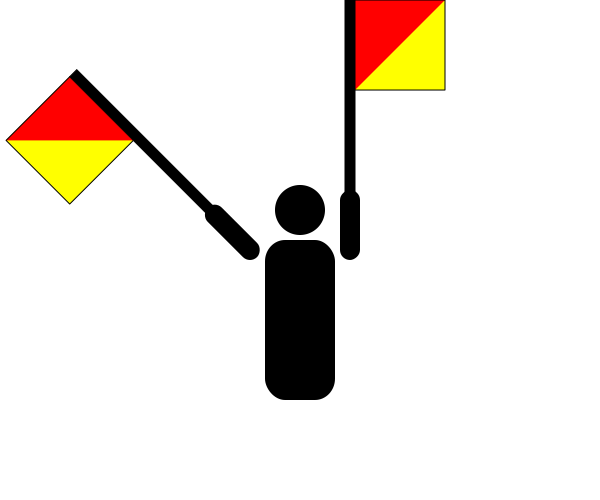
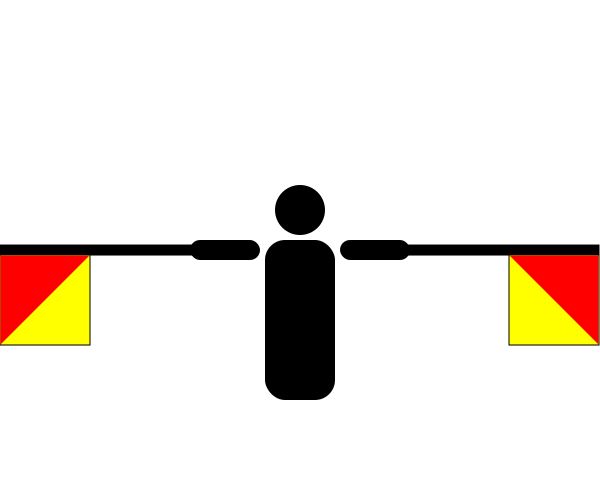
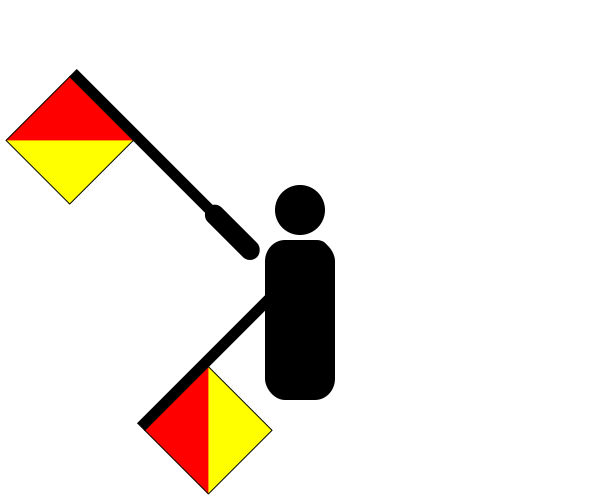
There are approximately 239 people named Petri in the UK. That makes it one of Britain's least common surnames. Only around four in a million people in Britain are named Petri.
Origin: Hellenic
Region of origin: Europe
Country of origin: Greece
Religion of origin: Christian
Language of origin: Greek
