PEOPLES
Peoples is a surname that manifests several distinct etymological pathways, reflecting the complex tapestry of the British Isles and the wider medieval diaspora.
The most direct derivation arises from the Middle English word peple, a variant of people meaning “community” or “population.” In this context the surname is considered occupational or descriptive, likely given to an individual who held a leadership or prominent role within a local society. The term appears in early records of the 13th and 14th centuries, for example in Yorkshire as Hawis Pepell (1301) and John Pepil (1324).
Another avenue of origin traces the name back to the Norman influence following the Conquest of 1066. Here Peoples is seen as a diminutive of Pepys, itself derived from the Old French personal name Pepis, an oblique case of Pepin. The name was introduced into Britain by Norman settlers and is linked historically to figures of the Frankish royal line such as Pepin le Bref. Early documentary evidence includes the Domesday entry for Ralph Henry Pipin (1086). Variants that evolved over time include Peaple, Pepall, Peppett and others.
A distinct Irish lineage for the name is reported in some sources, where Peoples is construed as an Anglicised form of the Gaelic patronym O'Duibhne. This corresponds to a notable clan that once inhabited a broad swathe of north‑west County Donegal. Within this tradition the surname denotes kinsmen or relations of a particular male ancestor, rather than a reference to a broader ethnic group. The emergence of the Anglicised form is thought to have occurred as a means of distinguishing members against the backdrop of English and later British administrative practices.
The surname bears numerous orthographic variants that reflect the fluid nature of medieval spelling. These include Peopl, Peples, Peple, Pepall, Pepple, Pipel, Pipall, and Populas, the latter stemming from the Latin populus. Several of these forms are found in early parish registers, such as the marriages recorded in St. Pancras, Old Church (1863) between Jeremiah John Peaple and Clara Perry, and Septimus People and Hannah Mattock.
In contemporary times the surname is most common in the United States, particularly in large metropolitan areas such as Chicago and New York City. Nevertheless significant concentrations exist in the United Kingdom, Ireland, Canada, Australia, and France. This distribution pattern is consistent with historical migration flows from the British Isles during the late medieval and early modern periods.
Overall, Peoples exemplifies a surname with multiple potential roots, each grounded in verifiable medieval usage. Its presence across diverse linguistic and national contexts underscores the layered nature of surname development in Britain and its former colonies.
Typical given names associated with the Peoples surname
Male
- Andrew
- David
- James
- John
- Martin
- Michael
- Patrick
- Robert
- Thomas
- William
Female
- Ann
- Caroline
- Catherine
- Claire
- Clare
- Dorothy
- Elizabeth
- Emma
- Kathleen
- Laura
- Margaret
- Mary
- Nicola
- Wendy
Similar and related surnames
Related and similar names are generated algorithmically based on the spelling, and may not necessarily share an etymology.
How to communicate the surname Peoples in...
Braille
⠏⠑⠕⠏⠇⠑⠎
Morse
.--..---.--..-......
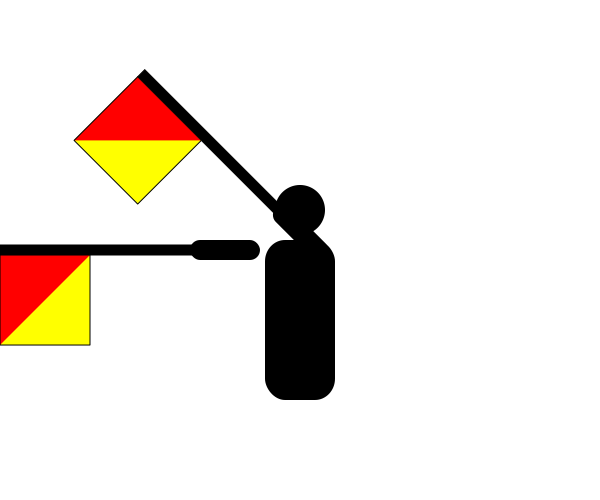
Semaphore




There are approximately 462 people named Peoples in the UK. That makes it one of Britain's least common surnames. Only around seven in a million people in Britain are named Peoples.
Origin: Celtic
Region of origin: British Isles
Country of origin: Ireland
Religion of origin: Christian
Language of origin: Gaelic