PENWELL
Penwell is an English surname of Anglo‑Saxon heritage, first recorded in the Middle Ages. Its formation combines two Old English elements that refer to prominent landscape features, a practice common in early English naming.
The first element, pen, generally signifies a hill, a high place or in some derivations an enclosure. The second element, well (from Old English well(a)), denotes a spring or a water source. Consequently, the name is commonly interpreted as “dweller by the hill with a spring” or, in a more literal sense, “enclosure near a well.”
Alternative early reconstructions identify the village of Pinwill in Leicestershire as the source of the name. Here the compound pening (meaning “a coin”) and waella (meaning “stream”) produce a meaning that has been read as “penny spring.” Some historical writers suggest that such springs were bought from, or offered for, people, a custom which persists in various cultures. The alliance of a small monetary value with a water source has been noted, but no direct textual record confirms the usage as a saintly or “holy spring.”
In Cornwall, the surname also appears as a locational name taken from a place called Penwell. The Cornish words pen (“top” or “end”) and well (“spring”) led to a name signifying “the well at the headland.” As was usual with surnames derived from place‑names, people who migrated from these villages often adopted the locational epithet to distinguish themselves in new settlements.
Variant spellings have survived the centuries, reflecting regional pronunciation and the lack of fixed orthography in early English. These include Pinwall, Pinwell, Pinwill, Pennewell, Penewell and others. Pronunciation differences can account for the shift from a silent w to a voiced, showing the fluidity of medieval spelling conventions.
Recorded instances in the early modern period support the spread of the surname beyond its original locales. The marriage record of Mary Pinwell to Thomas Pitchar at St. Lawrence Jewry, London, dated 10 October 1618, and the christening of Faith Pennewell at St. Olave’s, Southwark, on 10 May 1640, illustrate the name’s appearance in the capital. These early registers confirm that the name was already well established by the early fourteenth century in the fluidly mobile populations of London.
During the 19th century, the surname remained uncommon in its counties of origin but gained further presence in urban areas, especially London, as rural people moved into the city. Emigration in the 19th and 20th centuries transported the name to the United States and Australia, where it persists as a surname of English derivation. Today it remains uncommon but recognisable across English‑speaking countries.
In the present day, Penwell functions as a family surname with no specific occupational or social implication. It serves primarily as an identifier of family lineage, a link to a particular place or landscape, and a linguistic artefact of Anglo‑Saxon naming practices.
Similar and related surnames
Related and similar names are generated algorithmically based on the spelling, and may not necessarily share an etymology.
How to communicate the surname Penwell in...
Braille
⠏⠑⠝⠺⠑⠇⠇
Morse
.--..-..--..-...-..
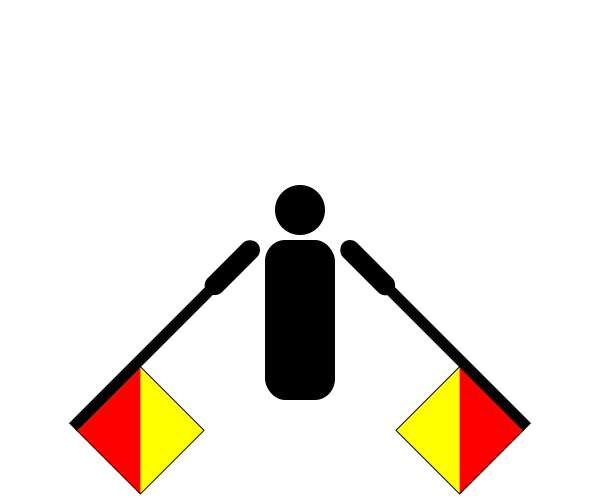
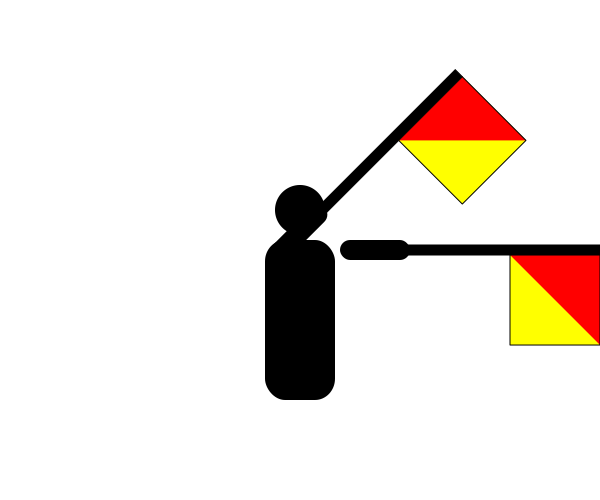
Semaphore



Sorry, we don't have any statistics on this name. That's probably because it's very uncommon in Britain.
