PENDERGRAST
Pendergrast is a surname of Welsh origin that is traditionally regarded as a patronymic derivation from the personal name Pender, which is interpreted as “chief” or “head”, combined with the element grast, meaning “grace”. The resulting meaning, therefore, can be rendered as “chief of grace” or “head of grace”.
Historical evidence indicates that the name also has a locational origin, linked to a lost settlement called Brontegeest (also recorded as Prentagast) in Flanders, near Ghent. Flemish settlers brought the toponymic surname to Normandy, and it was introduced into Britain by a follower of William the Conqueror known as Prenliregast. Prenliregast’s son Philip was granted lands near Haverfordwest in Pembrokeshire, an area that became associated with the castle known as Prendergast Castle. The name appears in the records of Berwickshire as well, where a place called Prenegast is thought to derive from the same family.
The early history of the family in Wales is highlighted by a member who served with Strongbow, Earl of Pembroke, during the Irish invasion of 1169. This individual secured extensive estates in southern and western Ireland, and his younger son, William, established New Castle near Clonmel in Co. Tipperary, which remained the family seat for several centuries. The earliest documented spelling of the surname is that of Maurice de Prendergast, dated 1169 in Pembrokeshire records held for the reign of King Henry the Eleventh (1154‑1189).
Another line of tradition records the name as an anglicised form of the Gaelic surnames Mac Conaing or Mac Cionaoith, meaning “Son of Cúanuait”. This Gaelic construction signified a person who was gentle, beloved or comely. During the sixteenth and seventeenth centuries, the Gaelic names were often rendered in English as Pendergrast. In some interpretations, the elements pendra (head or outcrop) and grasst (gray‑haired or grizzled) have been used to suggest a meaning such as “son of the grizzled man”.
The surname is recorded in the United Kingdom from the mid‑thirteenth century, with the first mention in Surrey in the 1200s. In Ireland it appears as early as the fifteenth century, particularly in Wicklow; the family is believed to have entered the country through Scottish migration, with documented occurrences in Scotland dating to 1517. The name crossed the Atlantic during the nineteenth and twentieth centuries, first appearing in the United States in 1790 in New York and Ontario, and later spreading to other states such as New York, California, Massachusetts, Virginia, North Carolina, Florida and Wisconsin. Admirably, the name is also common in Canada, where it is found in Ontario, Nova Scotia, British Columbia and Alberta, and in Australia, with particular concentration in New South Wales and Victoria.
There are numerous orthographic variants of the surname. Documented spellings include Pendergast, P(r)endergrast, Prendergrass, Prendeguest, Pendergest, Pendegrass, Pendegast, Pendegard, Pendygrass and others. Each version preserves the same core meaning derived from the original personal and locational elements.
Notable bearers of the name include John Patrick Prendergast (1808‑1893), who authored the seminal work “The Cromwellian Settlement of Ireland” among other historical studies. Earlier, the arms associated with the name appear in Burke’s General Armory as a per chevron embattled argent and gules, with two pheons counterchanged, and a crest of a red griffin rampant holding a pheon argent in its claws. The first heraldic bearer was William de Pendergast, who was recorded as a descendant of the Norman family of the Barons of Pau.
Contemporary demographic studies indicate that there are more than 2,600 individuals worldwide who bear the surname Pendergrast. DNA research has been employed to determine the geographical concentration of surname carriers, confirming a predominant presence in the United Kingdom, with significant communities in Canada and the United States. The distribution pattern persists, reflecting the historical migrations and diaspora of the family line across the English‑speaking world.
Similar and related surnames
Related and similar names are generated algorithmically based on the spelling, and may not necessarily share an etymology.
How to communicate the surname Pendergrast in...
Braille
⠏⠑⠝⠙⠑⠗⠛⠗⠁⠎⠞
Morse
.--..-.-....-.--..-..-...-
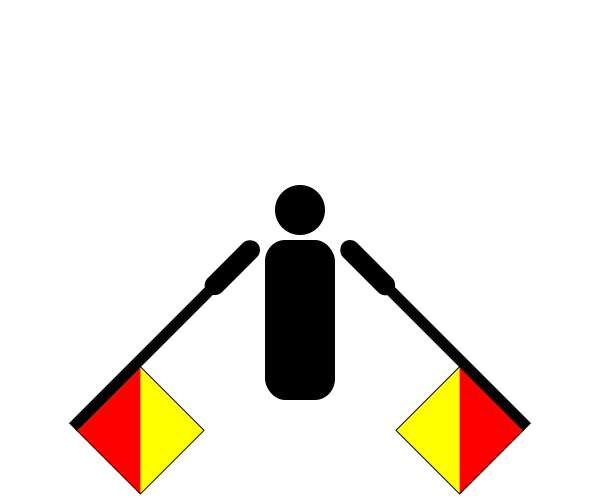
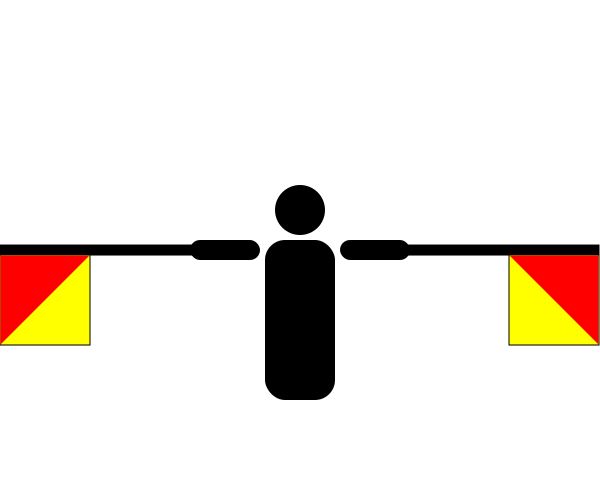
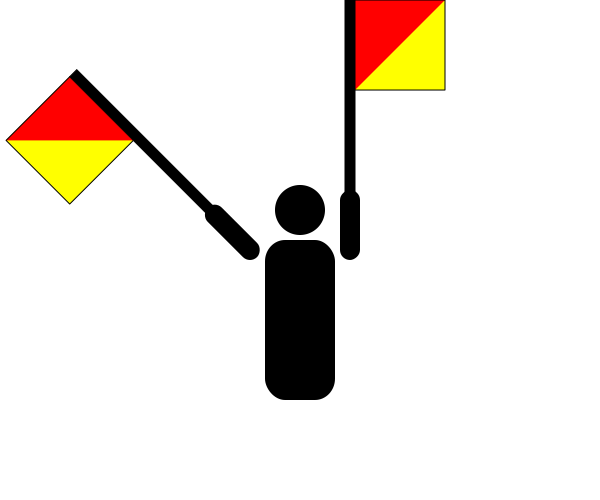
Semaphore





Sorry, we don't have any statistics on this name. That's probably because it's very uncommon in Britain.