PELZER
The surname Pelzer has its roots firmly planted in Germanic linguistic soil. It is an occupational name that originally described a person involved in the handling of fur. The Middle High German term peltzer translates directly as “furrier” or “one who works with fur,” and this etymology is reflected in the earliest documentary evidence.
Historical records locate the very first use of the name in Cologne, in a document dated 1038. This early instance confirms that bearers of the surname were already associated with the fur trade in the western regions of the Holy Roman Empire. From these beginnings the name spread northwards through German-speaking territories and later into neighbouring regions such as Switzerland and South Africa by the late nineteenth and early twentieth centuries, when large waves of emigration were taking place.
In addition to its German linguistic heritage, the name has a Dutch‑German variant that points to the craft of making pilches – leather garments that resemble the modern sheepskin coat. The term pilcher is the English rendition of the same occupational root, and the original Dutch form is Pelser. The Latin source pellicia, meaning “skin” or “hide,” provides the base from which the German and Dutch forms evolved. Consequently, the surname is sometimes found in spellings such as Peltzer, Beltzner, Peltz, Pelz and Belz, the latter being a recognised German variation.
When the Pelzer line crossed the English Channel, the name adapted to local spelling conventions. In England it appears as Palser, Pelser, Pallsher, and Palsoe. The earliest English record dates to a witness entry in the diary of St. Catherine’s by the Wardrobe, London, on 18 July 1628, relating to a Thomas Palsar (spelt “Palser”). This document demonstrates that the surname reached Britain during or shortly after the Huguenot period, although the precise circumstances of that migration are recorded without conjecture.
In the modern era, the Pelzer surname remains most commonly found in Germany, where, according to the World Names Public Profiler, there are more than nine thousand individuals who bear the name. In the United States, the family can trace a significant concentration back to South Carolina and the Upper Midwest, with particular communities in Missouri, Arkansas, Illinois, Wisconsin, and Georgia. The name is also registered in the United Kingdom, Canada, and Australia, evidencing a broad geographic dispersion stemming from the earlier waves of emigration.
Variants of the surname reflect both dialectical differences and the adaptation to various linguistic environments. German localized forms include Peltzer, Pellzer, Pelter, Pelz and Peltz; Czech and Polish renditions may appear as Pletzer, Pletzerin, or Pletz. Although some contemporary scholars have suggested a link to the Old German word pilz (“mushroom”), there is no substantiated documentary evidence to support such a hypothesis, and the occupational furrier derivation remains the authoritative explanation.
The Pelzer surname, therefore, offers a clear window into the economic activities of medieval European societies, particularly the fur trade, and illustrates the manner in which occupational names spread and evolved across language boundaries and continents. Its persistence into the present day serves as a testament to the enduring influence of trade guilds and craft specialisations in the shaping of family identities across centuries.
Similar and related surnames
Related and similar names are generated algorithmically based on the spelling, and may not necessarily share an etymology.
How to communicate the surname Pelzer in...
Braille
⠏⠑⠇⠵⠑⠗
Morse
.--...-..--....-.
Semaphore


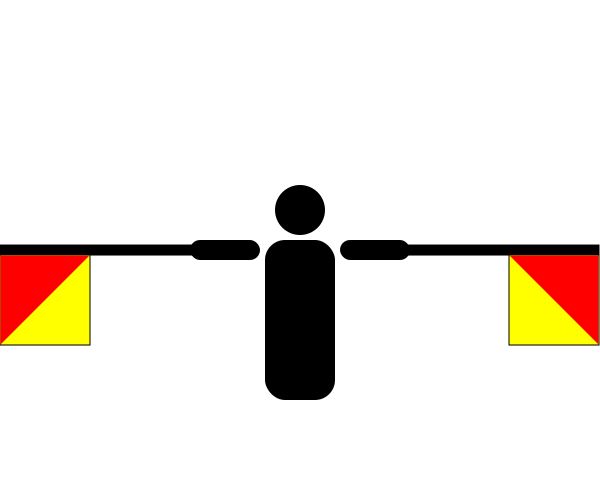
There are approximately 60 people named Pelzer in the UK. That makes it one of Britain's least common surnames. Only around one in a million people in Britain are named Pelzer.
