PAVIA
Pavia is a surname of Italian origin, deriving ultimately from Latin roots and the contemporary place‑name of the city of Pavia in Lombardy, Northern Italy. The name is traditionally understood to stem from the Latin word papia, meaning “swampy land.” As such, it is thought to have first been employed as a topographic surname for those who lived in or near marshy terrain, or as a locational identifier for individuals who hailed from the city itself.
Italian surnames are generally regarded as among the most difficult for genealogical research, owing to frequent spelling variations across generations and the fragmented administrative histories of pre‑unification Italy. Different branches of the same family may have adopted markedly divergent orthographies, leaving only a handful of letters from the original name preserved. In the case of Pavia, the surname is a clear locational type and has been documented in a wide array of European country records. Variants recorded include Pavier in Switzerland, Pavie in Languedoc, Puve in Germany, Pavey in England, as well as Pavese, Puvia and Pavinese within Italy. These spellings demonstrate both phonetic adaptation to local languages and the fluid nature of surname orthography in pre‑modern Europe.
Early documentary entries for descendants of the Pavia name appear in the sixteenth and early seventeenth centuries. A notable example is Catharine Pavia, dated to 15 January 1581, who married Antoine Eschard in Geneva, Switzerland, during the reign of Emperor Rudolf II of the Holy Roman Empire. Subsequent mentions include Guiseppe Pavia (also recorded as Pavese) who solemnly bound himself to Catarina Piacentino in Pavia city on 14 June 1626, and Toussain Pavie of Rumigny in the Ardennes, France, christened 2 February 1660. A later instance records Anna Maria Puve in Rheinhessen, Germany on 27 July 1811, illustrating the surname’s movement beyond its Italian heartlands.
While the most common explanation for the surname relates to the city of Pavia, other scholarly observations note a secondary derivation from the Latin pava, meaning “plain,” which could signify a flat or open area. Such an interpretation aligns with an occupational hypothesis whereby the name described a person associated with the maintenance of medieval roads. This theory has some support in medieval Lombard records, where individuals who performed road‑maintenance services were occasionally identified by a surname reflecting their profession rather than only their place of origin.
Throughout history the name has been linked, albeit loosely, with aristocratic standing in Lombardy and Piedmont. The earliest references to nobles bearing the name trace back to the twelfth century, a period when Italian society was divided into multiple city‑states. The adoption of Pavia by these elites served as a marker of civic pride and was subsequently transmitted through generations. That the surname has persisted with such a reputation is evidenced by the continued presence of bearers in political, military, and commercial spheres across Italy up to the present day.
Presently, the surname remains most common in northern Italian regions, notably Lombardy, Piedmont, Veneto, Emilia‑Romagna and Tuscany. Its occurrence outside Italy is frequent in the United States—particularly in Pennsylvania, New York, New Jersey and Florida—as well as in South American destinations such as Argentina, Uruguay and Chile. Each diaspora context has given rise to additional orthographic variants reflecting local linguistic practices, including Pavey in England, Pavie in France and Puve in Germany, amongst others.
Noteworthy is that the surname Pavia is sometimes conflated with the Italianised form of the given name Paolo (Paul). While this resemblance exists, the primary lineage of the family name is situated firmly in toponymic rather than patronymic tradition, reflecting an association with a specific locality rather than a lineage from a particular forefather.
In sum, the Pavia surname exemplifies the complex interplay of geography, language and social status characteristic of Italian family names. Its documented evolution across centuries and borders, its multiple orthographic manifestations, and its enduring link to the historic city of Pavia collectively illustrate a name that has maintained both continuity and adaptability in the face of linguistic and administrative change.
Similar and related surnames
Related and similar names are generated algorithmically based on the spelling, and may not necessarily share an etymology.
How to communicate the surname Pavia in...
Braille
⠏⠁⠧⠊⠁
Morse
.--..-...-...-
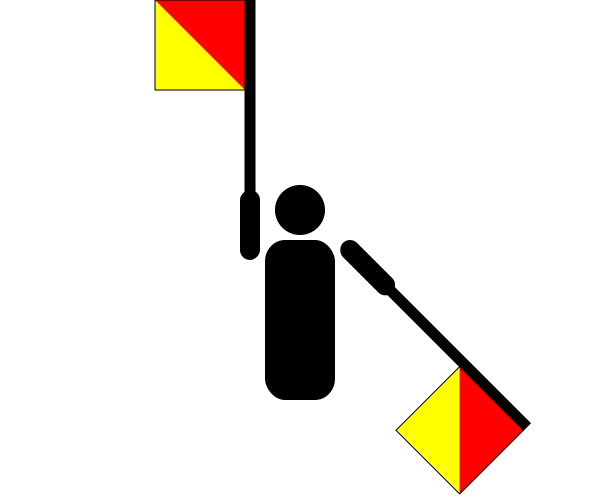
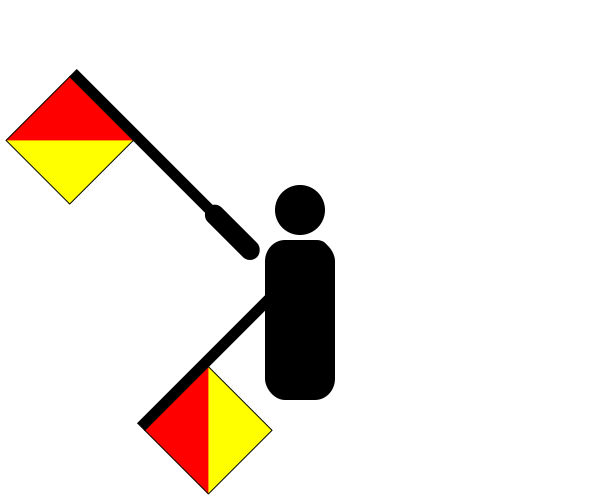
Semaphore


Sorry, we don't have any statistics on this name. That's probably because it's very uncommon in Britain.
