PASLEY
Pasley is an English surname that originates as a locational name derived from places in the British Isles. The earliest recorded spellings, such as Passelewe in 1273 and Passelegh in 1303, appear in the Hundred Rolls of Norfolk and the Feudal Documents of Sussex. These forms reveal that the name was first taken by individuals who lived near or owned land that was mainly pasture or grazing ground.
The Old English roots of the name are seen in words such as pascel or pasc, meaning pasture, and in the personal name Poecca or Pacca combined with leah, a clearing in a wood. Thus Passelewe originally denoted “Poecca’s clearing” and later evolved into the modern spelling Pasley.
Historical evidence records individuals bearing the surname in the 13th and 14th centuries: Robert de Passelegh appears in the 1303 Feudal Documents of Sussex, and Edmund Passeleye is noted as a witness in the 1314 Assize Court Rolls of Kent. In the 17th century, William, son of Andrew Pashley, was christened at St. Giles Cripplegate, London on 29 September 1642.
A notable bearer of the name was Robert Pashley (1805‑1859), a barrister and traveller who published Travels in Crete in 1837 after touring Asia Minor, Crete and Greece. His journeys reflect the broader movement of people with the surname beyond England during the 19th century.
Heraldic representations associated with the name vary. One family armorial badge is a purple shield bearing a gold lion rampant, while another features a crowned silver shield. A separate coat of arms linked to the Scots Pasley line (now often written Paisley) depicts a silver sheaf of wheat, symbolising generosity and the desire to share bounty with those less fortunate.
Although predominantly English, the surname has Scottish and Irish connections. The village of Paisley in Renfrewshire, Scotland, offers a Brythonic derivation of the name from pasia (pasture) and gwy (water), suggesting a water meadow or marshy field. The name spread to England following the Norman Conquest in 1066 and later reached Ireland during the 12th‑century Anglo‑Norman invasion.
In modern times, bearers of the surname are found worldwide, with significant populations in the United States, Canada, Australia, New Zealand, and the Caribbean. According to a 2019 census report, the name accounts for approximately 0.008 per cent of the U.S. population, with a slight concentration—0.012 per cent—in Florida. Variants such as Pazley, Pasly, and Pasla appear in different regions but trace back to the same root.
The distribution of the surname remains a useful indicator of migration patterns, illustrating how families bearing the name have moved from early Anglo‑Saxon settlements in the British Isles to North America, Australasia and beyond. This global reach confirms the lasting legacy of the Pasley name in contemporary society.
Typical given names associated with the Pasley surname
Male
- Andrew
- Anthony
- Darren
- David
- Duncan
- Gianno
- John
- Martin
- Michael
- Robert
- Simon
- Thomas
Female
- Deborah
- Dorothy
- Elizabeth
- Gayle
- Helen
- Ilona
- Janet
- Linda
- Margaret
- Paula
- Pauline
- Sarah
- Sophie
- Susanne
Similar and related surnames
Related and similar names are generated algorithmically based on the spelling, and may not necessarily share an etymology.
How to communicate the surname Pasley in...
Braille
⠏⠁⠎⠇⠑⠽
Morse
.--..-....-...-.--
Semaphore


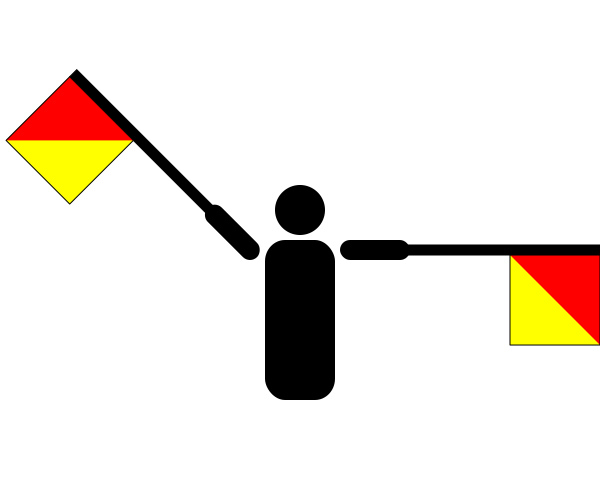
There are approximately 164 people named Pasley in the UK. That makes it one of Britain's least common surnames. Only around three in a million people in Britain are named Pasley.
Surname type: Location or geographical feature
Origin: English
Region of origin: British Isles
Country of origin: England
Religion of origin: Christian
Language of origin: English

Famous people named Pasley
- Malcolm Pasley - Royal Navy officer (1926 to 2004)
- Sir Thomas Pasley, 1st Baronet - Royal Navy admiral (1734 to 1808)
Names and descriptions courtesy of Wikipedia, and may contain errors. This is not intended to be an exhaustive list of every famous person with this name.