PARRAMORE
Parramore is a surname of dual linguistic heritage, possessing roots in both English and Old French. It has been described as an English surname derived from a nickname, and alternatively as a locational name based on a vanished place or geographic feature.
The etymological foundation of the name traces back to the Old French phrase par amour, literally translating to “for love.” In medieval usage the phrase conveyed a sense of affectionate or loving behaviour, and the nickname was thus bestowed upon individuals noted for their warmth or tenderness. Over the centuries the nickname evolved into the hereditary surname Parramore, with early spellings such as Paramour and Paramore.
Documentary evidence of the surname appears first in the late thirteenth century. In the Subsidy Rolls of Sussex of 1296 the name occurs as John Paramour, and in the Writs of Parliament for London in 1301 it is recorded as Roger Paramour. The earliest known instance, however, is found in the Hundred Rolls of Lincolnshire for the year 1273, where the name appears as John Paramour during the reign of King Edward I, known as “The Hammer of the Scots.”
Literary references confirm the contemporary use of the term. In Geoffrey Chaucer’s “Canterbury Tales,” a character remarks, “My fourth husband was a reveller: this is to say he had a paramour.” This illustration demonstrates that the term survived in common parlance well into the fourteenth century.
Church registers provide further evidence of the surname’s prevalence in early modern England. In 1580 Anne Paramore married John Tompson at St. Giles Cripplegate, and in 1601 Elizabeth Paramor wed Anthony Hall in St. Mary le Bow. Both entries are preserved in the parish archives of London and show the name’s continued use in recorded baptisms and marriages.
The migration of the name to the American colonies is documented in the early seventeenth century. John Parramore was recorded among the inhabitants of Virginia in the 1622 census, and by 1624 Robert Paramour was listed as a resident of James City, Virginia on the ship “Swan.” These early entries indicate that the name crossed the Atlantic within a few decades of the colony’s foundation.
Variations of the spelling have been consistently noted throughout history. Common forms include Parramor, Parramour, Parremor and Perremour. In addition, distinct variants such as Perramore and Perramours appear particularly in later colonial and post-colonial records, underscoring a broad anglicisation of the original French phrase.
Another hypothesis proposes a locational derivation from the Anglo‑Saxon elements parra, meaning a park or enclosed area, combined with more, denoting a moor or heathland. If this interpretation is correct, the surname would, on the one hand, designate a person dwelling near a park on moorland, and on the other hand could retain the affectionate nickname connotation. At present, however, the precise geographical origin of the name remains uncertain.
In contemporary times, the surname is heavily concentrated in the United States, especially along the eastern Atlantic seaboard. The name appears across North and South Carolina and is also frequent in rural areas of Alabama and Mississippi. Moreover, a notable proportion of families bearing the name are identified as African‑American, many of whom trace their lineage to the aforementioned southern regions.
Beyond the United States, sparse occurrences of the surname exist in the United Kingdom, with limited representations in England, Scotland and Ireland. Only a handful of contemporary families retain the name in these countries, signalling its relative rarity outside of North America.
Diaspora movements have carried the name further afield. In Canada, Mexico and Brazil, small numbers of families among the Caribbean diaspora and early colonial settlers carry the surname. These instances illustrate how the name has travelled alongside broader migration patterns in the modern era.
The continuity of the Parramore lineage is attested by a documented family line that survived the original settlement of the British Colony of Virginia. John Parramore, arriving in 1622 at the age of sixteen from the Isle of Thanet in Kent, became an indentured servant who later purchased land and married, thereby establishing an unbroken progeny that persists to the present day. The surname’s endurance across four centuries and across continents demonstrates both the resilience of the name and its capacity to adapt to diverse cultural environments.
In sum, the surname Parramore encapsulates a rich fusion of linguistic origins, historical documentation and migratory experience. Its roots in the Old French expression for love contend with alternative locational theories, while its journey from medieval England to the American colonies, and subsequently to the wider world, illustrate a complex tapestry of social history.
Typical given names associated with the Parramore surname
Male
- Daniel
- Elliot
- Ernest
- Ian
- James
- John
- Julian
- Lee
- Neil
- Philip
- Roger
- Sean
- Terence
- Tom
Female
- Angela
- Caroline
- Christine
- Dorothy
- Glennis
- Jan
- Joanne
- Julie
- Kathryn
- Lynn
- Mary
- Sheila
- Susan
- Victoria
Similar and related surnames
Related and similar names are generated algorithmically based on the spelling, and may not necessarily share an etymology.
How to communicate the surname Parramore in...
Braille
⠏⠁⠗⠗⠁⠍⠕⠗⠑
Morse
.--..-.-..-..------.-..
Semaphore


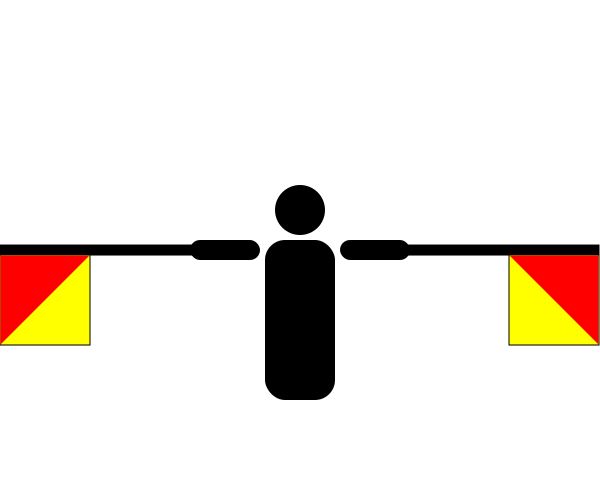
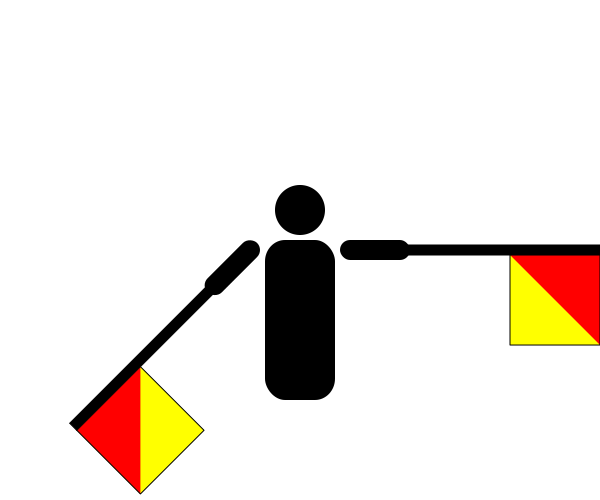
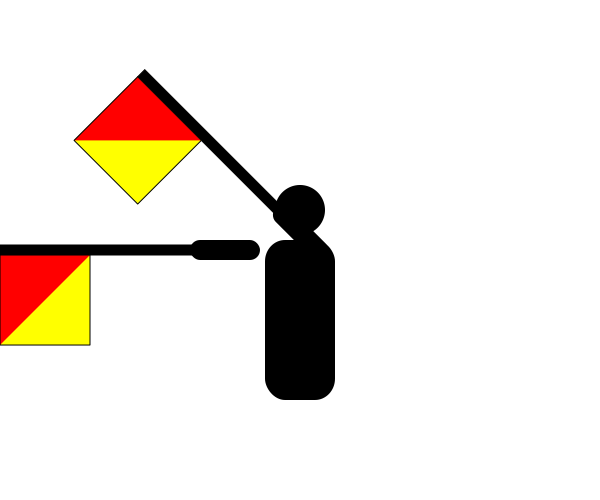

There are approximately 152 people named Parramore in the UK. That makes it one of Britain's least common surnames. Only around two in a million people in Britain are named Parramore.
Surname type: Location or geographical feature
Origin: English
Region of origin: British Isles
Country of origin: England
Religion of origin: Christian
Language of origin: English
