PARKHURST
Parkhurst is an English toponymic surname that descends from the Old English words parruc, meaning “enclosure”, and hyrst, meaning “wooded hill”. The name was originally applied to a person who lived near or within a place called Parkhurst, hence it may be interpreted as “dweller by the enclosed wooded hill” or, in a broader sense, a “park on the hill”.
The earliest recorded use of the surname dates back to the thirteenth century in Kent, where Isabella de Parhurst is mentioned in the Feet of Fines of 1273. The name appears to have been adopted from a local placename rather than from a person’s occupation. In the centuries that followed, the surname spread across the counties of Staffordshire, Surrey and Kent, and later beyond the borders of England.
During the early sixteenth century, family members began to migrate to the New World. In 1635 George Parkhurst arrived in New England, and a few decades later John Parkhurst settled on Long Island in 1663. Their early presence helped establish the surname in the United States, where it continues to be carried by many descendants today.
Today the Parkhurst surname can be found in several English‑speaking countries. In the United States it ranks as the 12 377th most common surname, with the greatest concentration in New England states such as Maine and Massachusetts. In Canada it is the 1 856th most common name, predominantly in Ontario and British Columbia. In the United Kingdom the name is comparatively rare, ranking 9 407th overall but occurring more frequently in the East of England, West Midlands, and Yorkshire and Humberside regions. In Australia the surname is the 3 628th most common, approximately 11 000 individuals carry the name, mainly in the Australian Capital Territory and Tasmania.
Several notable individuals have borne the surname. The American novelist Laurence Parkhurst is known for his work Red Willow, and Les Parkhurst, a retired English footballer, has gained recognition in the sporting world. These figures illustrate the surname’s continued presence in contemporary culture.
Variations of the Parkhurst surname have emerged over time, including Parkhust, Parkheust, Parquest, Parckhurst, Parquhust and Parkherst, among others. Compound forms such as Parkhurst‑Roupell, Parkhurst‑Adamson and Parkhurst‑Branthwaite also exist, reflecting the name’s adaptability in different familial and regional contexts. The surname’s evolution is a testament to the enduring nature of English place‑based names in the modern era.
Typical given names associated with the Parkhurst surname
Male
- Alan
- Andrew
- Christopher
- David
- Graham
- Ian
- James
- John
- Mark
- Neil
- Richard
- Stephen
Female
- Alison
- Elizabeth
- Emma
- Evelyn
- Helen
- Irene
- Jill
- Linda
- Lisa
- Nicola
- Sara
- Sarah
- Susan
- Wendy
Similar and related surnames
Related and similar names are generated algorithmically based on the spelling, and may not necessarily share an etymology.
How to communicate the surname Parkhurst in...
Braille
⠏⠁⠗⠅⠓⠥⠗⠎⠞
Morse
.--..-.-.-.-......-.-....-
Semaphore


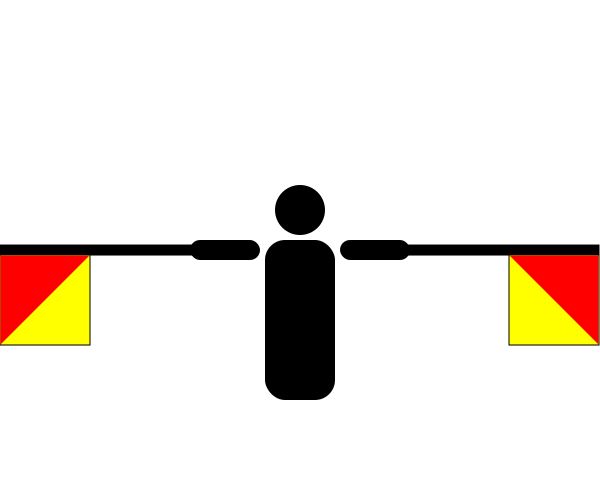
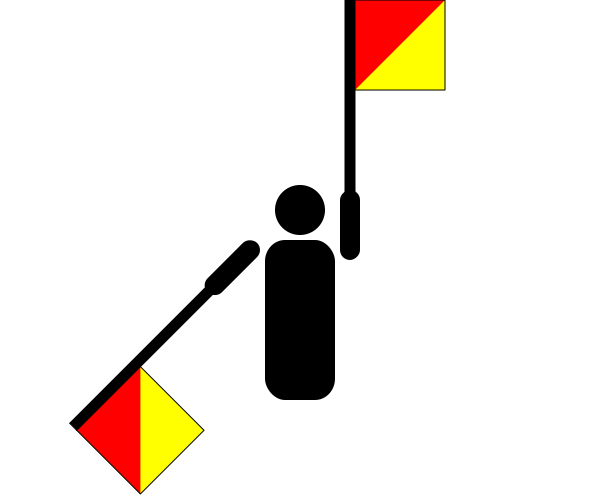


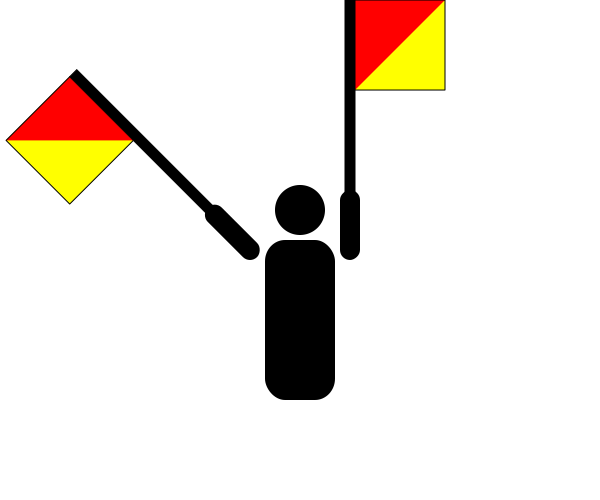
There are approximately 360 people named Parkhurst in the UK. That makes it one of Britain's least common surnames. Only around six in a million people in Britain are named Parkhurst.
Surname type: Location or geographical feature
Origin: English
Region of origin: British Isles
Country of origin: England
Religion of origin: Christian
Language of origin: English
