PAKES
Pakes is a surname of English provenance, the etymology of which is rooted in medieval personal names of English and Latin origin. The name first appears in primary records dating from the late twelfth century, suggesting a relatively early establishment within English society.
The most frequently cited derivation of the surname is from the medieval given name Pake, a diminutive of Patrick. The personal name Patrick was introduced into the English linguistic milieu through Latin, where it means “noble” or “patrician.” Accordingly, the surname Pakes can be interpreted, in a patronymic sense, as indicating “son of Pake” or more generally “descendant of Patrick.”
Alternative accounts trace Pake to the Old English personal name Pacca, which survives only as a placename element and is not recorded in the surviving corpus of southern Anglian names beyond the early Old English period. Proponents of this line of reasoning often point to the medieval name Pack and to attestations in the Assize Court Rolls of Cambridgeshire (1260), where the form Payke is found. A different hypothesis situates Pake within the Middle English or Old French lexical fields of paske or pasque, the latter denoting Easter. Under that interpretation the name would have originally functioned as a nickname for an individual born at Easter or for one who had a particular connection with that season, perhaps through a feudal obligation that fell on the Easter date.
In evidence of its historical persistence, the earliest recorded instance of the name in the form Pac is found in the Kalendar of Bury St. Edmunds (1190), a document preserved in the archives of the ancient Benedictine house of Bury St. Edmunds, Suffolk. The entry dates from the reign of King Richard I, the so‑named Lionheart, who reigned from 1189 to 1199. A further attestation appears in the Pipe Rolls of Leicestershire (1195), where a person named Roger Pake is listed. These early references establish the presence of the name in distinct legal and fiscal contexts, a pattern that was not uncommon for surnames signalling landholding or tenancy in the medieval period.
The surname continued to be documented throughout the early modern era. In London, a woman named Jane Pack was christened on 20 April 1561 at St. Mary Somerset, an event recorded in parish registers. The marriage of Elizabeth Pack to John Andrew was solemnised at St. Andrew's, Enfield, on 28 November 1592, another parish entry that demonstrates the use of the name in the realm of family life. By the mid‑seventeenth century the surname had crossed the Atlantic. William Pack, aged 27, departed from the Port of London aboard the vessel Paule bound for Virginia in July 1635, signifying the early participation of bearers of the name in the colonising endeavours of the English Crown.
As with many English surnames, spelling variants have appeared in historical documents. The five recorded forms—Pack, Packe, Paik, Pakes and Patch—reflect the fluid nature of orthographic representation in a pre‑standardised alphabet. Such variation is not uncommon; it often arises from differences in local dialect, recording authority or simply the preferences of clerks and scribes. The multiple spellings do not appear to have signalled divisions within the family, but rather that the name was documented in a variety of registers and contexts over the centuries.
In sum, the surname Pakes encompasses a heritage that blends Latin, Old English and Middle English influences. It demonstrates an early and consistent presence within legal, ecclesiastical and colonial records. The meaning attached to the name, whether via its connection with Patrick and the notion of nobility or through its tentative link to Easter, reflects the common medieval practice of deriving surnames from personal characteristics, nicknames or patronymic elements. The historical documentation that survives from the late twelfth century to the seventeenth century confirms that bearers of the name were integrated into a wide range of social spheres, from the courts of Cambridgeshire to the plantations of Virginia, bridging the realms of law, church and emerging empire.
Typical given names associated with the Pakes surname
Male
- Andrew
- Christian
- Christopher
- Daniel
- David
- Gerard
- Joel
- Matthew
- Michael
- Nicholas
- Richard
- Robert
- Stephen
Female
- Edna
- Jennifer
- Joan
- Joanne
- Kirsty
- Laura
- Louise
- Margaret
- Nicola
- Susan
Similar and related surnames
Related and similar names are generated algorithmically based on the spelling, and may not necessarily share an etymology.
How to communicate the surname Pakes in...
Braille
⠏⠁⠅⠑⠎
Morse
.--..--.-....
Semaphore


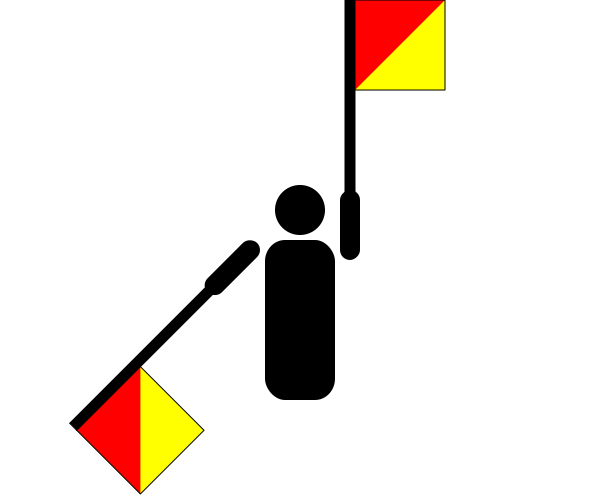


There are approximately 258 people named Pakes in the UK. That makes it one of Britain's least common surnames. Only around four in a million people in Britain are named Pakes.
