PAICE
The surname Paice is traditionally classified as of English origin, though its earliest forms are recorded in both English and French contexts. The name is a variant of a number of earlier spellings, including Peace, Pace, Pase and Payce, a form that has been documented in English legal and church records from the thirteenth century onward.
Its etymological root is the Middle English word pace, itself derived from the Anglo‑Norman French word paci, which ultimately comes from the Latin pax and its genitive pacis meaning “peace”. In medieval usage the word was employed as an occupational marker for a person who acted as a peacemaker or mediator, and it was also applied to individuals noted for a calm or harmonious disposition. Consequently, the surname Paice can be understood as signifying a person associated with peace or someone who played a part in resolving disputes.
An alternative hypothesis for the name’s origin references a medieval nickname for a mild‑mannered, even‑tempered man, again derived from the root pace. Historical records indicate that, at times, surnames revived by sarcasm could be borne by individuals who were the opposite of their nominal description, illustrating the complexity of surname evolution in the medieval period.
Another potential source of the surname involves a confusion with the personal names Pash or Pask(e), names that were used frequently in medieval England as both given names and nicknames for those born during the Easter festival or for whom the festival had some other association. It is hypothesised that such individuals may have performed a feudal obligation – for instance, providing a specific service or goods on the date of Easter – which led to the adoption of the surname in a particular locality.
Documentary evidence for the spelling Paice and its variants dates back to the early thirteenth century. The earliest recorded instance is that of John Pais in 1219, listed in the Register of the Freemen of Leicester during the reign of King Henry III (1216–1272). Subsequent entries include Roger Pays in the 1275 Hundred Rolls of Norfolk, William Pace in 1242 in the ‘Book of Fees’ for Devonshire, and Peter Pece of Yorkshire in 1302. Church records from the sixteenth century reflect the persistence of the name: the marriage of Alice Pace to Thomas Picket was recorded in 1539 at St. Michael Bassishaw, and the wedding of Alyse Paice to John Garrot was held on 16 August 1573 at St. Lawrence Pountney, London.
Collectively, these sources demonstrate that the surname Paice has been in continuous use for eight centuries, having evolved through a mix of linguistic influences and social practices. Its enduring presence in legal, financial and ecclesiastical documents attests to both the name’s early establishment and its sustained relevance within English society.
Typical given names associated with the Paice surname
Male
- Alan
- Andrew
- Christopher
- David
- Guy
- James
- John
- Malcolm
- Michael
- Robert
- Robin
- Stephen
- Terry
- William
Female
- Alison
- Barbara
- Emma
- Julie
- Karen
- Linda
- Lisa
- Lorraine
- Michelle
- Nicola
- Patricia
- Rachel
- Sarah
- Sharon
- Susan
Similar and related surnames
Related and similar names are generated algorithmically based on the spelling, and may not necessarily share an etymology.
How to communicate the surname Paice in...
Braille
⠏⠁⠊⠉⠑
Morse
.--..-..-.-..
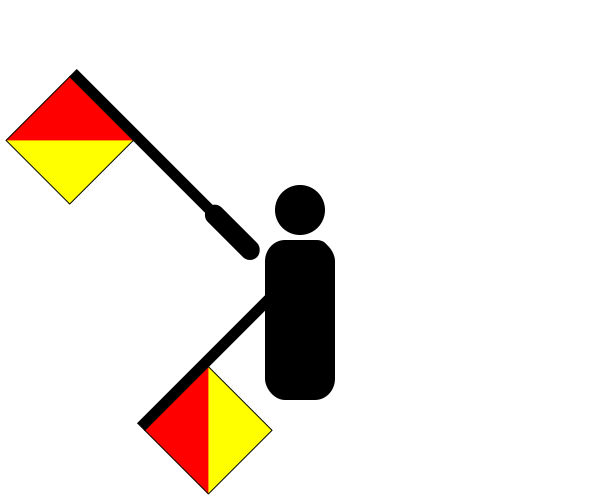
Semaphore




There are approximately 1,424 people named Paice in the UK. That makes it roughly the 5,593rd most common surname in Britain. Around 22 in a million people in Britain are named Paice.

Famous people named Paice
- Ian Paice - Rock drummer, songwriter
- Jim Paice - Politician
Names and descriptions courtesy of Wikipedia, and may contain errors. This is not intended to be an exhaustive list of every famous person with this name.