PAGAN
Pagan is a surname whose roots lie in the Latin word paganus, which originally signified a rustic or country dweller. Over centuries the term expanded in meaning to designate a person who lived outside the bounds of a Christian community, and later to describe a non‑believer or heathen.
The earliest documentation of the name appears in the Domesday Book of 1086, where a figure is recorded as Edmund filius Pagen. In the 12th century, records of the Knights Templars mention Reginoldus filius Pain (1185), confirming the use of the gentile as a personal name during that period. By 1268, the forename Payn was noted, indicating that the name had become entrenched in English onomastics.
Subsequent evolution produced a range of patronymic forms, including Paine, Pane, Payne, Pagan, Pagon and the noble‑prefix variant Fitzpayn. This diversity, which later grew to fourteen spellings, reflects the surname’s penetration into different linguistic communities.
In heraldry, the name acquires a distinct visual identity. A grant dated 12th January 1586 bestows upon the family a gold shield, over which a bend engrailed lies between two cotises sable, adorned with three golden heraldic roses. Rising above the shield, the crest consists of a demi‑ostrich, clutching a key in its beak – a motif that has become emblematic of the Pagan lineage.
While the name has Italian, Latin and Spanish origins, its geographic spread is particularly notable. In Europe, it is found across Spain, Italy, France and England. Shipping records note a Susanna Pain baptised in the parish of St. Michael's, Barbados, on 5th August 1678, pointing to early migration to the Caribbean. In the Americas, the surname is most common in the United States and Mexico, with a historical association with the American Southwest—Texas, Arizona and New Mexico—and a significant presence in Puerto Rico. The 2000 U.S. census records Pagan as the seventh most frequent last name in Puerto Rico, while a 2000 Mexican survey places it as the 77th most popular surname, with more than 535,000 individuals bearing the name.
Modern usage of Pagan generally indicates Hispanic or Latin American heritage, particularly when spelled Pagán in Spanish. Variants such as Pagano in Italian and Paganini in Italy further demonstrate the cultural adaptation of a core Latin root. The meaning of the name, however, remains anchored in the historical concept of someone dwelling outside the mainstream Christian milieu.
In sum, the surname Pagan illustrates how a term denoting rural habitation or non‑belief can transform into a family name, acquiring patronymic, heraldic, and regional variations across time and space. Its persistence into the present day offers insight into linguistic evolution, migration patterns and the enduring impact of early Christian categorisation on European onomastics.
Typical given names associated with the Pagan surname
Male
- Andrew
- David
- Ian
- James
- John
- Michael
- Robert
- Stephen
- Thomas
- William
Female
- Catherine
- Donna
- Emma
- Helen
- Jayne
- Joanne
- Karen
- Laura
- Linda
- Margaret
- Mary
- Paula
- Sarah
- Susan
- Victoria
Similar and related surnames
Related and similar names are generated algorithmically based on the spelling, and may not necessarily share an etymology.
How to communicate the surname Pagan in...
Braille
⠏⠁⠛⠁⠝
Morse
.--..---..--.
Semaphore


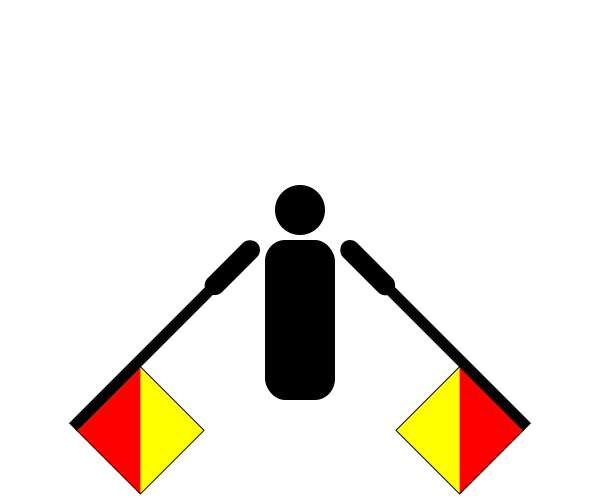
There are approximately 1,015 people named Pagan in the UK. That makes it roughly the 7,299th most common surname in Britain. Around 16 in a million people in Britain are named Pagan.
Origin: Iberian
Region of origin: Europe
Country of origin: Spain
Religion of origin: Christian
Language of origin: Spanish

Famous people named Pagan
- James Pagan - Reporter and editor for the Glasgow Herald and Antiquarian (1811 to 1870)
Names and descriptions courtesy of Wikipedia, and may contain errors. This is not intended to be an exhaustive list of every famous person with this name.