PACHECO
Pacheco is a surname that traces its roots to the Iberian Peninsula, specifically to the Spanish language and culture. The name is predominantly associated with Christian communities in Europe and has spread widely to Latin America and the Americas through migration and colonial expansion.
The primary etymology of Pacheco is Spanish in origin. It derives from the word pacho, which in Spanish denotes something that is small or little. As a toponymic surname, it originally identified individuals who came from a locality named Pacheco within the Iberian region. This place-based naming convention was common in medieval Spain, where surnames often reflected geographic origins.
Variations of the surname reflect regional spelling preferences and linguistic evolution. Common forms include Pachecos and Pachecón, each retaining the core root while adapting to local phonetics and morphology. The name has been preserved in both Portugal and across the wider Latin‑American diaspora, where it continues to be a frequent surname.
In terms of demographic distribution, Pacheco is widespread across Spanish-speaking countries. It is found throughout Spain and Portugal, where historical records document its use from medieval times onward. In the New World, the surname became established during the period of Spanish colonisation and is now common in countries such as Mexico, Chile, Peru, and Argentina. More recent migration patterns have introduced the name into the United Kingdom and the United States, where it remains part of the broader Hispanic surname landscape.
The linguistic character of Pacheco is firmly rooted in the Spanish language, and it is generally associated with Christian religious traditions of the Iberian Peninsula. The surname aligns with the broader naming practices of Christian Iberian families, many of which adopted place-based identifiers during the medieval era.
Some scholars have proposed an alternative derivation linking Pacheco to the Latin name Franciscus, which translates to “free man.” While this hypothesis connects the name to a wider Romance language tradition that includes variants such as Francisco in Spain and Francis in England, the predominant consensus among onomasticists regards the Spanish toponymic origin as the more historically substantiated explanation. The alternative perspective should therefore be regarded as an ancillary interpretation rather than the primary etymology.
Overall, the surname Pacheco exemplifies a classic Spanish toponymic surname that has persisted for centuries. Its meaning, linguistic roots, and geographic spread provide insight into the cultural and historical dynamics of surname development in the Iberian world and its former colonies.
Typical given names associated with the Pacheco surname
Male
- Anthony
- Antonio
- Carlos
- David
- Fernando
- Jose
- Juan
- Luis
- Marco
- Mark
- Michael
- Rogerio
- Stephen
Female
- Ana
- Angela
- Beatriz
- Brigitte
- Carole
- Claudia
- Laura
- Maria
- Pamela
- Paula
- Rosa
- Stephanie
- Vanessa
- Victoria
Similar and related surnames
Related and similar names are generated algorithmically based on the spelling, and may not necessarily share an etymology.
How to communicate the surname Pacheco in...
Braille
⠏⠁⠉⠓⠑⠉⠕
Morse
.--..--.-......-.-.---
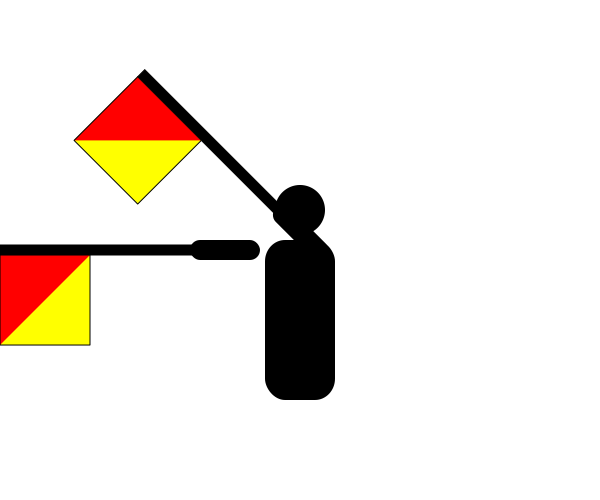
Semaphore


There are approximately 477 people named Pacheco in the UK. That makes it one of Britain's least common surnames. Only around seven in a million people in Britain are named Pacheco.
Origin: Iberian
Region of origin: Europe
Country of origin: Spain
Religion of origin: Christian
Language of origin: Spanish

Famous people named Pacheco
- Mayumi Pacheco - Football player
Names and descriptions courtesy of Wikipedia, and may contain errors. This is not intended to be an exhaustive list of every famous person with this name.