PABST
The surname Pabst is of German origin and derives from the Middle High German word pabst, a term for the pope. The word is ultimately taken from the Latin papa, the ecclesiastical title used for the priest who is the head of the Roman Catholic Church. In medieval Europe the term was initially applied to the clergy of any rank, and over time it came to denote specifically the bishops, cardinals and ultimately the bishop of Rome.
As an occupational surname it was given to individuals who worked for or were thereby associated with the papal court. It may also have served as a patronymic or nickname for a person who was considered especially pious, devout, or who displayed an austere clerical appearance. In some localities the name was also applied to those who had played the role of the pope in medieval pageants that travelled across the continent.
The surname occurs in many linguistic variations that reflect the spread of the family name throughout Europe. Among the recorded forms are Pope, Pape, and Lepope in English and French; Pabst, Babst, Baff, Paff, Pfaff, and Pfaffe in German; Papez in Czech; Papiez and Papierz in Polish; Papis in Flemish; and De Paepe in Dutch. There are also diminutives such as Pfaffel, Papen and Paffen. Early documentation of the name is found in the 13th century, for example in the 1230 rolls of the English city of Cambridge under the entry “Agnes le Pope”; in 1242 Konrad Pabst appears in the records of Leipzig; and in 1287 Wernherus Pfaffe is listed in Lorch, Hesse.
Other etymologies for the surname link it to the Middle High German papensteche, referring to a papal staff, or to the Low German babst, meaning “strong”. In the 12th and 13th centuries it therefore could have described not only ecclesiastical officials but also a knight or other noble who possessed a powerful paternalistic presence. The first medieval mention of a Pabst in a German context is associated with a knight in the dialect region of Ansbach in the year 1253.
In modern times the name remains largely concentrated in Germany and neighbouring Central European countries such as Austria, Poland and the Czech Republic. Aside from its European roots, the surname became far more widely known in the United States through the establishment of the Pabst Brewing Company in the 19th century by Jacob Best, a German immigrant. The brewery, founded in Milwaukee, Wisconsin, propagated the name throughout North America and beyond. Although the surname is uncommon in the United States relative to its European prevalence, members of the Pabst family have made significant contributions to the food and beverage industry wherever they have settled.
Across its many geographical variations and historical contexts the surname Pabst continues to signify both a connection to ecclesiastical authority and a sense of strength or leadership. Its endurance from medieval records to contemporary commerce reflects the lasting legacy of a family name that once denoted service to the papacy and which today embodies a tradition of stewardship and influence.
How to communicate the surname Pabst in...
Braille
⠏⠁⠃⠎⠞
Morse
.--..--......-
Semaphore




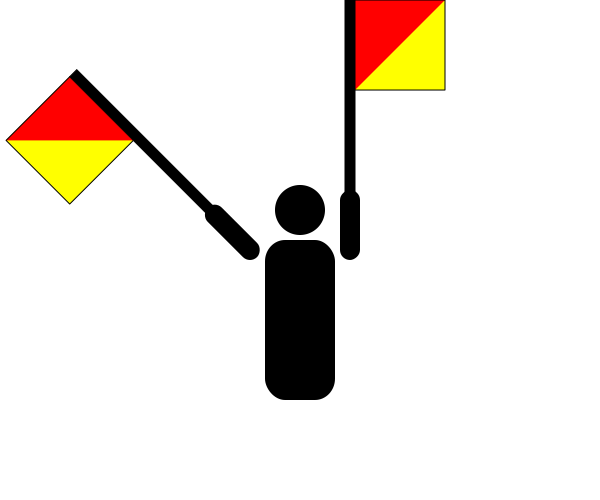
There are approximately 27 people named Pabst in the UK. That makes it one of Britain's least common surnames. Fewer than one in a million people in Britain are named Pabst.
Region of origin: Europe
Country of origin: Czech Republic
Language of origin: Czech
