OVER
Over is an English surname of Anglo‑Saxon origin, first recorded in the thirteenth century. It is a name that has been shaped by the landscape of the British Isles and, over time, by the movements of its bearers beyond the borders of England.
The name has multiple possible meanings, all linked to the Old English word ofer and the Middle English word over, which together signified a riverbank, a hill or a slope. Historically, it may have functioned as a topographic surname for someone who lived upon or near such a feature, or as a locational name for a person from one of the villages called Over. A further possibility is that it operated as a nickname for one who lived on the other side of a river or hill, with the sense of ‘across’ or ‘beyond’ being conveyed by the same Middle English word.
Recorded forms of the surname include Ofer, Over, Ower, Owers, Nower, Overall, Overend and Overland. In the Middle Ages these spellings appeared in a variety of ways, yet the core element of the name remained recognisable across the documents.
As a topographic surname it denoted residence on a riverbank, slope or ridge. The Old English pre‑seventeenth‑century term ofer had a long “o” and could mean seashore or riverbank, but also possessed an earlier distinct meaning of a slope, bank or ridge. In Middle English these two meanings merged into the single term over(e), and the surname came to indicate the person’s direct relationship with such terrain.
If it is treated as a locational surname, Over originates from any of the several English places named Over, situated in the counties of Cheshire, Derbyshire, Cambridgeshire and Gloucestershire. Moreover, a settlement called Overend near Stourbridge in Shropshire and a small hamlet called Overland in Kent, close to Sandwich, also contribute to the toponymic roots of the name. The place names themselves derive from the same geographic descriptors that characterise the topographic sense of the surname.
The earliest documented instance of the family name dates from 1275, appearing in the Worcestershire Subsidy Rolls under the spelling Thomas atte Overe. Other early references include a record in the Hundredorum Rolls of 1273 that lists inhabitants of Teesdale in Durham, and a marriage entry in St. Dunstan’s, Stepney, London, on 24 August 1574 for William Over and Jone Higgens.
In modern times, the surname remains common in England and is also found throughout the United States, Canada, Scotland, Wales, Ireland, Australia and New Zealand. While the name is predominantly of English origin, it shares linguistic and genealogical ties with Dutch and German surnames such as Overbach, which means “over the stream.” These connections illustrate the broader European dispersion of surnames derived from similar Old Germanic roots.
The historical depth of the name Over reflects a long tradition of settlement and resilience. Bearers of the name were often those who chose to inhabit, or were chosen to inhabit, places that lay above or beside rivers, hills or other features of the landscape. This act of selecting a location based on its physical characteristics is a testament to the determination and practical spirit of their ancestors, qualities that descendants of the surname may take pride in.
Typical given names associated with the Over surname
Male
- Andrew
- Anthony
- Brian
- David
- Jeremy
- John
- Michael
- Peter
- Richard
- Robert
- Stephen
Female
- Brigitte
- Eileen
- Elizabeth
- Janet
- Jean
- Karen
- Lisa
- Margaret
- Pamela
- Rebecca
- Sarah
- Susan
- Victoria
- Wendy
Similar and related surnames
Related and similar names are generated algorithmically based on the spelling, and may not necessarily share an etymology.
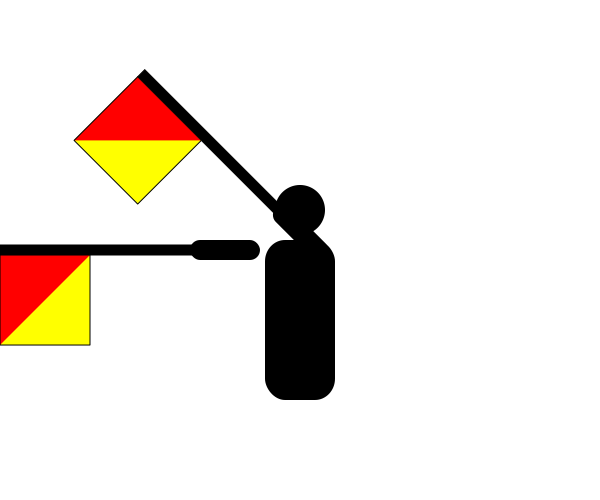
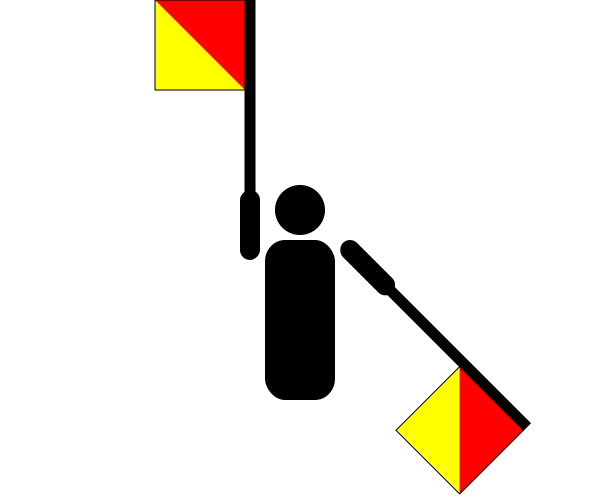
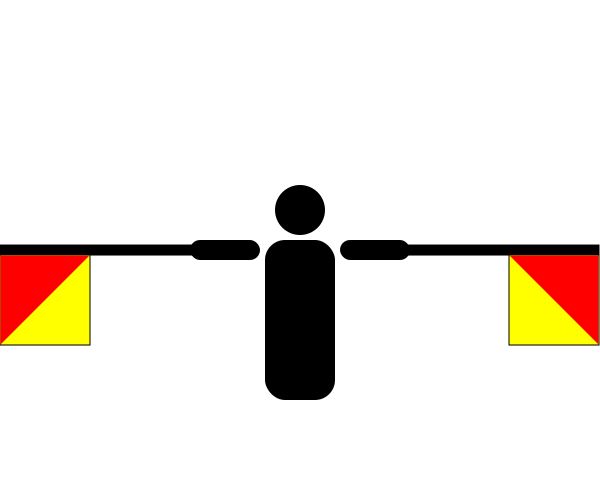
How to communicate the surname Over in...
Braille
⠕⠧⠑⠗
Morse
---...-..-.
Semaphore

There are approximately 810 people named Over in the UK. That makes it roughly the 8,684th most common surname in Britain. Around 12 in a million people in Britain are named Over.
Surname type: Occupational name
Origin: English
Region of origin: British Isles
Country of origin: England
Religion of origin: Christian
Language of origin: English
