ORMAN
Orman is a surname of English origin, traditionally classified as an occupational name. It derives from the Middle English word orman, meaning a forest or woods. The name was typically bestowed upon individuals who lived or worked in or near a forested area, thereby signifying a close association with the natural environment.
The earliest documented instance of the name appears in the Yorkshire Poll Tax Records of 1379, recorded as Ormunde. This reference, made during the reign of King Richard One (known as Richard of Bordeaux, 1378-1400), marks the first known spelling of the family name in English legal archives.
Variations of the surname include Ormond, Ormonde, and Orman. These forms are evident throughout historical documents, reflecting the common practice of orthographic alteration in medieval records. Such variants have occasionally led to confusion regarding the surname’s precise lineage.
Orman also has a distinct Gaelic-Irish provenance. In this context it may be a development of the Irish surname O' Ruaidh, where O' denotes descent and ruaidh translates to red, potentially alluding to a red-haired progenitor. The name initially appeared as O' Rooe before folk etymology re‑adapted it to resemble the East Munster region known as Ormond. This Irish line of the surname is most firmly established in the counties of Cork and Waterford.
Another English root of Orman is derived from the personal name Osmond, itself a composite of the pre‑7th century elements os, meaning God, and mund, meaning protector. Thus, some bearers of the name may be traced to an ancestor conceptually described as “protected by God” or a “protector of God.” A prominent individual of this line was Sir James Ormonde, lord‑treasurer of Ireland, who was knighted for his services during Simnel's Rising and died in 1497. His lineage includes James Butler, fifth earl of Ormond, and records of marriage such as that of Alfred Ormonde and Waverley Scott at St. Clement Danes, Westminster, in June 1845.
In Turkish, the word orman translates directly to “forest.” Consequently, the surname has been used as a topographical designation for those who lived near or worked within a forested area. It may also relate to the Turkish title “Orman,” denoting a forest or park warden. The name is comparatively common within Turkey and among populations descended from Turkish immigrants in European nations such as Germany. Within the United States, the surname is partially recognisable through public figures such as Suze Orman.
From a Jewish perspective, Orman constitutes a variant of the Yiddish surname Ohrmann, arising from the Hebrew word or meaning light. It is interpreted as “man of light,” reflecting a liturgical or symbolic identity. Jewish families often adopted non‑Jewish surnames, and this form of Orman is believed to be one such adaptation.
The surname appears in a variety of alternate spellings, reflecting regional linguistic influences and historical transcription practices. Recorded variants include Ormann, Ormon, Ormond, Ormanowski, Ohrman, and Ormanovic. Each of these retains a connection to the core etymological sense, whether tree, forest, or other nature‑related motifs, while also indicating diverse cultural and geographic origins.
Typical given names associated with the Orman surname
Male
- Ali
- Andrew
- Brian
- Christopher
- David
- James
- John
- Kevin
- Mark
- Matthew
- Michael
- Paul
- Peter
Female
- Barbara
- Carolyn
- Christine
- Geraldine
- Helen
- Jane
- Jean
- Joan
- Karen
- Louise
- Margaret
- Maria
- Mary
- Sarah
- Victoria
Similar and related surnames
Related and similar names are generated algorithmically based on the spelling, and may not necessarily share an etymology.
How to communicate the surname Orman in...
Braille
⠕⠗⠍⠁⠝
Morse
---.-.--.--.
Semaphore
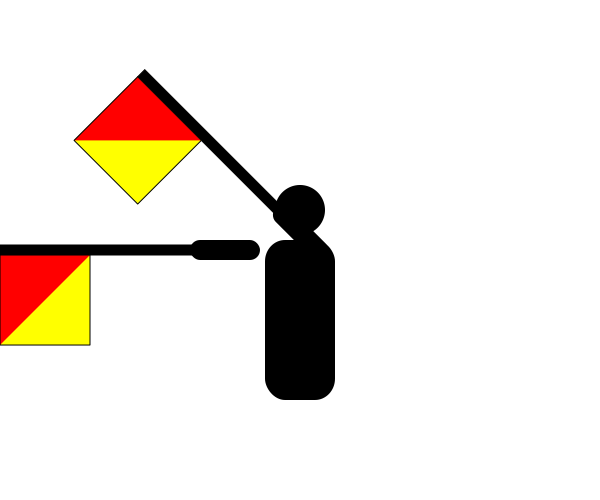
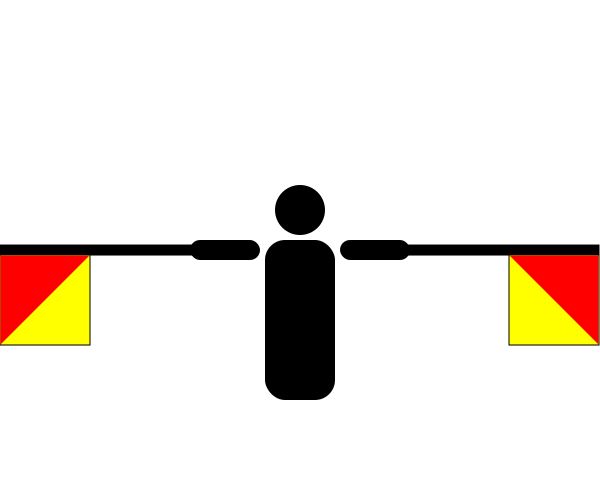
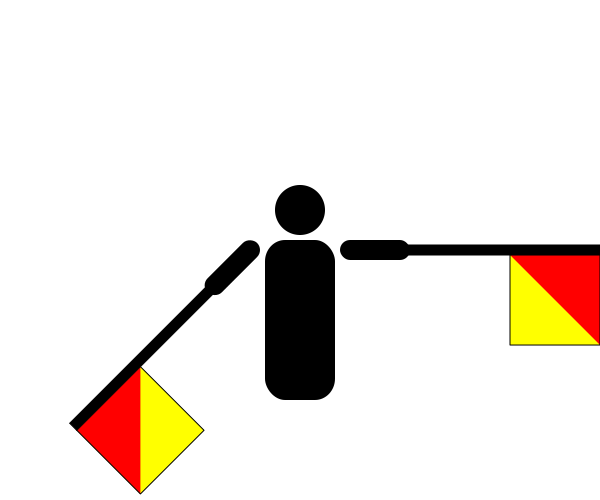

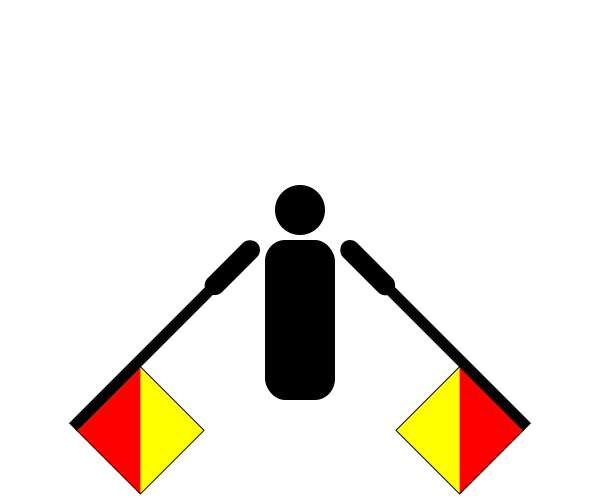
There are approximately 814 people named Orman in the UK. That makes it roughly the 8,648th most common surname in Britain. Around 12 in a million people in Britain are named Orman.
Surname type: Occupational name
Origin: English
Region of origin: British Isles
Country of origin: England
Religion of origin: Christian
Language of origin: English
