OLLIER
The surname Ollier is principally of French origin, its earliest forms being recorded in the 13th century in England and in France. The name has been examined from several viewpoints, and the evidence suggests that it is a polygenetic surname, deriving from an occupational nickname, a patronymic, and a topographical reference, all within the same linguistic milieu.
Occupational origin. Ollier is documented as arising from the Old French verb olier, meaning “to smell” or “to scent.” In medieval societies the occupation of a perfumer or a person working with fragrances and scents was important enough to earn a sobriquet. Consequently, an individual notable for a keen olfactory sense or for producing scents would have been addressed, and later crammed by onomastic tradition, as Ollier.
Patronymic origin. The same surname can also be linked to the personal name Olivier, the French form of Oliver. In the Middle Ages it was not uncommon for families to adopt the name of a fore‑father as a surname, attaching the suffix –er or slightly modifying the spelling. This practice produced a patronymic form that was effectively “son of Olivier.” The root personal name, in turn, comes from the Old Norse Áleifr or the Old German Alfihar, both meaning “elf‑army.” The adoption of the name could therefore have signalled a person regarded as a leader or endowed with a spiritual quality.
Topographical origin. Alternate spellings found in English record, such as Holliar, Hollier, Hollyar, Hollyer, Hawler, Holyard, Hollyard and others, are the product of a medieval English tendency to derive a surname from a setting. These variations are mostly associated with terms holy-yard – a place of worship – or with living or working in a holly wood. The prevalence of such variants demonstrates the influence of local dialects and the difficulty faced by clerks in standardising spelling. A note of interest is that some early records of the name are tied to London churches: Elsbeth Oliar married in 1562 at St Antholin’s; Maryan Holyard was christened at St Andrews in 1576; Isaac Ollyer celebrated marriage in 1699 at St Dunstans.
Etymological connection to olive. A further line of evidence points to the Old French word olivier, meaning “olive tree.” Historically, people who owned, cultivated or worked in olive groves, particularly in the southern and southeastern parts of France where olives were abundant, were sometimes identified by this descriptor. Though the olive was a commercial object—often used in the Mediterranean—a person associated with olive cultivation could have received the surname as a reminder of his occupation or landholdings. Modern geographical distribution shows that the Ollier name remains more common in France and in French‑speaking regions of Belgium and Canada, but it has also migrated to the United Kingdom, the United States, Australia and other English‑speaking countries.
Extant forms and modern distribution. The name is found today in a multitude of spellings – Ollier, Olliers, Olier, Ollière, Ollierre, Ollier-ops, etc. – each reflecting phonetic shifts across different linguistic regimes. Historically, the frequency of the surname in England can be traced back to the earliest surviving assize roll of Cambridge in 1260, where a person recorded as Roberte Olyvyer appears. This early record indicates that even in the thirteenth century, individuals bearing a variant of the name were adequately recorded by legal documents.
Conclusion. The Ollier surname, being of French heritage, demonstrates a remarkable convergence of occupational, patronymic and topographical origins. The multiplicity of its early spellings, coupled with documented clerical entries from medieval England, underscores the dynamic nature of surname development in a pre‑modern European context. Its continued presence throughout modern France and in overseas communities attests to the lasting legacy of naming conventions rooted in language, labour and locational identity.
Typical given names associated with the Ollier surname
Male
- Andrew
- Christopher
- David
- James
- John
- Matt
- Michael
- Paul
- Philip
- Robert
- Stephen
- Thomas
- Tony
Female
- Barbara
- Christine
- Elizabeth
- Emma
- Jane
- Margaret
- Rachel
- Rebecca
- Sarah
- Susan
Similar and related surnames
Related and similar names are generated algorithmically based on the spelling, and may not necessarily share an etymology.
How to communicate the surname Ollier in...
Braille
⠕⠇⠇⠊⠑⠗
Morse
---.-...-......-.
Semaphore
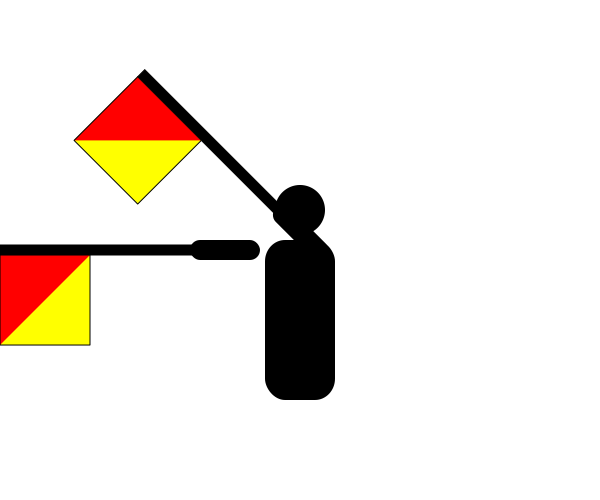

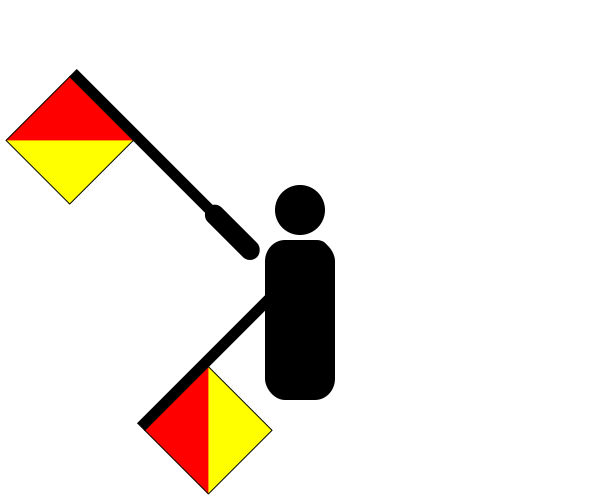

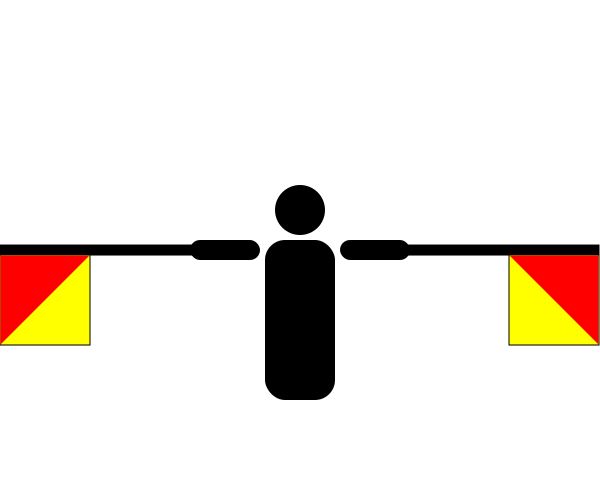
There are approximately 860 people named Ollier in the UK. That makes it roughly the 8,317th most common surname in Britain. Around 13 in a million people in Britain are named Ollier.
