OLIN
Olin is a surname of Norse and Swedish origin, which over the centuries has developed a wide array of variants in several languages, including English, Dutch, German, Polish and Irish.
The earliest derivation of the name can be traced to the Old Norse personal name Óláfr, meaning „ancestor’s descendant” or „heir of the ancestors.” In Scandinavia the surname was initially patronymic, identifying the descendant of a man named Óláfr; it later became a hereditary family name that was passed down unchanged.
From the Swedish context the surname is also linked to the island Oland and the geographical name Oeland. The suffix ‑in is indicative of belonging to or descending from, so Olin may otherwise be read as “descendant of Olof.” The same patronymic system was common in other Scandinavian countries, and the name is still common in Sweden today.
In England the name appears under a number of forms – Oland, Olland, Olin, Olanda, Olander, Ollander, Allander, and Allender – none of which are frequent. The English forms may derive either from the Dutch surname Hollander, describing a person of Dutch origin from the province of Holland, or from the place name Holland used for various villages in Lincolnshire and Surrey. In either case the name functioned to identify someone from low‑lying land; the term is etymologically related to the description of inland marshes that were drained by Dutch engineers from the fifteenth to eighteenth centuries.
Documentary evidence of these forms appears in parish records dating from the Stuart period. For example, Adam Olland was recorded at Spalding in Lincolnshire on 19 December 1613; John Olander was a child‑bearing witness at St Marks in Stoke Newington on 22 February 1664; and George Allender was christened at St Sepulchre in London on 15 April 1750.
In Poland the surname takes the form Olinick and is derived from the place name Olin in the area of Olińskie. The construction of the name follows the Polish practice of adding the suffix ‑ick to a place name, thereby signalling a person who originates from that locality.
The distribution of Olin in the twentieth and twenty‑first centuries is dominated by the United States, where the 2020 Census recorded 8,711 individuals bearing the surname. The highest concentrations were found in Texas, Illinois, Colorado, Wisconsin and California. Worldwide, the surname is claimed by roughly 35,000 people, with substantial numbers in Sweden, Norway, Denmark and Iceland, as well as in England, France, Germany, Ireland, Australia and the Netherlands.
Other recognised variants include the German and Dutch forms Ohlmann and Ohlenschläger, the English form Olien derived from the Anglo‑Saxon elements Ælf and wine, and the Irish form O’Linn (a rendering of O Luinne). These variants are generally rare, but they illustrate the breadth of the name’s historical migrations and linguistic adaptations.
In summary, the surname Olin has a well‑documented pedigree that can be traced back to Old Norse and Swedish origins, while its presence in England, Poland, the United States and other countries reflects centuries of migration, cultural exchange and linguistic variation. The name remains common in Scandinavia, uncommon in Australia but still identifiable in various European regions, reflecting both its ancient roots and its modern dispersion.
Typical given names associated with the Olin surname
Male
- Jan
- Matthew
- Paul
Female
- Anna
- Belinda
Similar and related surnames
Related and similar names are generated algorithmically based on the spelling, and may not necessarily share an etymology.
How to communicate the surname Olin in...
Braille
⠕⠇⠊⠝
Morse
---.-....-.
Semaphore
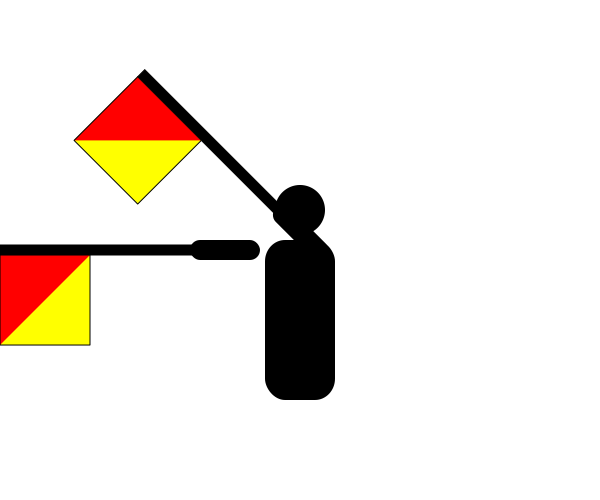

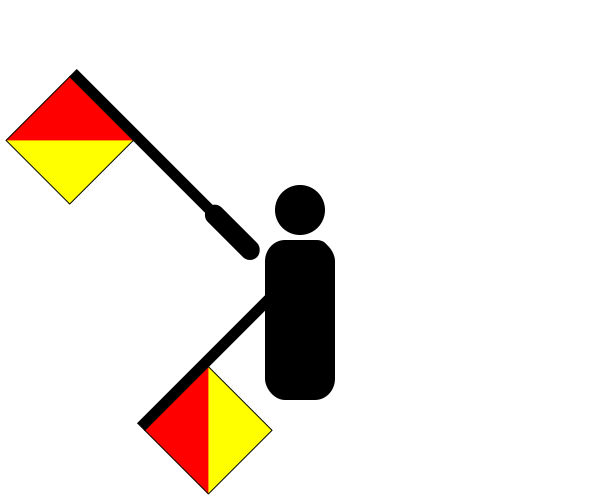
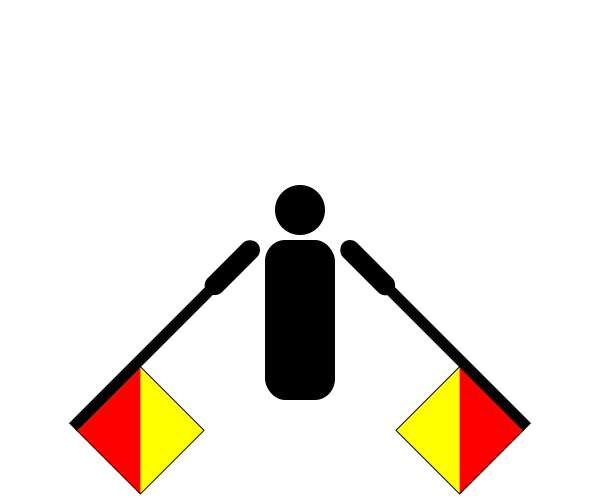
There are approximately 40 people named Olin in the UK. That makes it one of Britain's least common surnames. Only around one in a million people in Britain are named Olin.
Region of origin: Europe
Country of origin: Poland
Language of origin: Polish
