OLDER
Older is a surname of English origin, first recorded in the early fifteenth century but derived from much older roots in the English language.
The earliest known use of the name appears in the Curia Regis rolls of 1221, where a Ralph de Alre is mentioned. The form Alre is a variant of the modern surname Older and shows the long-standing connection between the name and the English language.
In Middle English the word old meant aged or elderly. When applied as a nickname it often identified an individual regarded as older or wiser, or as a distinguishing marker between two people bearing the same given name – a practice similar to the contemporary use of senior and junior. The surname therefore signifies a person’s association with age or seniority.
Anglo‑Saxon derivations add further depth to the etymology. The name may stem from one of the Old English personal names Ealdhere or Aethelhere, composed of the elements eald (old) or aethel (noble) joined with here (army). Alternative explanations posit that Older arose from a topographical description: individuals living near an alder tree or alder glade were identified by the Old English word alor for alder. Topographical surnames were among the earliest created, as natural features provided readily recognisable identifiers in the small communities of the Middle Ages.
Historical records illustrate the development of the surname. By 1327 a John atte Alre is recorded in Somerset, and by 1332 an Alexander Aldres appears in Warwickshire. These variations – Allder, Alldre, Alders – demonstrate the fluid spelling of the name during the medieval period. In 1668 a marriage between Charles Allder and Katherine Sugar at St. Katherine Cree Church in London further confirms the persistence of the surname in the early modern era.
In addition to its use as a nickname, the name Older may indicate an ecclesiastical role, signifying a person who held the position of elder within the church. This occupation was respected and carried a duty of community leadership, which could have reinforced the usage of the name as a family identifier.
Modern distributions of the surname show that it is common throughout the United Kingdom, with a particular concentration in northern England, notably Yorkshire and Durham. Internationally, Older is also found in sizeable numbers in Germany, Switzerland, the United States, Canada, Finland, Mexico and France. Variants such as Old, Olderidge, Oldridge, Olders, Oldurer, Ollder and the orthographic form Olderr reflect regional adaptations of spelling and pronunciation over time.
In the Germanic tradition, the surname has been associated with an early occupational title for a skilled ale brewer, though the precise connection remains a matter of historical interest. The name also survives in Dutch-speaking regions where it is occasionally rendered as Oudar. Additional phonetic variants appearing in German records include Eder, Edler and Ellder.
Overall, Older exemplifies the ways in which a simple descriptive term – originally meaning aged or elder – can evolve into a lasting family name, acquiring diverse geographical, professional and historical connotations while retaining its fundamental association with seniority and distinction.
Typical given names associated with the Older surname
Male
- Anthony
- Barry
- Brian
- Christopher
- David
- John
- Matthew
- Michael
- Paul
- Robert
- Stephen
Female
- Carol
- Cheryll
- Deborah
- Diane
- Jennifer
- Joanne
- Lucy
- Margaret
- Mary
- Sandra
- Sarah
- Susan
- Veronica
Similar and related surnames
Related and similar names are generated algorithmically based on the spelling, and may not necessarily share an etymology.
How to communicate the surname Older in...
Braille
⠕⠇⠙⠑⠗
Morse
---.-..-....-.
Semaphore
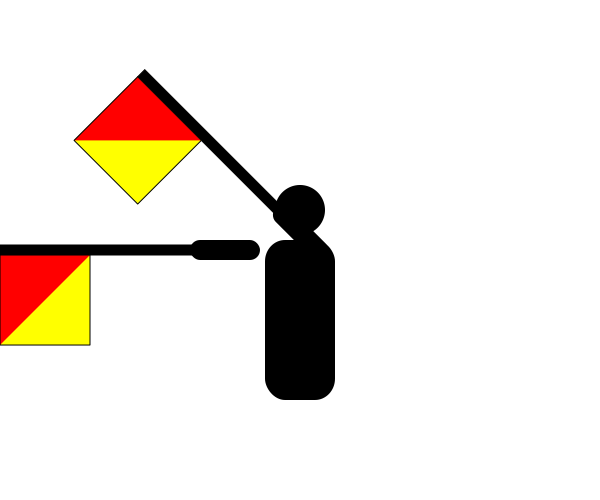


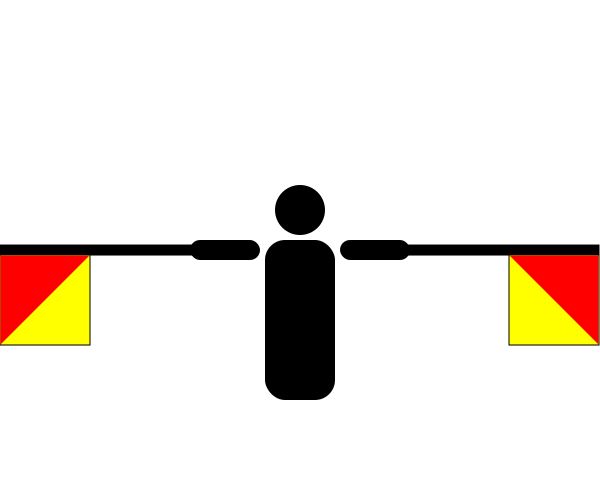
There are approximately 455 people named Older in the UK. That makes it one of Britain's least common surnames. Only around seven in a million people in Britain are named Older.
Surname type: Occupational name
Origin: English
Region of origin: British Isles
Country of origin: England
Religion of origin: Christian
Language of origin: English
