OGAN
Recorded variant spellings include O Gan
The surname Ogan is found in a range of cultural contexts, reflecting a complex history of migration, linguistic evolution and occupational association. Though it is better known in contemporary usage as a family name, its earliest attestations lie in medieval legal and ecclesiastical records spanning Scotland, England, Wales and Ireland.
The name has a strong Gaelic lineage. It derives from the Scottish Gaelic personal name Ogán which translates literally as “young warrior” or “young champion.” Ogan was originally a patronymic surname, employed to denote the descendants of a distinguished male forebear who was often described as courageous or martial in character. This semantic field is reinforced by the frequent appearance of the name in clan registers and Scottish charters where martial reputation is a key marker of lineage.
Recorded occurrences of the surname appear in 13th‑century documents. In 1292, a John Wagan is mentioned in the English placita de quo warranto, indicating a presence in the county of Cumberland. A subsequent reference in 1297 lists a John Wougan in the Ministers Accounts of the earldom of Cornwall, suggesting mobility of the family within the English realm. The name also appears in Ireland in 1317, associated with Thomas Wogan, son of Sir John Wogan, former Chief Justice, who held estates in County Kildare. These records demonstrate that the surname, whether spelled Ogan or Wogan, was established throughout the British Isles by the early 14th century.
There are numerous orthographic variants of the name. In England and on the island of Wales the surname is often encountered as Wogan, while the form Ogden and Hogan appear in English and Irish lineages. The suffix -an in Ogan may be interpreted as a patronymic marker denoting “son of,” aligning it with similar surname constructions in Slavic and Turkish onomastics, though such interpretations are not speculative. The surname is also known in Slavic and Turkish contexts in forms such as Oganov, Oganovich, Oganovsky and Oganoğlu, adaptations that often add regional suffixes for “son of” or “belonging to.”
An alternative etymology associates the name with an occupational or topographical origin in England. The Old English elements bere (‘barley’) and ham (‘village’ or ‘estate’) combine to form a meaning of “someone from the village where barley is grown” or “barley merchant.” While this derivation is documented in South East England, it likely represents a separate line of development rather than a direct descent from the Gaelic patronymic.
Modern distribution data reveal that the surname is most prevalent in the United States, with significant numbers in Russia and Nigeria as well. Within the United Kingdom the name is comparatively rare, though it persists in small clusters mostly in Scotland and the north of England. Concentrations among American states include Oklahoma, Oregon and California. The disparate geographical spread reflects historical migration patterns, including the Scottish diaspora, the movement of English families during the Tudor and Stuart periods, and later global migration waves throughout the 19th and 20th centuries.
Overall, the surname Ogan showcases a multifaceted heritage. Its Gaelic roots emphasise a martial pedigree, while its recorded medieval presence across the British Isles indicates a widespread, adaptable identity. Complementary occupational and linguistic developments have produced a variety of forms that coexist in contemporary family histories. The name remains a testament to the interweaving of language, geography and social structure that characterises the history of surnames within the British tradition.
Similar and related surnames
Related and similar names are generated algorithmically based on the spelling, and may not necessarily share an etymology.
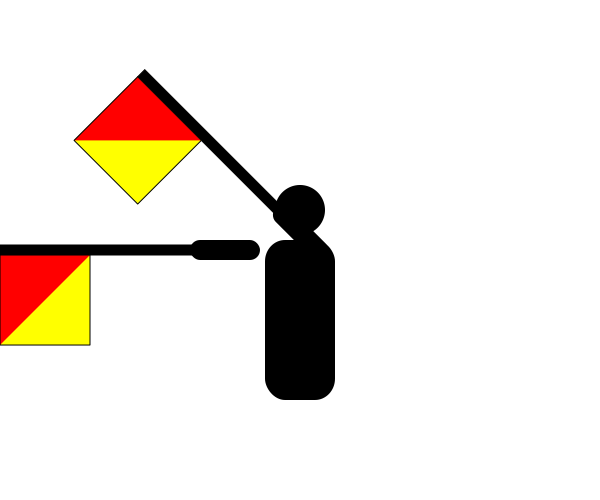
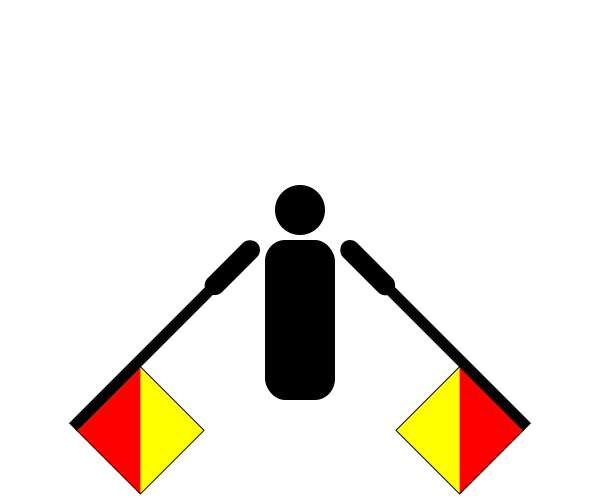
How to communicate the surname Ogan in...
Braille
⠕⠛⠁⠝
Morse
-----..--.
Semaphore


There are approximately 125 people named Ogan in the UK. That makes it one of Britain's least common surnames. Only around two in a million people in Britain are named Ogan.
