NUNAN
Nunan is a surname of Gaelic origin, principally found within Ireland and its diaspora. The name is derived from the Irish patronymic Ó Nuanáin, which denotes a descendant of the personal name Nuanán. This personal name itself is believed to be a diminutive of the Old Irish term nuadh, meaning “new” precisely a term that would have been applied to someone regarded as fresh or recently joined a clan.
Throughout the centuries the surname has been recorded in several forms, including Noonan, Neenan, O Noonan, Nunnane, Nunnaine and Nuunan. The various spellings reflect linguistic shifts and the influence of non‑Irish orthographic conventions, particularly in the British Isles and in the English colonies.
Spatially, the earliest and most consistent concentration of the Nunan name has been in County Cork in the province of Munster, as indicated by the earliest archives which list individuals as O Nuanain in the early sixteenth century. A secondary cluster is evident in County Clare, where the surname continues to appear in parish records. The name has penetrated Scotland, the United Kingdom, the United States, Canada and Australia, where significant immigration in the eighteenth and nineteenth centuries spread the surname beyond its original Irish heartlands.
In the context of medieval Irish society the Nunan clan often held the position of erenagh – hereditary custodians of church property. Historical documents describe a Nunan cleric responsible for the church of St. Berrecth in the village of Tullylease, situated in the barony of Dulhallow. The erenagh role, which included both religious and managerial duties, often conferred a measure of local influence upon the families who inherited it.
One of the earliest notable figures bearing the name was William O Noonan, recorded in 1340 as the king’s surgeon in England. He earned high honours after saving the life of the Duke of Clarence, the son of King Edward the First. More recently, James Noonan became a prominent leader within the American labour movement during the early twentieth century, underscoring the surname’s presence in transnational contexts.
In modern times the Nunan surname is most frequently encountered in Australia, where it is one of the more common surnames, ranking among the most frequent in New South Wales and Victoria. The first Australian Nunan clanmen are recorded as having settled in New South Wales during the nineteenth century, with subsequent migration eastward and southward.
The semantic components of the name suggest attributes associated with leadership and renewal. Interpretations range from “descendant of the beloved one” – a reference to the revered founder of the clan – to connections with terms like nuall (army or host) and nuadha (new). These meanings imply, at the very least, an association with resilience, bravery and the capacity to lead.
Overall, the Nunan surname embodies a rich tapestry of Gaelic heritage, regional concentration in Ireland, and global diaspora, with a historical trajectory that reflects both the cultural continuity of Irish clans and the wider patterns of migration that have carried the name to new lands.
Typical given names associated with the Nunan surname
Male
- Christopher
- Daniel
- David
- James
- John
- Kevin
- Mark
- Michael
- Paul
- Robert
- Thomas
Female
- Alison
- Anne
- Carol
- Christine
- Claire
- Elizabeth
- Helen
- Jacqueline
- Michelle
- Sarah
Similar and related surnames
Related and similar names are generated algorithmically based on the spelling, and may not necessarily share an etymology.
How to communicate the surname Nunan in...
Braille
⠝⠥⠝⠁⠝
Morse
-...--..--.
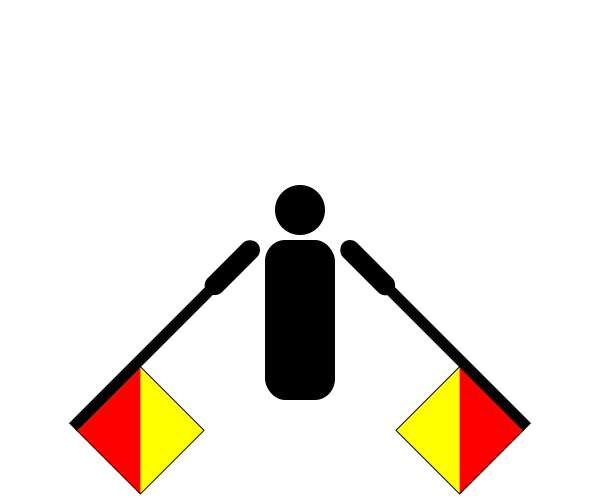
Semaphore


There are approximately 275 people named Nunan in the UK. That makes it one of Britain's least common surnames. Only around four in a million people in Britain are named Nunan.
