NORVELL
The surname Norvell has a multifaceted heritage rooted in the British Isles. It appears most frequently among families that historically settled within England and Scotland, and it is identified as a Christian, English-language surname.
One principal derivation is from the Old Norse personal name Thorfinnr, which translates to “Thor’s friend” or “Thor’s servant”. This etymology suggests that bearers of the name were either descended from or closely associated with a person named Thorfinnr, thereby implying a character of loyalty and strength.
In addition, some lines of the name can be traced to Norman French origins. After the Conquest of 1066, the surname was introduced into Britain as a contracted form of the locational name Normanville, derived from either of the two places so called in Normandy. The earliest documented form is Emma de Normanuill (1195) in the Sussex Pipe Rolls. Recorded individuals such as John Norvaile and George Norvil appeared in Stirling in 1471, and William Norvell served as the thesaurar of the burght of Stirling in 1561.
Another possibility derives from an Anglo-Saxon explanation. Here Norvell is regarded as a variant of the locational name Norwell from Nottinghamshire. The place-name means “the north stream or spring”, from the Old English pre-7th-century elements north ‘north’ and well(a) ‘well, spring, stream’. Early evidence includes the name Henry de Northewelle in the Sussex Subsidy Rolls of 1296. Church registers provide further data, such as the christening of Joane, daughter of George Norvell, in Plymtree, Devonshire, on 10 January 1664.
In the Scottish context, Norvell is often treated as a habitational surname derived from the Old Norse element nordfjall, meaning “north of the mountain”. This form is linked to various Scottish places, including Norwell in Nottinghamshire and Northwell in Northamptonshire, indicating families who lived near these northern springs or hills. The earliest recorded spelling, Robert Norvyle, dates to a 1373 charter witness in Fife, during the reign of King Robert XI (1371‑1390).
The family granted a coat of arms in Scotland depicts three black martlets on a silver bend on a black shield. This heraldic description is used in contemporary genealogical references and historical portraits of the clan.
In modern times, the surname Norvell remains relatively uncommon in the United Kingdom. In the United States it is more frequently encountered, ranking 25,447th in commonness according to the 2018 census. Its prevalence is greatest in the eastern and southern states, notably Pennsylvania, Virginia, North Carolina, Mississippi and Alabama. Historical records suggest that several individuals bearing the name were on the Mayflower, indicating that the family has been established in America since colonial times. Prominent bearers in recent centuries include actress and stuntwoman Robin Norvell, and associations with figures such as Nelson Rockefeller’s wife Margaretta Large Fitler Murphy “Happy” Rockefeller and various professional athletes.
The spelling of the name has varied considerably over centuries. Recognised variants include Norval, Norvall, Norvil, Norville, Orvell, Orvill, Orvil, Orvel, Norvile, Norvelli, Norvelles, and occasionally Norvell s or Norvells. These alternations arose from clerical transcription, regional dialectal influence, and the linguistic evolution of the English and Norse languages.
Typical given names associated with the Norvell surname
Male
- Andrew
- Andy
- Dan
- George
- Walker
Female
- Beth
- Christine
- Elspeth
- Lorrane
- Wendy
Similar and related surnames
Related and similar names are generated algorithmically based on the spelling, and may not necessarily share an etymology.
How to communicate the surname Norvell in...
Braille
⠝⠕⠗⠧⠑⠇⠇
Morse
-.---.-....-..-...-..
Semaphore
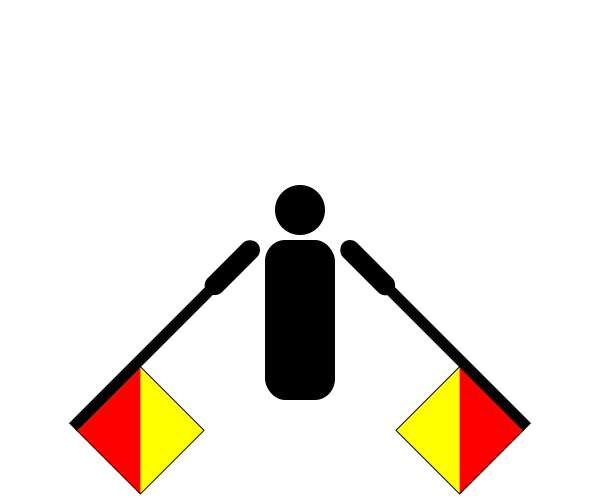
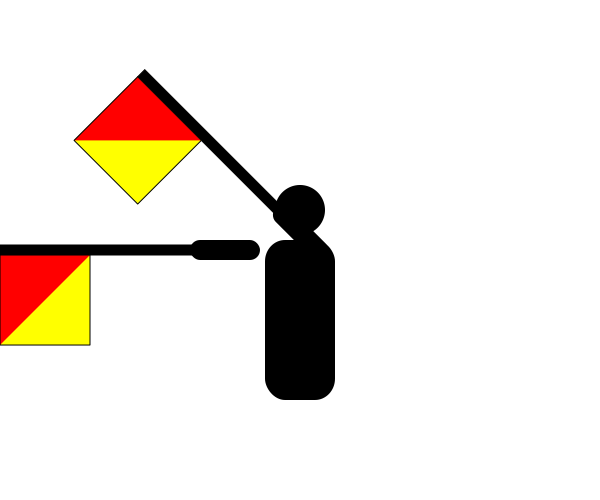
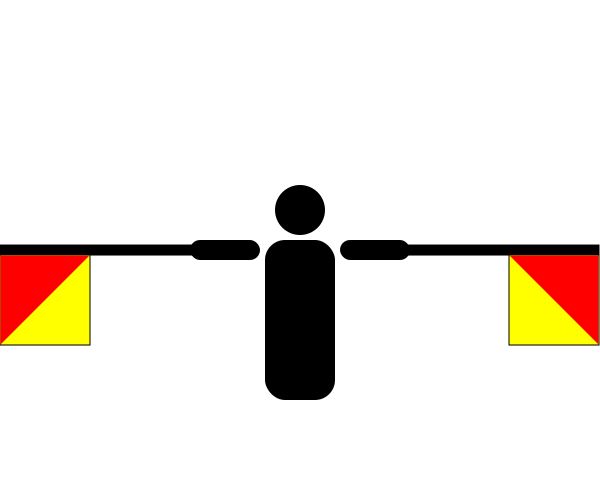
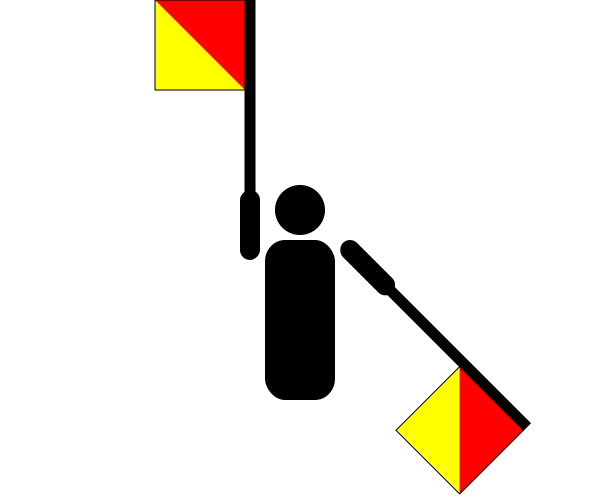


There are approximately 88 people named Norvell in the UK. That makes it one of Britain's least common surnames. Only around one in a million people in Britain are named Norvell.
Origin: English
Region of origin: British Isles
Country of origin: England
Religion of origin: Christian
Language of origin: English