NOLDER
Nolder is a surname that is found in both England and Germany, each with its own distinct etymological background. In England, the name is thought to have originated in the Anglo‑Saxon period as a topographical reference to a dwelling near alder trees, derived from the Middle English phrase atten aldre and earlier Old English elements such as aet thaem alre. The earliest surviving records of the name appear in the late thirteenth century, for example William atte Nalre in the Assize Court Rolls of Somerset, dated 1277 during the reign of King Edward the First. Later developments of the medieval preposition atten led to variations such as att naldhres and eventually Nalder, with the prefix atte dropping out over time. By the sixteenth and seventeenth centuries, spellings such as Naldhres, Alre and eventually Nolder were recorded in parish registers in counties such as Essex, Somerset and London. One of the earliest matrimonial and christening documents showing the name in England is the marriage of Elnor Nalder and Thomas Smith in Kintbury, Berkshire, on 5 February 1559, and a christening of John, son of Francis and Ann Nolder, at St. Giles’ Cripplegate, London, on 13 February 1664.
The English bearers of the name were often identified with local civil service or provincial governance, a use that echoes the meaning of the Old English word naldor, meaning ruler or chief. Over time, variations in spelling emerged, including Alder, Alders, Older, Allder and the more recent Nolda, each reflecting the shifting orthographic practices of the periods in which they were recorded.
In Germany, the surname Nolder derives from the Middle High German word nuolderen or olden, meaning ancestors or forefathers. It is a patronymic form that traditionally denoted descent from a particular ancestor or the chief of a family line. The name is associated with settlement areas in the Upper Rhine Valley, Bavaria, North Rhine–Westphalia and Zweibrücken, and is frequently found in Austria and Switzerland, especially within the Vienna region, Burgenland, Styria, Zurich, Aargau, Basel‑Landschaft, St. Gallen and Thurgau. In German, related forms such as Noulden, Nolden, Nolte, Nolt and Nolten illustrate the phonetic evolution of the name during immigration and Anglicisation processes.
In the United States, individuals bearing the surname Nolder are estimated to have settled primarily in the Northeast and Midwest. Pennsylvania, in particular, shows a concentration of the name in its Dutch areas of Berks, Lancaster and York counties, as well as in New Jersey and Maryland. The surname appears in recorded immigration documents for families arriving from Germany and surrounding regions during the eighteenth and nineteenth centuries. Modern spelling variants that appear in American records, such as Nölder, Noelder, Noeller, Noellner and Nothaler, show the continued influence of German orthography.
Coat‑of‑arms records for the English branch of the family indicate a silver shield featuring four gold lozenges on a saltire engrailed azure, surrounded by four griffins’ heads erased per pale in red and green. The crest consists of a griffin’s head erased. This heraldic image was granted to the family line in 1787 and remains a notable representation of the name’s historical presence in England.
Notable contemporary bearers of the surname include Brandon Nolder of Pennsylvania, who is recognized for his work as a painter. While the profession of artist diverges from the traditional trades historically associated with the name, it exemplifies the modern wide range of occupations held by those who carry the surname.
Similar and related surnames
Related and similar names are generated algorithmically based on the spelling, and may not necessarily share an etymology.
How to communicate the surname Nolder in...
Braille
⠝⠕⠇⠙⠑⠗
Morse
-.---.-..-....-.
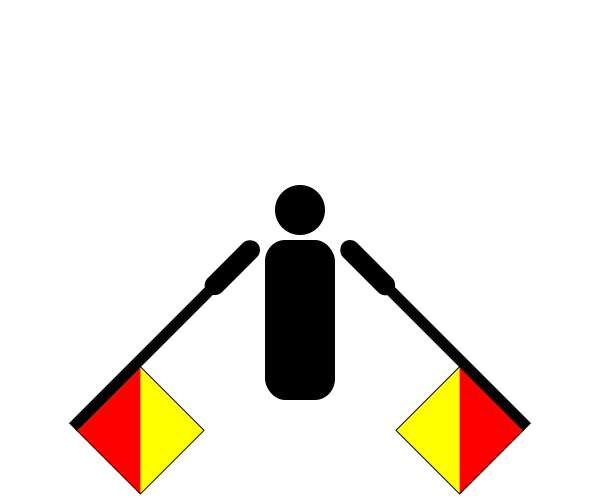
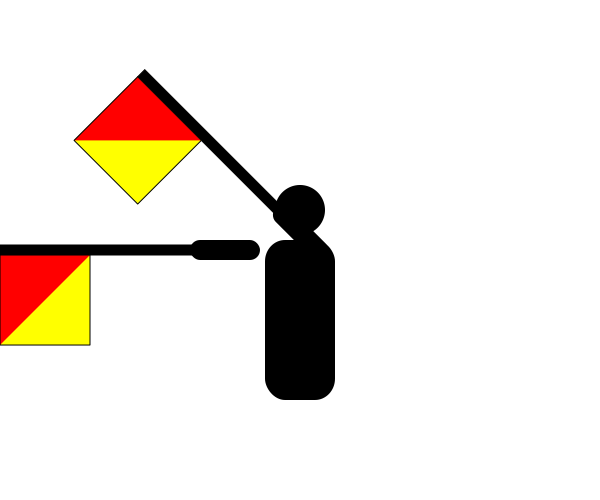
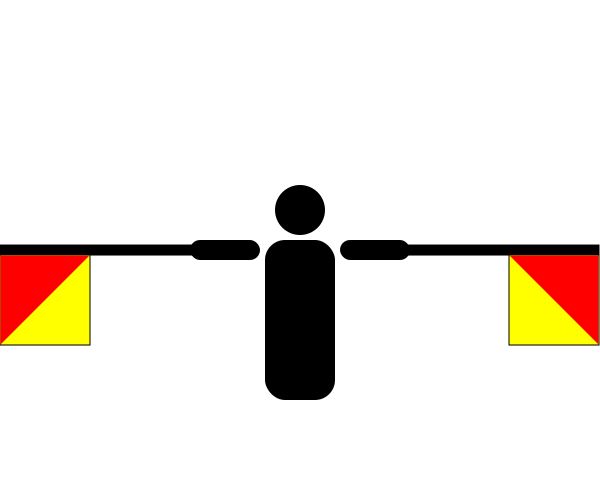
Semaphore


Sorry, we don't have any statistics on this name. That's probably because it's very uncommon in Britain.
