NOBLET
Noblet is a surname of French origin, first recorded in the eleventh and twelfth centuries within the Anglo‑Norman sphere. The name is derived from the Old French word noble, itself coming from the Latin nobilis, meaning “noble” or “high‑born.” It was originally employed to describe a person who possessed noble descent or held noble qualities such as honour, dignity and integrity.
The earliest extant record of the name is found in the Pipe Rolls of Berkshire dated 1187, where an individual named Ordric Noblet is mentioned during the reign of King Henry XI. In England the surname appears in the Curia Regis Rolls of 1206, the Subsidy Rolls of 1327, and in matrimonial and baptismal entries in Lancashire such as the 1540 marriage of Robert Noblet to Joan Bolton in Kirkham and the 1545 christening of George, son of Richard Noblet, also in Kirkham.
Two principal derivations have been proposed for the surname. The first is a diminutive of Noble, used both as a nickname for a person of distinguished birth or character and, rather sarcastically, for someone of very modest station. The second suggests a double diminutive form of the medieval male given name Nobb – a pet form of Robert – resulting in the construction Nobb‑el‑ot. Robert, from the Germanic elements hrod (renown) and berht (bright), was introduced to England by the Normans and became widespread across all social strata.
In France the surname is most common in the northern departments of Nord‑Pas‑de‑Calais and Picardy, while in the United Kingdom it is primarily concentrated in Lancashire. From the eighteenth century onward, members of the Noblet family emigrated to North America, where the name can now be encountered in the United States and Canada. The distribution of the surname across these regions attests to its long history and adaptability.
Variants of the surname that have appeared in historical records and modern documents include Noblet, Noblett, Noblette, Noble, Noblettes, Nobler, Nobely, Noelettes, Nolet, and Nault. In France, the spelling Noblette was popular through the mid‑sixteenth century, and the name also appears in early English records under forms such as Hugo Nobleat, Osbert Nobalatus, and Willelmus le Noblet.
Although the name originally signified aristocratic status, many families bearing the surname lost feudal privileges during the French Revolution. Today, bearers of the name are more likely to identify simply with a French heritage rather than with a noble lineage. Nevertheless, the etymological roots of the surname continue to evoke the historical associations with nobility and honour that have shaped its legacy through the centuries.
Typical given names associated with the Noblet surname
Male
- Andrew
- Charles
- David
- Ian
- James
- John
- Mark
- Michael
- Paul
- Thomas
- Tom
Female
- Angela
- Anne
- Caroline
- Elisabeth
- Elizabeth
- Janet
- Joanne
- Julie
- Margaret
- Mary
- Rebecca
- Sarah
- Susan
Similar and related surnames
Related and similar names are generated algorithmically based on the spelling, and may not necessarily share an etymology.
How to communicate the surname Noblet in...
Braille
⠝⠕⠃⠇⠑⠞
Morse
-.----....-...-
Semaphore
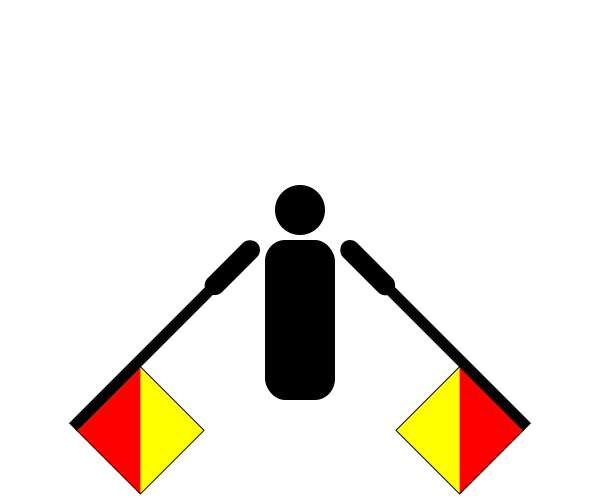
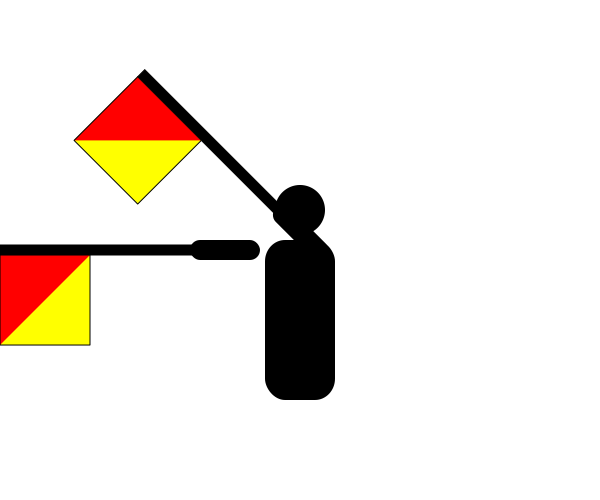
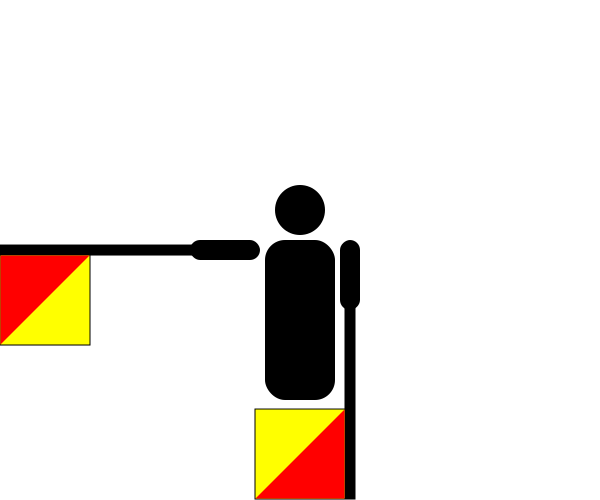


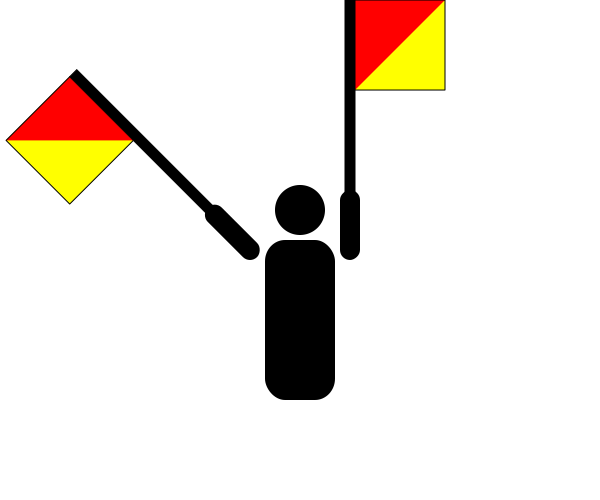
There are approximately 326 people named Noblet in the UK. That makes it one of Britain's least common surnames. Only around five in a million people in Britain are named Noblet.
Origin: English
Region of origin: British Isles
Country of origin: England
Religion of origin: Christian
Language of origin: English