NIGHTINGALE
The surname Nightingale is of English origin and falls within the category of a nickname surname, often derived from a characteristic or comparison with a natural element. Its etymology traces back to the Old English word nihtegale, meaning “nightingale”, a small bird noted for its melodious song. In medieval England it was customary to attribute a nickname to an individual whose singing voice was particularly pleasing or whose disposition was cheerful and lively, and Nightingale likely arose as a descriptive name for someone exhibited such qualities.
The earliest documented instance of the name appears in the so‑called Pipe Rolls of Gloucestershire in 1176, when a Walter Nichtegale is recorded. Subsequent medieval entries show a gradual evolution of spelling: Richard Nihtingale in Bedfordshire (1227), Alan Nightegale in Cambridgeshire (1260) and Henry Nitingale in London (1287). Over the following centuries the surname settled into its modern forms, most commonly Nightingale, though variants such as Nightingall and Nightingirl can still be found in historical records.
Within 19th‑century Britain the name gained extraordinary renown through Florence Nightingale (1820–1910). Known as the Lady of the Lamp for her wartime nursing efforts during the Crimean War, she dramatically elevated the status of the nursing profession. In 1860 she founded a training school for nurses in London, thereby institutionalising nursing education and creating a professional framework that endured to the present day.
A notable family bearing the name from Cambridge was granted a heraldic arms, which is divided per pale with ermine and red, containing a rose counterchanged, and a crest featuring a silver ibex seated and tufted, armed and maned in gold. This coat of arms reflects the longstanding presence of the Nightingale name within English gentry and serves as a visual representation of its historical prestige.
In summary, the Nightingale surname exemplifies the tradition of nickname surnames rooted in natural symbolism. Its derivation from a revered bird, the documented medieval evolution, the profound cultural impact of Florence Nightingale, and its heraldic recognition collectively underscore the surname’s enduring significance within English history and society.
Typical given names associated with the Nightingale surname
Male
- Andrew
- David
- James
- John
- Mark
- Michael
- Paul
- Peter
- Richard
- Robert
Female
- Claire
- Elizabeth
- Emma
- Helen
- Jane
- Julie
- Lisa
- Margaret
- Patricia
- Sarah
- Susan
Similar and related surnames
Related and similar names are generated algorithmically based on the spelling, and may not necessarily share an etymology.
How to communicate the surname Nightingale in...
Braille
⠝⠊⠛⠓⠞⠊⠝⠛⠁⠇⠑
Morse
-...--.....-..-.--..-.-...
Semaphore
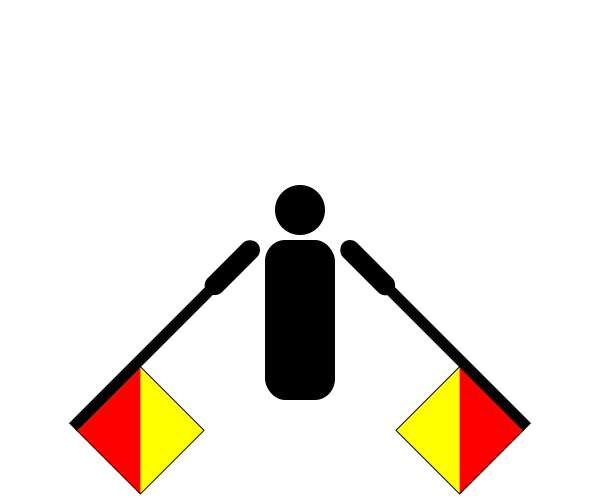
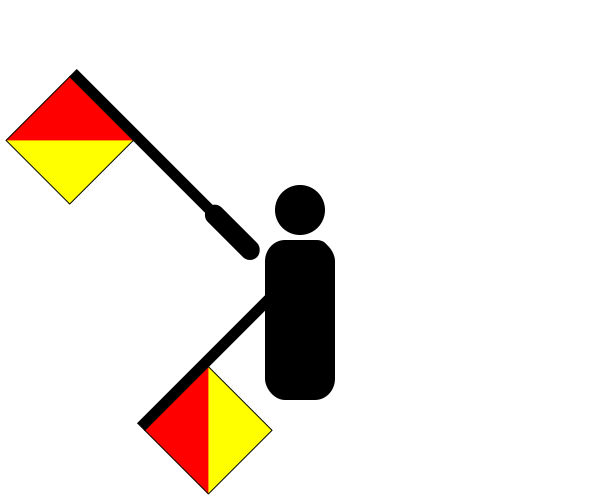


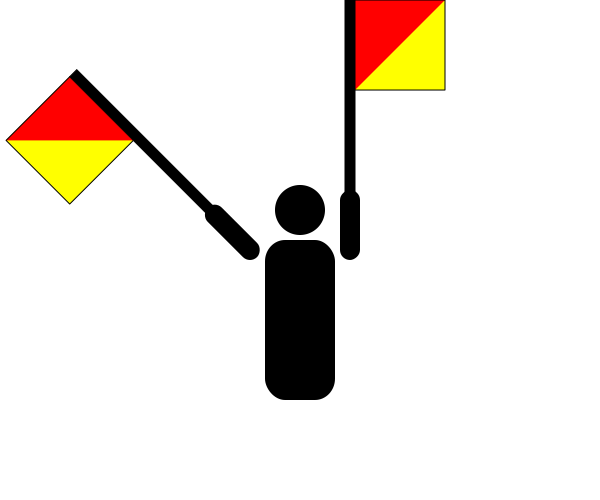


There are approximately 9,002 people named Nightingale in the UK. That makes it roughly the 1,051st most common surname in Britain. Around 138 in a million people in Britain are named Nightingale.
Surname type: Nickname
Origin: English
Region of origin: British Isles
Country of origin: England
Religion of origin: Christian
Language of origin: English

Famous people named Nightingale
- Florence Nightingale - Social reformer, statistician, and founder of modern nursing (1820 to 1910)
- Maxine Nightingale - Singer
- Mary Nightingale - Newsreader and television presenter
- Annie Nightingale - DJ
- Wally Nightingale - Musician (1956 to 1996)
- Michael Nightingale - Actor (1922 to 1999)
- William Nightingale - Unitarian (1794 to 1874)
- John Nightingale - Actor (1942 to 1980)
- Will Nightingale - Football player
- Benedict Nightingale - Journalist, critic
- Albert Nightingale - Football player (1923 to 2006)
- Mark Nightingale - Musician
- Luke Nightingale - Football player
- James Nightingale - Cricketer (1840 to 1917)
- Barney Nightingale - Rugby union player
Names and descriptions courtesy of Wikipedia, and may contain errors. This is not intended to be an exhaustive list of every famous person with this name.