NEWBORN
Newborn is a surname of English origin, frequently found in contemporary records across the United Kingdom, the United States, Canada, and other countries. Its earliest attestations derive from medieval English and Old English sources.
In the Middle English period the name is recorded as Newborn, Newbourn, Newbourne, Newburn and Newburne. The elements come from the word newe meaning “new” and the suffix borne meaning “born” or “stream”. The original sense was descriptive, applied to a person who was newly born or whose appearance was that of a young child. It may also have been used as a nickname for a youthful individual or as an occupational marker for someone who produced or sold new goods.
The name is also locational. It is almost certainly derived from a place called Newbourn in either Suffolk or Cheshire. The place name itself is older, coming from the pre‑7th‑century Old English phrase Neowe-burna, meaning “new stream”. The Domesday Book of 1086 records the Suffolk village as Neubrunna, indicating that the settlement was already established by the 11th century. Rivers in the medieval landscape were prone to changing course, and the village’s association with a river that had moved may have prompted some early bearers of the name to relocate, many of whom settled in London. The locational usage was typical of the period, with individuals identified as “from” a particular place after leaving their home village.
Church registers in London contain early examples of the surname from the Stuart period. For instance, John Newborne married Jone Fisher at St Dunstans in Stepney on 25 July 1616, and William Newburn was christened at St Mary’s in Rotherhithe, Kent, on 24 April 1812. These records illustrate how the surname was used by both families and single individuals across the city.
A parallel tradition of the surname exists among Ashkenazic Jewish communities, where Newborn functions as an Anglicised form of several Germanic and Yiddish names such as Neubauer, Newboer, and Neuberger. These names share the meaning “new dweller” or “new inhabitant”. Variations that appear in colonial American records include Newbower, Newboer, and Neuberger. Jewish families who migrated from Eastern Europe and Russia have recorded the name in forms such as Nowobilski, Nowobilszczyk, and Novobilsky. Despite these linguistic differences, the surnames can be traced back to the same original English form when brought into English-speaking contexts.
In terms of contemporary distribution, the surname is widespread. In the United Kingdom it is most common in the South East of England and London. The 2001 UK census recorded a particularly high frequency in Somerset and Staffordshire counties. In the United States the surname has its greatest representation in the southern states, with Georgia reporting the highest median frequency according to the 2000 Census, followed by Louisiana, Mississippi, Alabama, Illinois, Tennessee, California, and Ohio. In Canada the name is most frequently found in Ontario, according to the 2016 census, with notable numbers also in British Columbia, Nova Scotia and Alberta. Internationally, the name can also be found in Germany, Australia, the Netherlands and Israel, reflecting patterns of migration and immigration.
The variation in spelling has been considerable over time, reflecting the lack of standardised orthography in earlier centuries and the influence of local dialects and linguistic backgrounds. Recorded variants include Newbourn, Newbourne, Newburn, Newburne, Newbenn, Newbear, Newberry, and Newbury. Modern spellings have stabilised, but the surname remains vivid in its historical and geographical contexts, continuing to increase in prevalence in many countries due to ongoing migration.
Typical given names associated with the Newborn surname
Male
Female
Similar and related surnames
Related and similar names are generated algorithmically based on the spelling, and may not necessarily share an etymology.
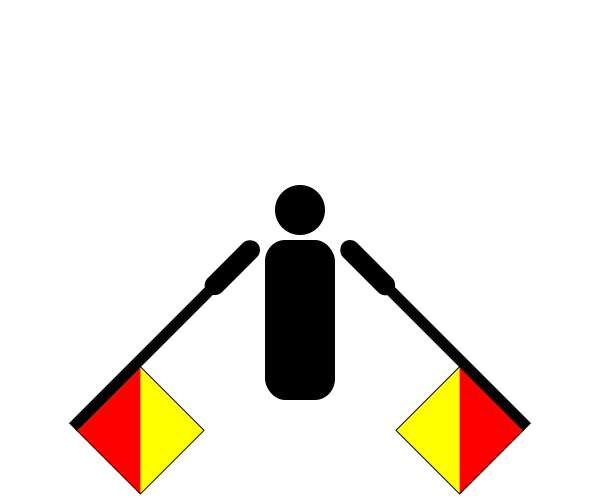
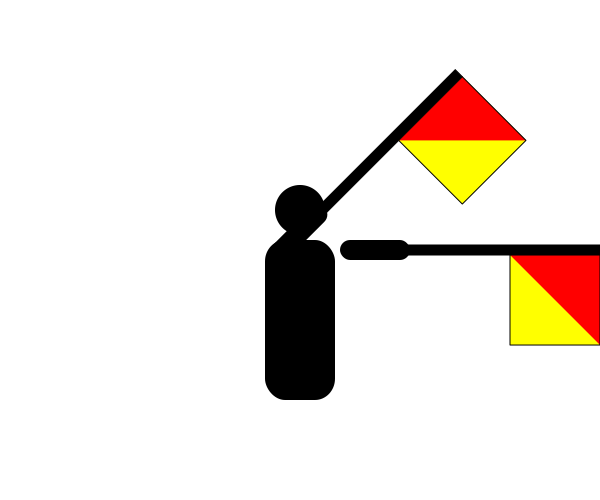
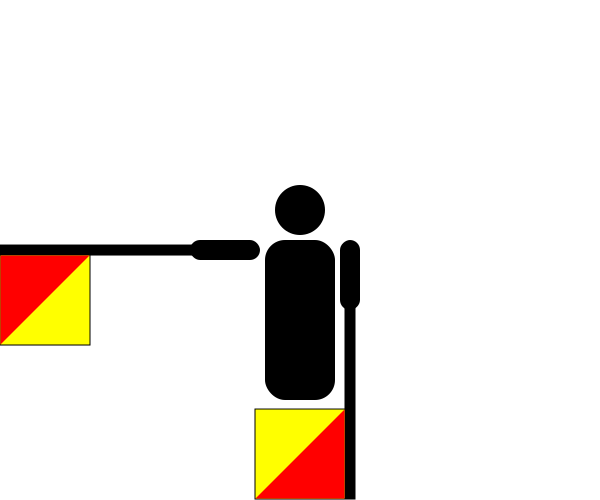
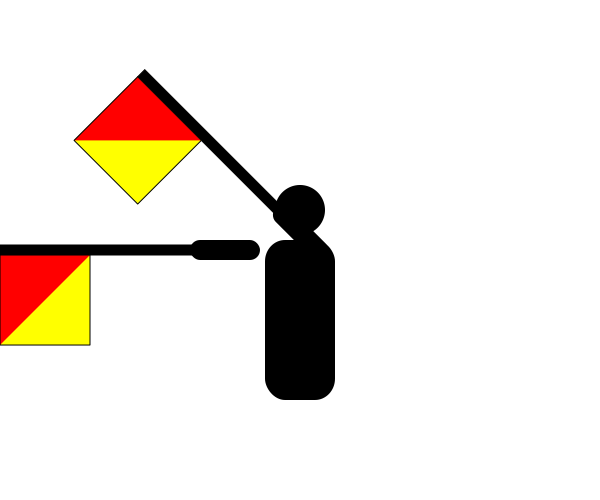
How to communicate the surname Newborn in...
Braille
⠝⠑⠺⠃⠕⠗⠝
Morse
-...---...---.-.-.
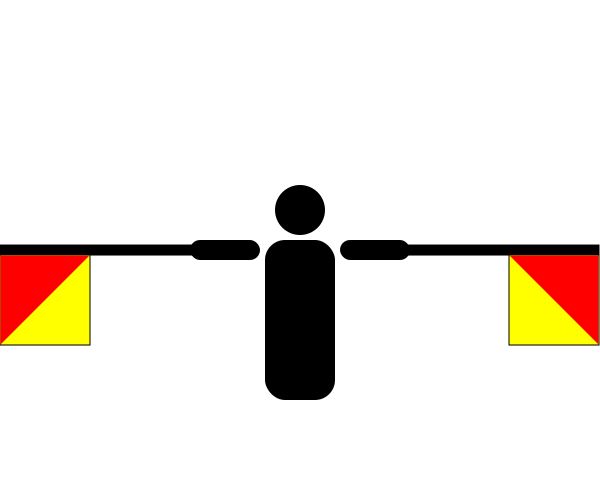
Semaphore

There are approximately 101 people named Newborn in the UK. That makes it one of Britain's least common surnames. Only around two in a million people in Britain are named Newborn.