NEW
New is a surname of English origin, first documented in the thirteenth century. Its earliest recorded spelling is William le Neuwe, found in the Assize Court Rolls of Warwickshire in 1221 during the reign of King Henry XIV, and it frequently appears as New or Newe in contemporary records.
The name derives from the Middle English word newe, meaning “new.” It was commonly adopted as a nickname for a person who was new to a settlement, an immigrant, or a stranger in a community. In a religious context it could also denote a novice in a monastery or a person who recently undertook a sacred occupation.
Another significant origin is topographic. The surname may refer to a dwelling beside a prominent yew tree. In the Middle Ages, yew trees were associated with sacred spaces, often standing in churchyard grounds. The plant also supplied the wood for the English Long Bow, a key weapon of the era. The derivation of the name from the Old English and Germanic word neowe and the later Middle English "ew" both denote the yew. Examples of early users include John atte Newe, recorded in the Subsidy Rolls of Somerset in 1327, whose name results from a fusion of the medieval phrase “atten ew.”
In addition, New has been recorded in a number of other spellings across Europe: Newe, Neu, Ney, Neye, Nige (German), Neu (Jewish), and Nyhlen (Swedish). Patronymic forms such as Newson and Newing appear in English documents. Variants in other languages—such as Dutch Nieuwenshuis and German Neu—indicate the widespread use of the root word “new” in surname construction.
The surname is prevalent in the British Isles, particularly within England, and it continues to be a common last name in the United Kingdom, Canada, the United States, Australia, and Ireland. According to contemporary data, it ranks within the top three hundred most common surnames in the United States, with a notable concentration in New England. In the United Kingdom and Australia its distribution varies, sometimes exhibiting densities below the national average and other times exceeding it.
While the core meaning of New relates to recency or novelty, its historical contexts—whether denoting a newcomer, a yew‑adjacent residence, or a novice religious figure—demonstrate the name’s adaptability across centuries and cultures. Despite the many orthographic variants that have emerged, the surname remains a distinctive marker of English heritage and continues to be borne by individuals worldwide in its many forms.
Typical given names associated with the New surname
Male
- Christopher
- David
- James
- John
- Michael
- Paul
- Peter
- Richard
- Robert
- Stephen
Female
- Carol
- Elizabeth
- Emma
- Jennifer
- Julie
- Linda
- Margaret
- Patricia
- Paula
- Samantha
- Sarah
- Susan
- Victoria
Similar and related surnames
Related and similar names are generated algorithmically based on the spelling, and may not necessarily share an etymology.
How to communicate the surname New in...
Braille
⠝⠑⠺
Morse
-...--
Semaphore
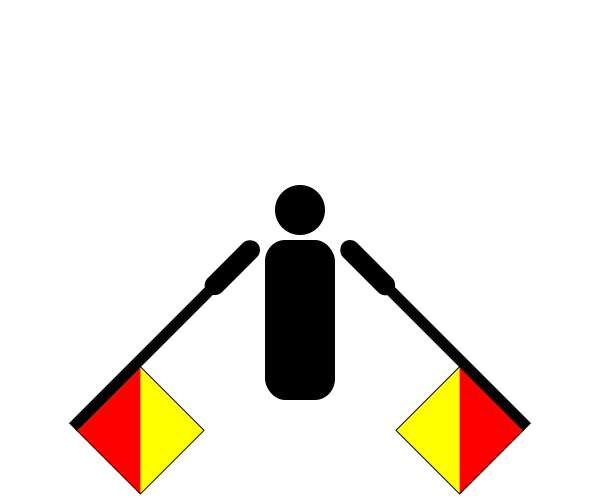

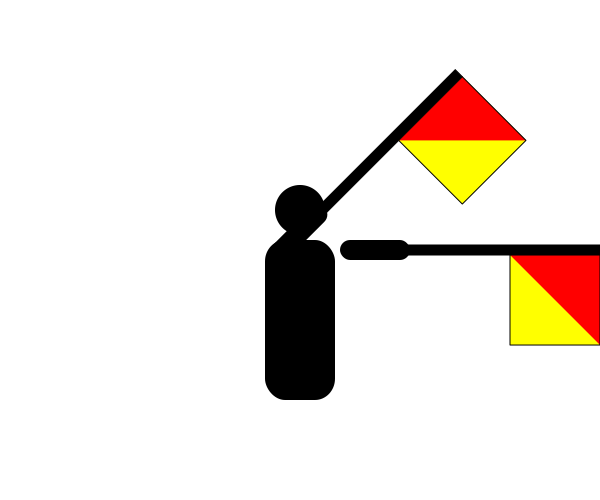
There are approximately 5,482 people named New in the UK. That makes it roughly the 1,731st most common surname in Britain. Around 84 in a million people in Britain are named New.
Origin: English
Region of origin: British Isles
Country of origin: England
Religion of origin: Christian
Language of origin: English

Famous people named New
- Hannah New - Actress
- Chris New - Actor
- Barbara New - Actress (1923 to 2010)
- Edith New - Leading UK suffragette (1877 to 1951)
- Christopher New - Writer and philosopher
- Paul New - Cricketer
- Laurence New - Army general
- Tom New - Cricketer
Names and descriptions courtesy of Wikipedia, and may contain errors. This is not intended to be an exhaustive list of every famous person with this name.