NEVITT
Origin of the surname Nevitt can be traced both to England and to France. In English usage it is regarded as a patronymic form derived from the medieval given name Nevot or Nevitt, itself a diminutive of the Norman French name Neville, which means “new town” or “new settlement”. Consequently the family name may be interpreted as “descendant of Nevile” or “son of a Neville”. In French usage the name is understood as having taken root through the Norman migration into the British Isles after the Conquest of 1066, and it has frequently been recorded under a variety of consonant‑initial spellings that reflect the phonetic shift from the Old English cniht (boy, serving lad, later knight) to the Norman French cnevit.
The earliest reference to the name appears in an 11th‑century document from Middlesex, where a Leuricus Cnivet is mentioned in the year 1087. By the 12th century, entries such as William Knivet of Lincolnshire (1154) and Thomas Knifet of the same county (1275) show the name in a variety of orthographic forms. The record of John Knyft in Essex in 1337 and the 1523 London marriage licence entry for William Knevett, of the household of the royal household, provide further evidence of its persistence in written records. A granted coat of arms for the Knevett family, a silver shield with a bend within a bordure engrailed sable and a crest bearing a dragon’s head between two wings, is a 16‑th‑century artefact that confirms the name’s status among hereditary gentry.
Beyond its patronymic interpretation, the name has also been described as a topographic designation. In Middle English it can be analysed as newe (new) + hutte (cottage or hut), giving a meaning of “dweller at the new cottage”. Other popular etymologies relate the name to an Old English word for a relative or a neighbour, and to the phonetic evolution of the identical term in Anglo‑Saxon documents. The surname’s range of spellings – including Nevett, Nevatt, Neavitt, Neavett, Nivett, Nifett, Nivet, Nifet, Naffat, Nivelli – is attested from the late medieval period through the modern era.
The distribution of the surname today is largely concentrated in the United Kingdom and North America. In the UK the name remains relatively uncommon but it is found throughout the country, with a higher concentration in the north‑eastern counties such as Yorkshire. The United States hosts a migration of the name primarily to the deep‑south states of Louisiana, Arkansas, Texas, Georgia, and Alabama, although a smaller presence exists in the broader southern region. Canadian records show sporadic occurrences, while Mexico has a few families recorded under this surname. The surname has also reached Canada, Australia, Germany, New Zealand, Scandinavia, Eastern Europe, Asia, and Africa, where it is encountered in small numbers and often recorded under local orthographic variants.
In contemporary history, notable bearers of the surname include Geoffry Nevitt, the former Archdeacon of Chester, whose ecclesiastical career spanned several decades in the early 21st century, and Chuck Nevitt, an American professional basketball player who played in the National Basketball Association during the 1980s and 1990s. Their achievements illustrate the diverse fields in which individuals with the surname have made a mark.
Typical given names associated with the Nevitt surname
Male
- Andrew
- David
- James
- John
- Michael
- Paul
- Peter
- Robert
- Simon
- Stephen
Female
- Amanda
- Ann
- Christine
- Janet
- Louise
- Margaret
- Michelle
- Nicola
- Patricia
- Rachel
- Sally
- Sarah
- Susan
Similar and related surnames
Related and similar names are generated algorithmically based on the spelling, and may not necessarily share an etymology.
How to communicate the surname Nevitt in...
Braille
⠝⠑⠧⠊⠞⠞
Morse
-.....-..--
Semaphore
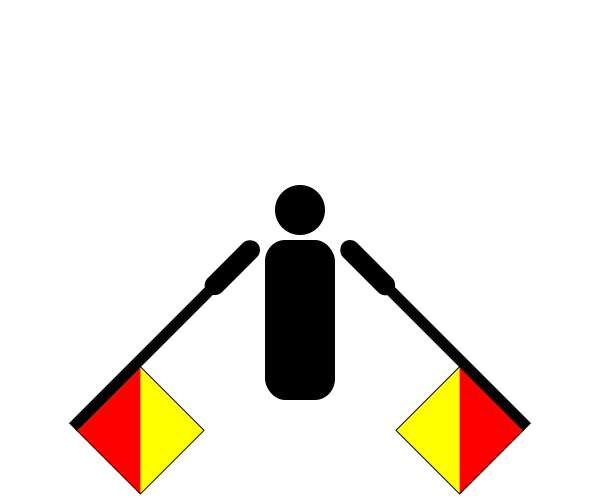

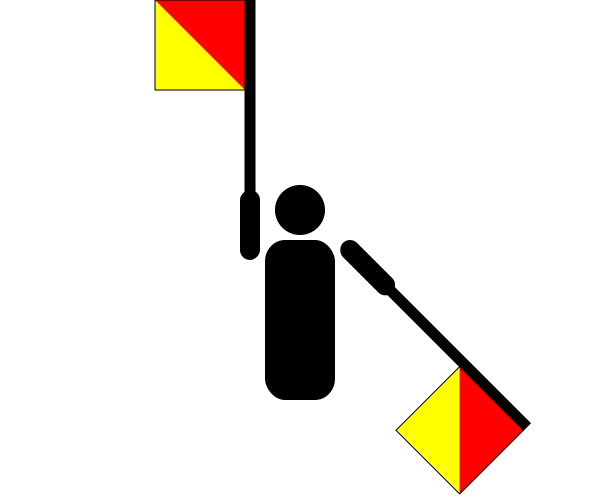
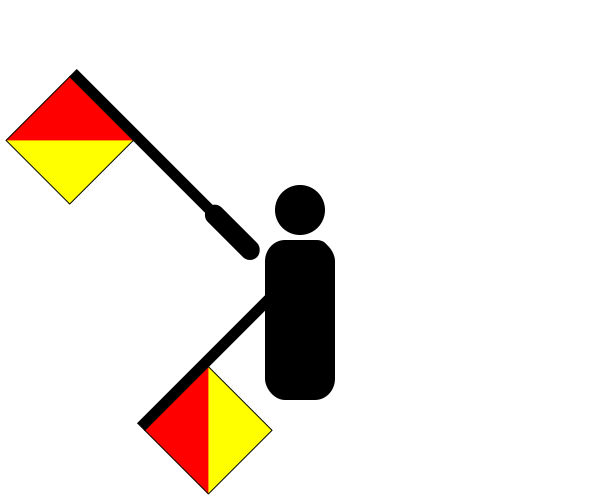
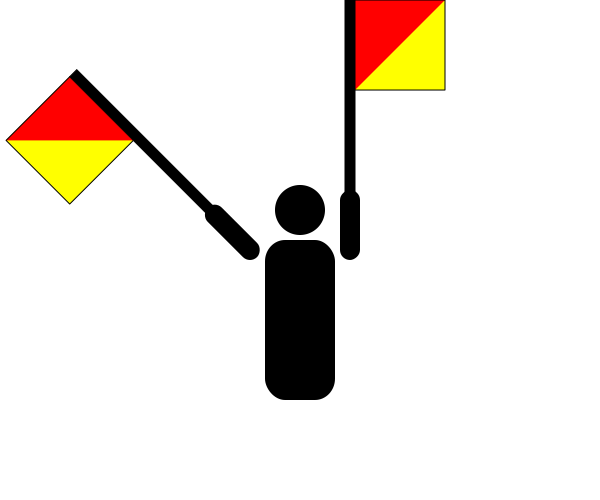
There are approximately 962 people named Nevitt in the UK. That makes it roughly the 7,587th most common surname in Britain. Around 15 in a million people in Britain are named Nevitt.
Origin: English
Region of origin: British Isles
Country of origin: England
Religion of origin: Christian
Language of origin: English
