NEAGLE
Neagle is a surname that arises from a complex interplay of Gaelic, Norman, and Anglo‑Saxon influences within the British Isles.
The earliest attestations of the name appear in 12th‑century records describing a Norman baron, Gilbert de Angulos, whose title was dated to 1193. The name de Angulos entered the Irish linguistic landscape following the Norman invasion of 1170, when the family was granted extensive estates in County Cork and across North Connacht. In Cork the name evolved into the Anglicised forms Nagle and Neagle, while in Connacht it was re‑Gaelicised as Nangle from the original de Nogla. Subsequent generations in Connacht adopted the patronymic Mac Costello, combining the Gaelic prefix mac – meaning “son of” – with the Norman personal name Oistealb (anglicised Costello).
Alternate etymologies have been suggested. One line of scholarship derives Neagle from the Gaelic Mac an Fhailghigh, a patronymic meaning “son of the poor man”, and another from MacFhiodhbhuidhe, which denotes “son of the dark or swarthy leader”. Either derivation would have been applied to a descendant of a notable ancestor whose characterised nickname or social status was preserved in the surname. Neither theory can be confirmed beyond the linguistic evidence supplied by early annals and the Annals of the Four Masters. Consequently, the precise semantic origin remains a subject of scholarly debate.
The orthographic history of the surname is itself a testament to its geographic mobility. More recent sources catalogue a wide range of variants: Neagle, Nagle, Nangle, ŒNeagle, Neaghil, Neagy, Nigel, Naigle, Nagel, Negele, Neagal, Neacle, Neicle, Neikle, Neigell, Neagill, Naegel, and Neagele, among others. Each incarnation reflects a local linguistic adaptation, whether it be the predominance of English, Irish, or Scots Gaelic phonology in a given region.
In the United Kingdom the name is concentrated largely in England, with significant occurrences in Scotland, Wales, and Northern Ireland. It appears at all levels of the civil registration system from the 19th century onwards, a pattern that mirrors broader migratory trends following the dissolution of Ireland’s feudal landholdings in the 17th and 18th centuries. Comparative census data shows that in 1881 the surname was reported approximate three dozen times in England alone, with higher frequencies in the counties of Cork and Connacht, where the family’s ancestral estates were located.
Across the Atlantic the surname has a prominent presence in the United States, particularly in Pennsylvania, New York, New Jersey, Oregon, Ohio, Illinois and Texas. This distribution aligns with known Irish migration flows during the 19th century, driven by famine and economic opportunity. Individuals bearing the name established communities in larger urban centres and in rural Virginia and the Ohio Valley, patterns that are documented in passenger lists, land grants and post‑war census returns.
Internationally, the name can be found in Canada, Australia, South Africa and several European nations including Germany, France, Sweden and Italy. These occurrences correspond to later waves of emigration during the late 19th and early 20th centuries, where families sought refuge or prosperity in colonial domains or in industrial metropoles of continental Europe. While the surname is occasionally listed as having Germanic roots, those instances are typically linked to the German surname Nagel and are recognised as distinct from the Irish or Anglo‑Saxon traditions.
The recorded lineage of the Neagle family does not indicate a tradition of aristocracy but rather demonstrates resilience and adaptability. In the 19th century they were noted for participation in trade, land cultivation and, in some branches, involvement in civic life. Their presence in county records is often linked to documented landholdings, obituaries, marriages and legal disputes, offering a rich tapestry for genealogical research.
An examination of the surviving church registers, and the civic documents preserved in the National Archives of Ireland and the National Archives of the United Kingdom, confirms this varied heritage. Dispersed across multiple cultural contexts, the Neagle name remains a living artefact of the intertwined histories of Norman conquest, Gaelic patronymics and English linguistic heritage.
For researchers tracing the provenance of the surname, careful attention to spelling variants and the particular geographic contexts of each record is essential. The name’s evolution illustrates a broader pattern of cultural accommodation, in which invading forces assimilated indigenous naming traditions, while indigenous families adopted foreign forms to ascertain legal and social advantage within a changing feudal framework.
Typical given names associated with the Neagle surname
Male
- Andrew
- Anthony
- James
- John
- Mark
- Martin
- Michael
- Paul
- Peter
- Tristan
- William
Female
- Alison
- Catherine
- Christine
- Diane
- Dianne
- Jane
- Jennifer
- Josephine
- Karen
- Kathleen
- Margaret
- Nadine
- Patricia
- Samantha
Similar and related surnames
Related and similar names are generated algorithmically based on the spelling, and may not necessarily share an etymology.
How to communicate the surname Neagle in...
Braille
⠝⠑⠁⠛⠇⠑
Morse
-...---..-...
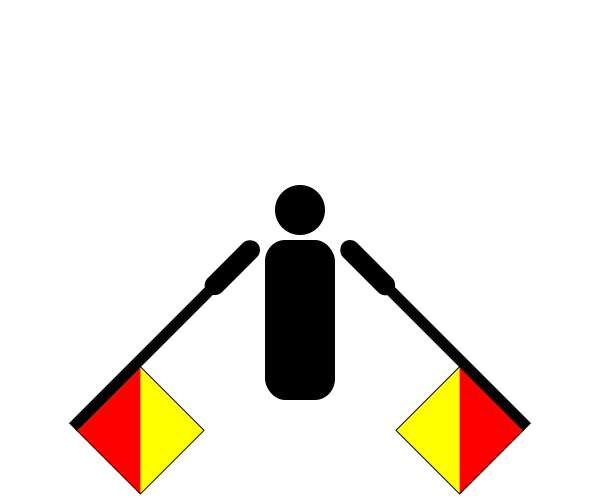
Semaphore


There are approximately 402 people named Neagle in the UK. That makes it one of Britain's least common surnames. Only around six in a million people in Britain are named Neagle.
Origin: English
Region of origin: British Isles
Country of origin: England
Religion of origin: Christian
Language of origin: English

Famous people named Neagle
- Lynne Neagle - Welsh politician and AM
Names and descriptions courtesy of Wikipedia, and may contain errors. This is not intended to be an exhaustive list of every famous person with this name.