NAST
Nast is a surname that finds its origins in the Germanic linguistic tradition. It is recorded in medieval German documents as early as the thirteenth century and has since evolved into a hereditary family name.
The earliest surviving mention is that of Ulrich dictus Ast of Mebkirch in the year 1271, followed by Conrad Nesteli of Konstanz in 1290, and later Ulrich Nast of Stuttgart in 1535. These records indicate that the name was in common use across different German regions in the Middle Ages and that it was initially a residential surname, identifying a person by the natural features of the place where they lived.
One of the prevailing etymologies derives from the Middle High German word nast or naste, which translates as “harsh” or “severe.” It is believed that the name originally served as a nickname for an individual who displayed a stern or strict character. Over time this descriptive epithet was adopted as a hereditary surname.
Another proposed derivation links Nast to the German word ast, meaning “branch.” In this sense the name would refer either to a person who lived near a forest or thickly wooded area or, on occasion, to an occupation such as forester or woodcutter. The spelling nestle found in Swiss records supports a branch‑related origin in some instances.
A further hypothesis suggests a connection with the Old German word nasse, literally “wet” or “moist.” This interpretation associates the surname with a wet clay bed or a particular wet landscape near the original domicile. Some scholars have also considered the Old German nasten, meaning “to snuff,” and nassen, meaning “throwing net,” implying possible associations with fishing or hunting activities.
In contemporary Germany the surname is most frequently encountered in the south‑west, particularly within the states of Baden‑Wurttemberg, Hessen, and Bavaria. It is also present, though less densely, in the northern‑eastern states of Brandenburg, Mecklenburg‑Vorpommern, and Saxony‑Anhalt, as well as in other regions such as Bavaria, Baden‑Wurttemburg, and Hesse.
Outside of Germany, the name is common in North America, especially in the Midwest states of Ohio, Indiana, Michigan, Illinois, and Wisconsin. Significant concentrations also appear in the eastern United States, including New York and Pennsylvania, and in Canadian provinces such as Ontario and Alberta. Smaller communities bearing the surname exist in Australia, New Zealand, South America, and other parts of Europe.
Perhaps the most famous bearer of the surname is the German‑born American caricaturist Thomas Nast (1840‑1902), whose satirical drawings of 19th‑century American politics earned him the reputation of “The Father of the American Political Cartoon.” Nast created the enduring symbols of the Republican Party’s elephant and the Democratic Party’s donkey, solidifying the name’s recognition beyond its geographic origins.
Variations of the surname include Nasta, Nasto, Nasti, Nastu, Naston, Nasut, Nassat, Nasat, Nastie, and Anast. Related surnames sharing the same root comprise Anstadt, Anstatt, Anster, Anstey, Anstie, Anstine, Anstre, Anstry, Anstice, Anstifer, and Ansty. Across the centuries the popularity of the name has fluctuated, with its prominence noted in the 2000 United States Census and in nineteenth‑century English records.
Similar and related surnames
Related and similar names are generated algorithmically based on the spelling, and may not necessarily share an etymology.
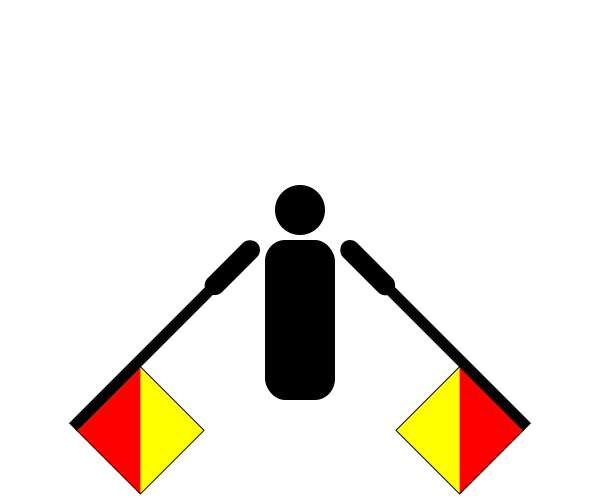
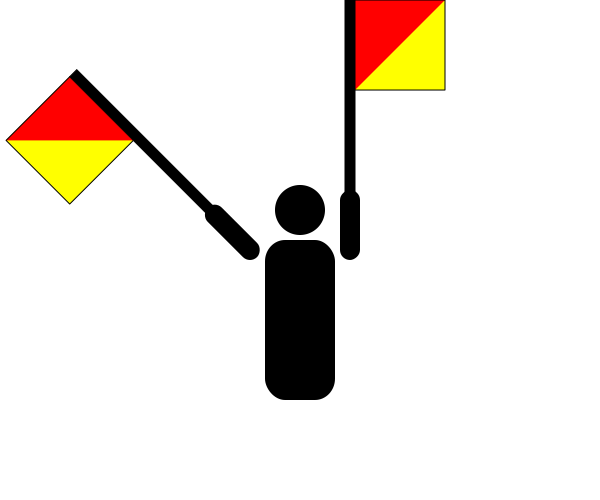
How to communicate the surname Nast in...
Braille
⠝⠁⠎⠞
Morse
-..-...-
Semaphore


Sorry, we don't have any statistics on this name. That's probably because it's very uncommon in Britain.
