NAISMITH
Naismith is a surname of predominantly Scottish provenance, with its earliest attestations rooted in the Gaelic linguistic tradition. The name is derived from the Gaelic *MacNeisde*, which literally means “son of Neisde.” While the personal name Neisde itself is of uncertain etymology, it is widely believed to possess Celtic origins. This Gaelic basis is reflected in the concentration of the surname within the Scottish counties of Lanarkshire and Renfrewshire, where it remains most common.
In addition to its Gaelic lineage, historical records reveal that Naismith appears in a number of variant spellings, including Nasmith, Naesmith, Naysmith, Knifesmith and Neasmith. These orthographic differences illustrate the fluidity of medieval spelling and underscore the surname’s Anglo‑Scottish character.
The surname is occasionally reconstructed as an occupational designation tracing back to pre‑7th‑century Old English. It is said to stem from the compound cnif smit, where smit derives from the verb *smitan* meaning “to smite.” Although the precise occupation implied by this term is a matter of scholarly debate, it has been suggested that a knifesmith might have referred either to a craftsman working with knives or to a soldier proficient in wielding a short sword.
Historical documentation first records the name in 1246, when an individual identified as Roger Knifsmith is mentioned in the archives of St Bartholomews Hospital in London. Subsequent entries include James Nasmite of York in 1379, Alan Nasmith—landowner in Brechin, Scotland—in 1415, and James Nasmith, who served as sheriff of Norwich in 1734.
The heraldic tradition associated with the surname features a coat of arms blazoned as follows: background sable, a dexter hand couped argent holding a sword between two broken hammers or. The crest consists of a hand grasping a hammer or, and the motto is the Latin phrase “Non arte sed marte,” which translates into English as “Not by craft, but by war.” These elements collectively reflect the historical martial affiliation sometimes attributed to bearers of the name.
In summary, the Naismith surname represents a fusion of Gaelic patronymic origin and Anglo‑Scottish occupational heritage, with a documented presence in Scotland and England dating back to the mid‑13th century. Its varied spellings, regional concentrations, and heraldic symbolism offer a window into the linguistic, social and martial landscapes of medieval Britain.
Typical given names associated with the Naismith surname
Male
- Alexander
- Andrew
- David
- Gavin
- George
- Ian
- James
- John
- Robert
- Scott
- Thomas
- William
Female
- Ann
- Carol
- Claire
- Elizabeth
- Janet
- Jean
- Lesley
- Linda
- Margaret
- Marjory
- Mary
- Michelle
- Rebecca
- Sarah
Similar and related surnames
Related and similar names are generated algorithmically based on the spelling, and may not necessarily share an etymology.
How to communicate the surname Naismith in...
Braille
⠝⠁⠊⠎⠍⠊⠞⠓
Morse
-..-.....--..-....
Semaphore
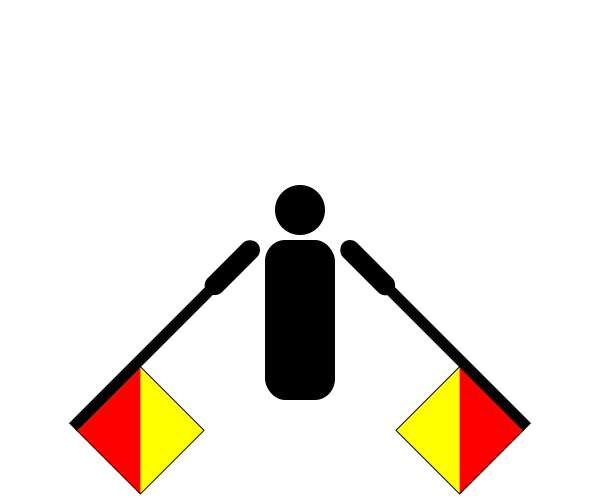

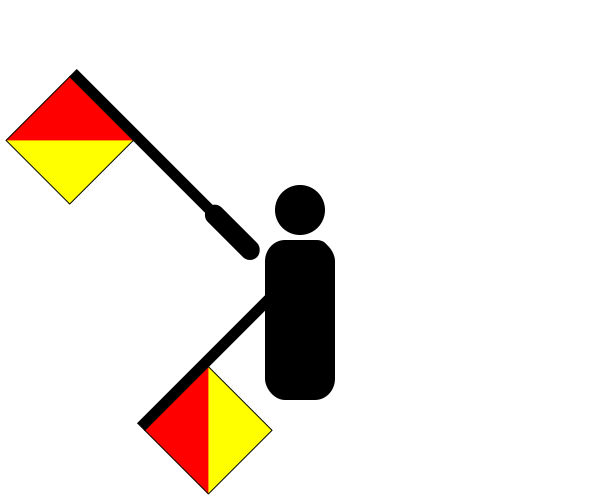

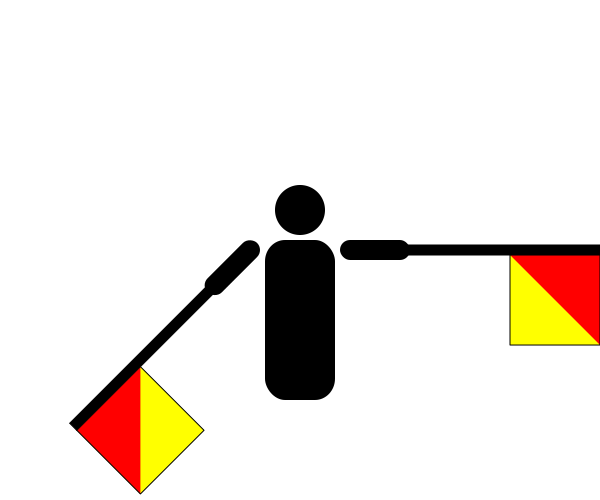
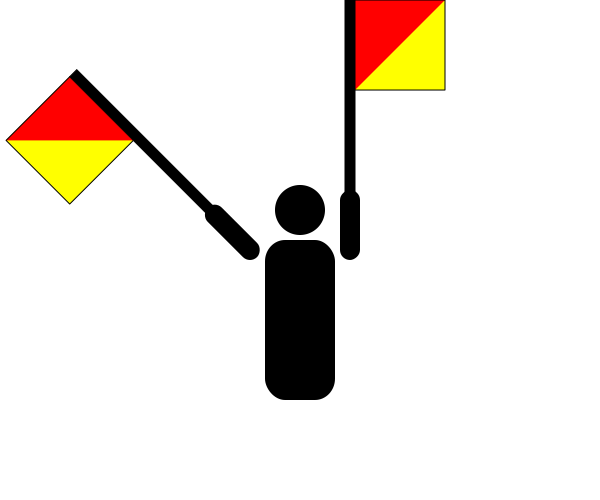

There are approximately 1,323 people named Naismith in the UK. That makes it roughly the 5,919th most common surname in Britain. Around 20 in a million people in Britain are named Naismith.

Famous people named Naismith
- Steven Naismith - Scottish football player
- Laurence Naismith - Actor (1908 to 1992)
- Kal Naismith - Scottish football player
- Jason Naismith - Scottish football player
- James Naismith - Professor of Structural Biology at the University of Oxford
Names and descriptions courtesy of Wikipedia, and may contain errors. This is not intended to be an exhaustive list of every famous person with this name.