NAISBITT
Naisbitt is a surname of English provenance, with notable influences from Norse onomastics. The name can be analysed as a compound of two elements: the first element, Nais, is generally recognised as a variant of the personal name “Nigel”, derived from the Old Norse name “Njáll”. The second element, bitt, functions as a diminutive suffix in Middle English, signifying “little” or “son of”. Consequently, the literal interpretation of Naisbitt is “little Nigel” or “son of Nigel”.
The surname also possesses a locational dimension. It is a variant of the Northern English and Scottish toponymic names Nesbit and Nisbet, which in turn stem from Middle English Nasebote. The toponym is believed to mean “dweller by the nosey place”, a reference to a feature of the landscape such as a piece of raised ground shaped like a nose or a bend in a river that resembles a nose. The name occurred in several places in the Border region, particularly Northumberland, and later in the barony of Nesbit in Berwickshire.
Evidence of the surname in documentary sources dates back to the late twelfth century. A charter witness, Robert de Nesbit, is recorded in the Records of the Abbey of Kelso between 1160 and 1200, during the reign of King William the Lion of Scotland. The earliest extant reference to the name in England appears in the Domesday Book of 1086, where the pathos of feudal landholding is evident. The surname subsequently spread throughout the British Isles during early medieval settlement, becoming established in Scotland, Northern Ireland and Wales as well as in England.
The most common contemporary distribution of the surname in the United Kingdom is in the counties of Yorkshire and Lincolnshire, where it remains in small pockets of villages and towns. In England it is occasionally found in Dorset, where a hamlet once called Nasebote is thought to have given rise to the locational form of the name.
In overseas contexts, notably the United States, the surname is most prevalent in Utah, Idaho and the southern and central regions of California. It is also recorded in Canada, Australia and New Zealand. The persistence of the name in these locales reflects patterns of emigration from Britain during the nineteenth and early twentieth centuries.
There have been several orthographic variants of the surname, including Nesbitt, Nesbit, Nisbet and Naisbett. While Naisbitt is the spelling most commonly preserved in the United States, the variants Nesbitt and Nesbit remain preferable in Scotland.
Among notable bearers of the name is Alexander Nisbet (1657–1725), a celebrated heraldic writer whose work contributed significantly to the study of coats of arms in Scotland. His surname, rendered here in the Scottish variant, illustrates the fluidity of spelling in historical records.
Although the precise etymology of Naisbitt has partially receded into antiquity, the surname today evokes a sense of loyalty to one’s family and a tangible link to British history. Generations of families with the name have maintained ties to Yorkshire, Lincolnshire and Dorset, while their descendants have dispersed across the Atlantic, carrying the name into new contexts.
Typical given names associated with the Naisbitt surname
Male
- Anthony
- Brian
- Carl
- Christopher
- David
- Dean
- John
- Michael
- Paul
- Peter
- Richard
- Stephen
- Thomas
- William
Female
- Claire
- Deborah
- Elizabeth
- Joanne
- Kathleen
- Kelly
- Linda
- Lucy
- Sarah
- Sheila
- Susan
Similar and related surnames
Related and similar names are generated algorithmically based on the spelling, and may not necessarily share an etymology.
How to communicate the surname Naisbitt in...
Braille
⠝⠁⠊⠎⠃⠊⠞⠞
Morse
-..-.....-.....--
Semaphore
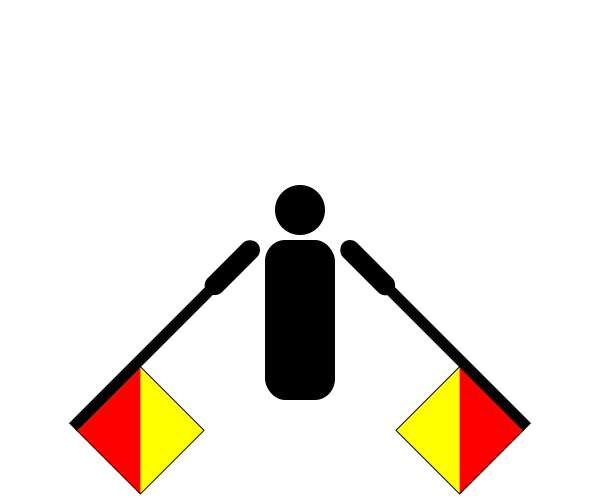

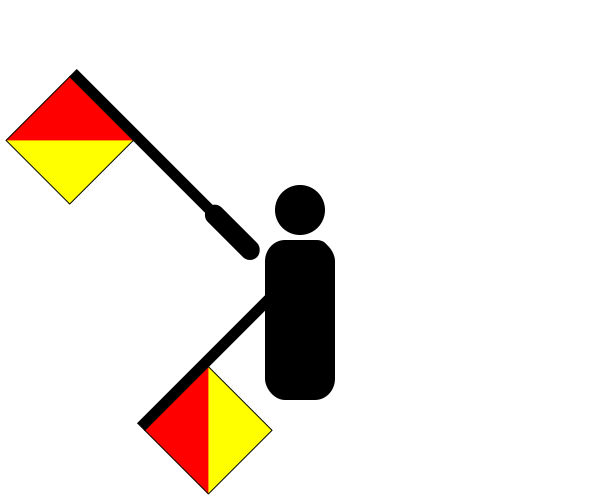

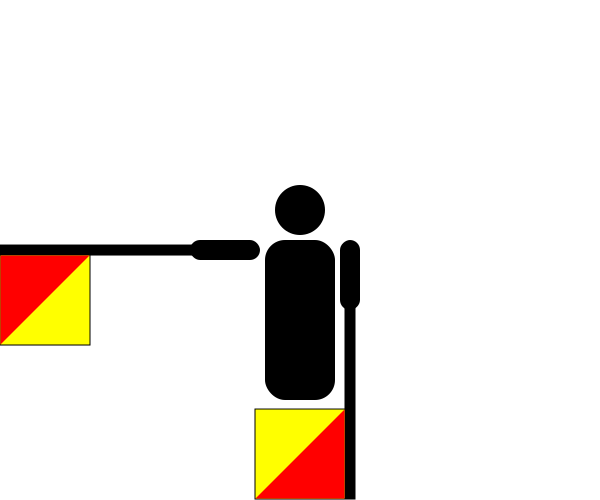
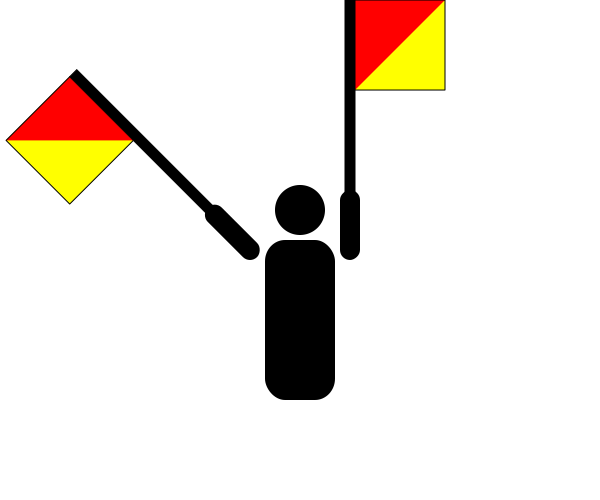
There are approximately 636 people named Naisbitt in the UK. That makes it one of Britain's least common surnames. Only around ten in a million people in Britain are named Naisbitt.
