MUTTER
Mutter is a surname of German origin, translating literally to “mother” in English. The name is derived from the Middle High German word muoter or muter, denoting a person of a spiritual or nurturing character, often applied to figures such as godparents or midwives.
The use of Mutter as a family name dates back to the Middle Ages, a period when hereditary surnames began to take hold across Europe. While the word itself means mother, the surname may have been conferred for a variety of reasons, including a person who displayed maternal warmth, kindness or authority within a community. In some instances it operated as a nickname for a village elder or a respected matriarch whose influence extended beyond the household.
Historical records reveal early forms of the name. One of the earliest documentary appearances is the 1130 Pipe Roll of London, where a man named Hugo le Motere is noted. This spelling reflects an early English variation of the name, possibly linked to the Old English verb motian meaning to plead or speak, an association that is also reflected in the related word moot, meaning a gathering for discussion. Such linguistic connections suggest that the name might have been employed for individuals who spoke on behalf of others, perhaps in court or other public forums.
By the seventeenth century the spelling had standardised in England to Mutter, as evidenced by the christening of Sarah Mutter in 1723 at St. Giles Cripplegate, London. The surname spread throughout the British Isles, and today it can be found among people of English, Scottish and Welsh descent who descend from German immigrants, as well as among those whose families resettled in England from continental Europe during the early modern period.
The surname has developed a number of variants that arise from regional pronunciation differences or clerical transcription over the centuries. Common alternatives include Muther, Muether, Mutters, Mutterer, Muttel and Muttels. In some cases the name has also been joined to other surnames by means of a hyphen, producing forms such as Mutter-Smith or Muether-Jones. Although these variants are orthographically distinct, they are generally recognised as referring to the same underlying family line.
Geographically, the surname most remains in Germany, particularly in the southwestern regions where the surname is still common today. Due to German emigration it has also taken root in other countries with significant German diasporas, including the United States, Canada and Australia. Within Britain, the name appears sparsely, reflecting the comparatively limited scale of German settlement relative to the broader English population.
Because surnames often change with migration, occupation and time, it is prudent for genealogical researchers to recognise that similar-looking names may not indicate a direct biological connection. Verifying lineage generally requires corroborative documentation such as parish registers, wills or census records, rather than reliance on surname similarity alone.
Typical given names associated with the Mutter surname
Male
- Alan
- Andrew
- Christopher
- David
- Gordon
- Ian
- James
- John
- Michael
- Paul
- Robert
- Thomas
Female
- Claire
- Dawn
- Dorothy
- Helen
- Jean
- Julie
- Louise
- Lucy
- Margaret
- Mary
- Sandra
- Sarah
- Susan
Similar and related surnames
Related and similar names are generated algorithmically based on the spelling, and may not necessarily share an etymology.
How to communicate the surname Mutter in...
Braille
⠍⠥⠞⠞⠑⠗
Morse
--..---..-.
Semaphore
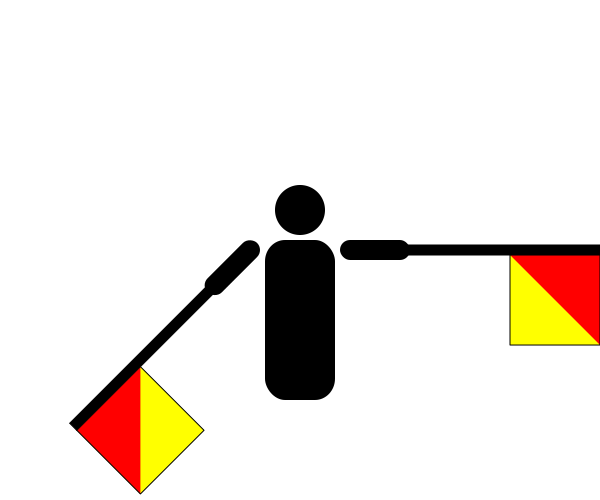

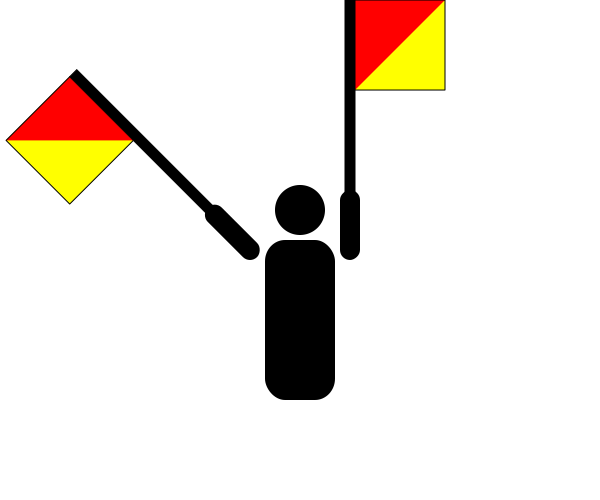

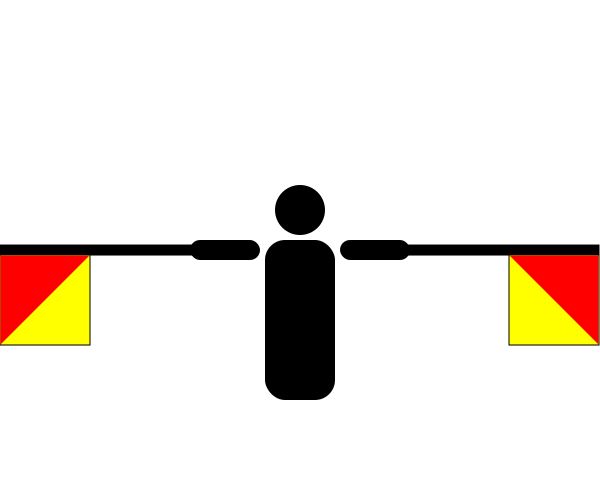
There are approximately 849 people named Mutter in the UK. That makes it roughly the 8,400th most common surname in Britain. Around 13 in a million people in Britain are named Mutter.
Surname type: Occupational name
Origin: English
Region of origin: British Isles
Country of origin: England
Religion of origin: Christian
Language of origin: English
