MUSTARD
Mustard is a surname of English origin, deriving from the Old French word moutarde which means mustard. Its appearance in the English language can be traced to the Norman conquest of 1066, when many French words were introduced into the Anglo‑Saxon vocabulary.
The name is classed as a nickname or occupational surname. As a nickname it would have applied to a person whose temperament or appearance was described as “hot” or yellowish, reminiscent of the colour of mustard seed. As an occupational surname it reflects a person involved in the cultivation, preparation or sale of mustard, a common trade in medieval England.
Early documentary evidence shows a variety of spellings including Mustard, Musterd, Mustarde and occasionally Mustart. The first recorded instance occurs in the Pipe Rolls of Yorkshire in 1191, where a man named Adam Mustard is listed. Subsequent entries in the Pipe Rolls of 1206 show William Mustard of Hereford, and later tax rolls from 1327 record John le Mustarder of Cambridge and Adam le Mustardman of Suffolk.
These records indicate that the surname, first attached to a distinctive personal characteristic, became hereditary well before it was used to denote occupation. By the 15th century many of such nickname surnames had been passed down through generations, even when the original trait or occupation was no longer present.
Over time a number of orthographic variants emerged, all retaining the same root. Some of the more common forms are Mustarde, Mustar, Mustaine, Mustow, and Mustoord. Foreign adaptations include Mustardier in French, Mustarda in Spanish, Mustarden in German and Mostarda in Italian. Surnames of similar origin, such as Musters, Musterton and Mustardman, also arise from the same root word “mostard.”
In the present day the family name remains relatively uncommon. Its greatest concentration in the United Kingdom is found in the East Midlands and East of England, while in the United States it is most frequently recorded in the Midwest, particularly in Indiana, Illinois and Ohio. These patterns reflect historical migrations and the continued use of the name across generations.
Although its frequency is modest, the surname Mustard is characterised by an evident historical depth and an association with both personal description and rural trade. Its persistence through centuries of linguistic change attests to a strong family lineage that has retained its identity from the medieval period to the modern era.
Typical given names associated with the Mustard surname
Male
- Alexander
- Anthony
- Charles
- David
- Edward
- Graham
- Ian
- James
- John
- Kevin
- Michael
- Robert
- William
Female
- Dorothy
- Helen
- Hilary
- Jacqueline
- Jean
- Joanne
- Julie
- Karen
- Margaret
- Michelle
- Pauline
- Ruth
- Sharon
- Winifred
Similar and related surnames
Related and similar names are generated algorithmically based on the spelling, and may not necessarily share an etymology.
How to communicate the surname Mustard in...
Braille
⠍⠥⠎⠞⠁⠗⠙
Morse
--..-...-.-.-.-..
Semaphore
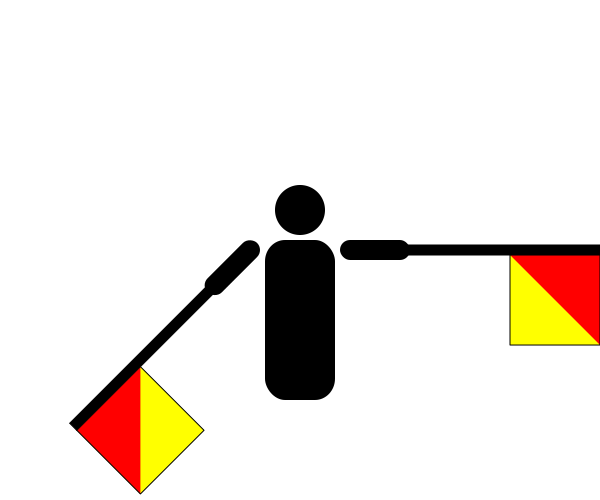


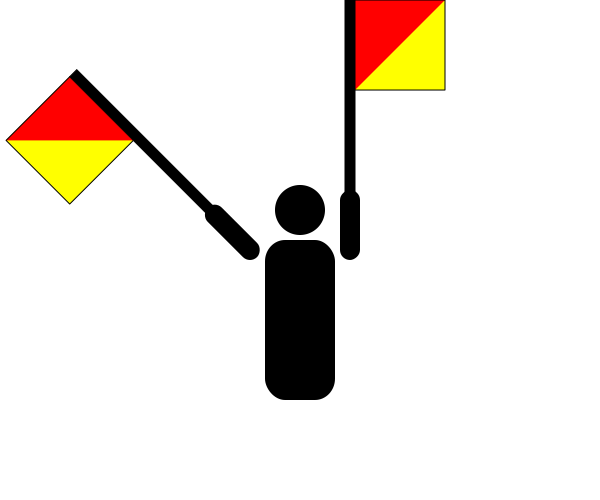

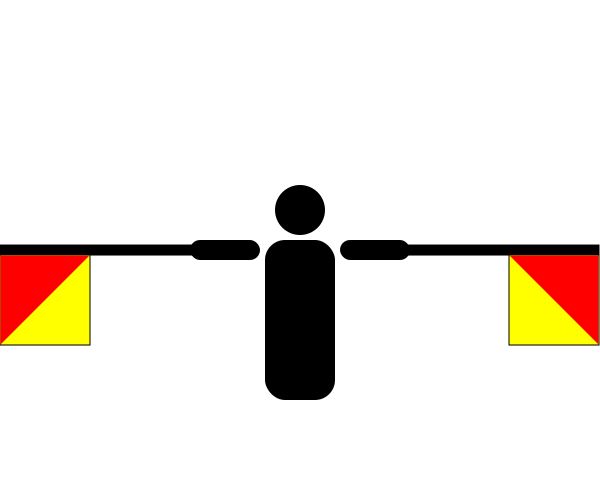

There are approximately 719 people named Mustard in the UK. That makes it roughly the 9,512th most common surname in Britain. Around 11 in a million people in Britain are named Mustard.
Surname type: Occupational name
Origin: English
Region of origin: British Isles
Country of origin: England
Religion of origin: Christian
Language of origin: English

Famous people named Mustard
- Phil Mustard - Cricket player
Names and descriptions courtesy of Wikipedia, and may contain errors. This is not intended to be an exhaustive list of every famous person with this name.