MURPHEY
Murphey is a surname of Gaelic Irish provenance, traditionally spelled in a variety of ways including Murphy, Morphy, Murphie and the Manx rendition Curphy. The name originates from the Irish patronym Ó Murchadha, meaning “descendant of Murchadh”. The personal name Murchadh is constructed from the elements muir, meaning “sea”, and cath, meaning “battle”; thus the surname conveys the sense of a “sea warrior” or “sea battler”.
The earliest recorded instance of the family name is found in the Early Medieval Records of Leinster, where Domhnall Dall Ua Murchadha, the chief sage of Leinster, is dated to 1127. The clan was central to the O‑Murchadha sept of Leinster, whose powers stretched through County Wexford and extended into the baronies of Muskerry in County Cork and Kerry. A notable chief, Sean O'Murchadha na Raithineach, served as the last head of the Blarney bards in the 18th century.
In the Ulster region the surname appears as MacMurchadha and is associated with Counties Tyrone and Armagh. One recorded member, Flaherty O'Murphy, is mentioned in the Annals of Tir Boghainne for County Donegal. The name gained prominence during the British rule of Ireland, particularly through the valour of two priests – Rev. John Murphy (1753‑1798) and Rev. Michael Murphy (1767‑1798) – who were martyred in the 1798 Rising.
Because Ireland was subject to Viking control for several centuries, many scholars note the cultural overlap between a maritime warrior lineage and Norse seafaring renown. The prefix O‑ signifies “grandson” or “male descendant of”, in keeping with traditional Gaelic naming conventions that highlighted the head of a tribe or an illustrious warrior.
Geographically, Murphey remains the most frequently occurring surname in Ireland, ranking as the second most common name overall. In the United Kingdom it is celebrated as the 36th most popular surname. In Canada it holds the 14th overall position and ranks seventh in Quebec. In Australia and New Zealand it is the 40th and 18th most frequent surnames respectively. The name has also found a foothold in the Caribbean, as well as within the United States, where it is listed as the 24th most common surname, embraced most widely in states such as Massachusetts, Rhode Island and New Jersey.
These figures reflect the sizeable migration of people bearing the name during the 19th and 20th centuries, a dispersal largely prompted by the Great Famine and subsequent emigration. In the United States, the surname is represented by prominent figures such as James Murfey (1791‑1872), a congressman pivotal to early Kentucky statehood, and Langhorn Murfee (1780‑1871), a civic leader who also served in the U.S. House of Representatives.
Current spelling variants incorporate the core Murphey form as well as more common iterations such as Murphy, Murfey, Murfie, Murfee and simply Murf. These variations appear across both Irish and American records, and the modern usage of Murphey demonstrates a sustained link to its Gaelic roots while also reflecting the natural evolution of surnames within diaspora communities.
Typical given names associated with the Murphey surname
Male
- John
- Joseph
- Malcolm
- Martin
- Peter
Female
- Alison
- Catherine
- Margaret
- Nicole
- Sheri
Similar and related surnames
Related and similar names are generated algorithmically based on the spelling, and may not necessarily share an etymology.
How to communicate the surname Murphey in...
Braille
⠍⠥⠗⠏⠓⠑⠽
Morse
--..-.-..--......-.--
Semaphore
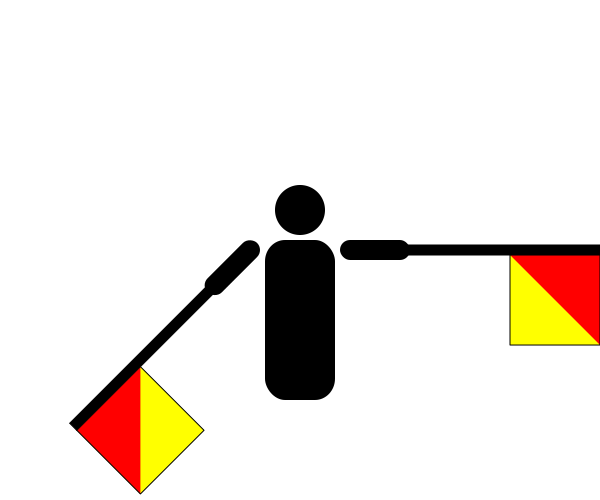

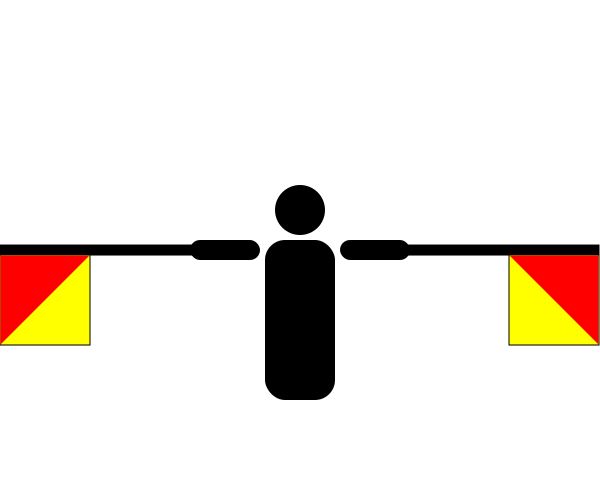


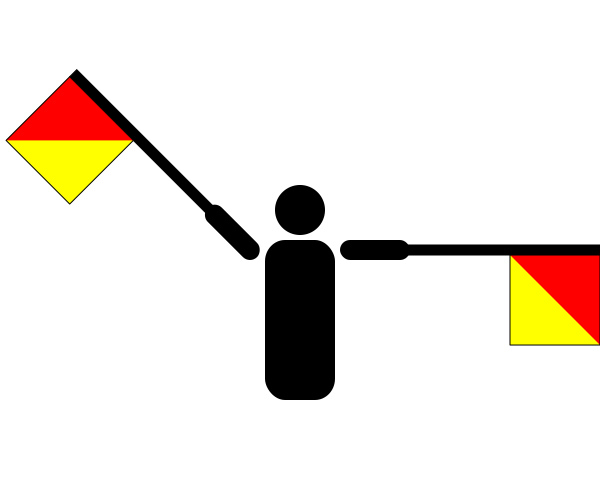
There are approximately 69 people named Murphey in the UK. That makes it one of Britain's least common surnames. Only around one in a million people in Britain are named Murphey.
Origin: English
Region of origin: British Isles
Country of origin: England
Religion of origin: Christian
Language of origin: English
