MUNSON
Munson is a surname of both English and Norse provenance, identified in the British Isles as having roots that reach back to the Viking era in northern England and the broader Anglo‑Saxon period. The name is fundamentally patronymic, denoting the lineage of an individual as the child of a particular ancestor.
In the Norse tradition the surname derives from the Old Norse personal name Mundr, which means “protection” or “hand.” By appending the patronymic suffix ‑son, the resulting form Munson literally means “son of Mundr.” This construction was customary in Norse societies as it linked a child directly to the name of a man of regard or status.
Other linguistic strands contribute to the development of the surname. The Old English words munuc and munec – meaning a monk or a person of monkish habits – appear in earlier forms such as Aylric Munec in a will dated around 1045. When combined with the patronymic suffix, these forms could produce variants that are recognisably similar to modern Munson.
There is also a Scottish variant pathway: the surname Manson is a contraction of Magnusson, meaning “son of Magnus.” Given the presence of Norse settlers on the islands that form part of Scotland, especially Shetland, this line offers an alternative explanation for the Munson expansion into the northern regions of the British Isles.
Location has sometimes been cited as a source of the surname. The place name Munstone, situated just north of Hereford, has provided a possible geographical origin in older texts. Though less frequently referenced, the placename connection illustrates the habit of deriving surnames from terrestrial identifiers, a practice common in medieval England.
Historical documents capture the name in varied forms. For example, a record in St. Leonards, Eastcheap, London, notes the christening of Cuthebert, son of Peter Munson on 23 February 1540. In the same period, St. Mary Magdalene, Bermondsey, London recorded the christening of a male Manson on 12 April 1554 and the marriage of Agnes Manson to Thomas Preston on 7 July 1555. These entries illustrate the coexistence of related spellings within close geographical proximity.
The earliest extant spelling in official records appears as John Mannisson in the Feet of Fines of Staffordshire dated 1305, during the reign of King Edward I. This early instance demonstrates that the name was in formal use within the English manorial system more than seven centuries ago.
Dialectical variation has produced an assortment of spellings, many of which remain in use today. In addition to the canonical Munson, common variants include Mounsey, Mouncey, Mounson, Monson, Munsor, Munsey and Menson. Each variant reflects subtle shifts in phonetic rendering or regional orthography and can be found clustered in particular English counties such as East Anglia, the North East and the South West.
In Britain the surname spread modestly, aligning with the distribution of Norse influence. Although not among the most prevalent surnames in the country, its presence is measurable in the census records of England and Wales, especially in the northern counties where Norse settlement was historically robust.
Across the Atlantic, the name became established among Scandinavian immigrants arriving in North America in the nineteenth and early twentieth centuries. The United States Census Bureau classifies Munson as the 3,523rd most common surname nationally, with approximately 25,150 bearers. The population concentration is strongest in the Midwest, with Minnesota housing just under nine thousand individuals and Wisconsin slightly behind with about eight thousand. Smaller clusters exist in Iowa, Illinois, New York, California, Florida, Texas, Oregon and Washington, reflecting internal migration from the core settlement regions.
International dispersion continues beyond the United States, with notable communities in Canada, Australia, New Zealand, and the United Kingdom. This diaspora, shaped by colonial migration patterns and modern relocation, ensures that the surname remains a living testament to its ancient Norse and Anglo‑Saxon roots, carried forward by individuals who bear the name with pride of lineage and heritage.
Typical given names associated with the Munson surname
Male
- Andrew
- Christopher
- David
- James
- John
- Mark
- Nicholas
- Paul
- Peter
- Robert
- Stephen
Female
- Ann
- Anne
- Betty
- Christine
- Denise
- Dorothy
- Elizabeth
- Helen
- Laura
- Linda
- Mary
- Rachel
- Sarah
- Susan
Similar and related surnames
- Magnusen
- Magnuson
- Magnussen
- Magnusson
- Mainson
- Manasian
- Mancienne
- Mancin
- Mancina
- Mancine
- Mancini
- Mancino
- Manieson
- Manison
- Manisun
- Mannison
- Mannson
- Mansan
- Mansani
- Mansen
- Mansion
- Manson
- Manssen
- Mansson
- Manzana
- Manzano
- Manzin
- Manzini
- Manzione
- Manzon
- Manzone
- Manzoni
- Meinsen
- Menison
- Mennesson
- Mensen
- Menson
- Menzano
- Minasian
- Mincin
- Mincione
- Minisini
- Minsin
- Minson
- Minssen
- Monason
- Monison
- Monsen
- Monson
- Monsoon
- Monzani
- Monzini
- Monzon
- Moonson
- Mounson
- Mumson
- Munon
- Munron
- Munsen
- Munston
- Munzone
Related and similar names are generated algorithmically based on the spelling, and may not necessarily share an etymology.
How to communicate the surname Munson in...
Braille
⠍⠥⠝⠎⠕⠝
Morse
--..--....----.
Semaphore
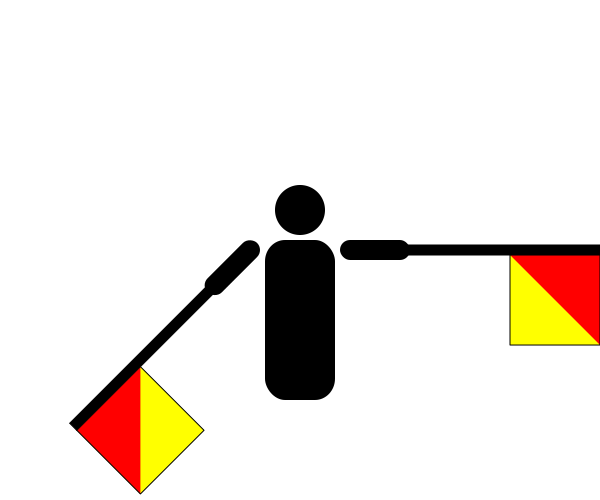

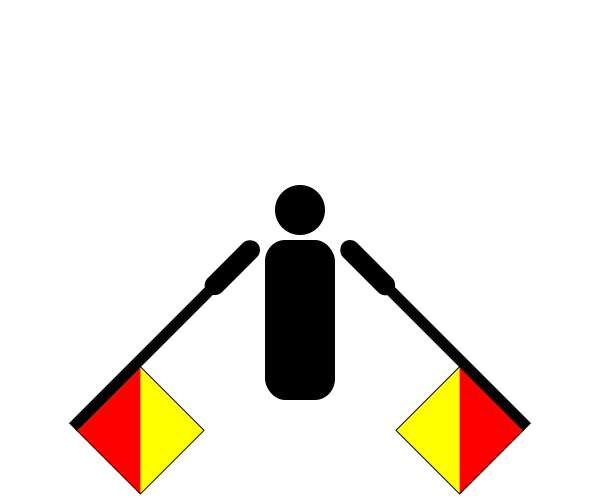

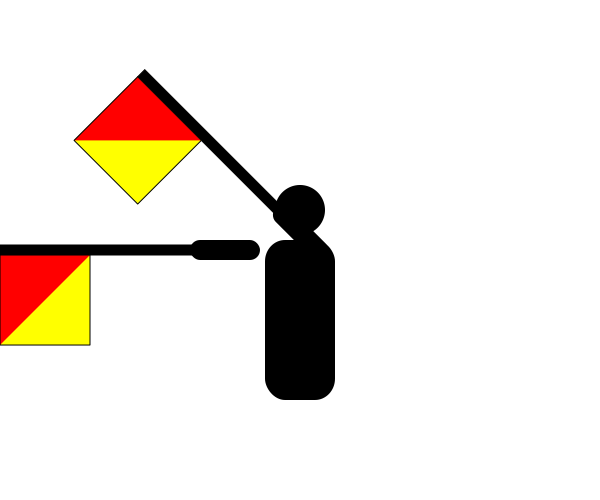
There are approximately 1,371 people named Munson in the UK. That makes it roughly the 5,757th most common surname in Britain. Around 21 in a million people in Britain are named Munson.
Surname type: From name of parent
Origin: English
Region of origin: British Isles
Country of origin: England
Religion of origin: Christian
Language of origin: English